 kudaes/unwinder
Call stack spoofing for Rust

Unwinder provides a full weaponization of SilentMoonWalk technique, allowing to obtain complete and stable call stack spoofing in Rust.
This technique comes with the following characteristics:
kudos to the creators of the SilentMoonWalk technique:
And of course a huge shoutout to namazso for the Twitter thread that inspired this whole project.
Import this crate into your project by adding the following line to your cargo.toml and compile on release mode:
[dependencies]
unwinder = "=0.1.4"
The main functionality of this crate has been wrapped in two macros:
call_function!() macro allows to run any arbitrary function with a clean call stack.indirect_syscall!() macro executes the specified (indirect) syscall with a clean call stack.To use any of these macros it is required to import std::ffi::c_void data type.
Both macros return a *mut c_void that can be used to retrieve the value returned by the function executed. More detailed information in the examples section.
This macro is used to call any desired function with a clean call stack. The macro expects the following parameters:
usize, isize or a pointer.This macro is used to perform any desired indirect syscall with a clean call stack. The macro expects the following parameters:
In order to pass arguments of different types to these two macros, the following considerations must be taken into account:
usize (u8-u64, i8-i64, bool, etc.) can be passed directly to the macros.&str and String) must be passed as a pointer.ptr::null(), ptr::null_mut(), etc. ) are passed as a 0 (no matter if it is u8, u16, i32 or any other).let k32 = dinvoke_rs::dinvoke::get_module_base_address("kernel32.dll");
let sleep = dinvoke_rs::dinvoke::get_function_address(k32, "Sleep"); // Memory address of kernel32.dll!Sleep()
let miliseconds = 1000i32;
unwinder::call_function!(sleep, false, miliseconds);
let k32 = dinvoke_rs::dinvoke::get_module_base_address("kernel32.dll");
let open_process: isize = dinvoke_rs::dinvoke::get_function_address(k32, "Openprocess");
let desired_access: u32 = 0x1000;
let inherit = 0i32;
let pid = 20628i32;
let handle = unwinder::call_function!(open_process, false, desired_access, inherit, pid); // returns *mut c_void
let handle: HANDLE = std::mem::transmute(handle);
println!("Handle id: {:x}", handle.0);
Notice that the macro returns a *mut c_void that can be directly converted to a HANDLE since both data types has the same size. This allows to access to the value returned by OpenProcess, which is the new handle to the target process.
let large = 0x8000000000000000 as u64; // Sleep indefinitely
let large: *mut i64 = std::mem::transmute(&large);
let alertable = false;
let ntstatus = unwinder::indirect_syscall!("NtDelayExecution", false, alertable, large); // returns *mut c_void
println!("ntstatus: {:x}", ntstatus as i32);
Notice that the macro returns a *mut c_void that can be used to retrieve the NTSTATUS returned by NtDelayExecution.
The spoofing process can be concatenated any number of times without an abnormal call stack size increment. The execution flow will be preserved as well. The following code is an example of this:
fn main()
{
	function_a();
}

fn function_a()
{
	unsafe
	{
		let func_b = function_b as usize;
		call_function!(func_b, false);
		println!("function_a done.");
	}
}

fn function_b()
{
	unsafe
	{
		let func_c = function_c as usize;
		call_function!(func_c, false);
		println!("function_b done.")
	}
}

fn function_c()
{
	unsafe
	{
		let large = 0x0000000000000000 as u64; // Don't sleep so we return to function_b, allowing to check the execution flow preservation.
		let large: *mut i64 = std::mem::transmute(&large);
		let alertable = false;
		let ntstatus = unwinder::indirect_syscall!("NtDelayExecution", false, alertable, large);
		println!("ntstatus: {:x}", (ntstatus as usize) as i32); //NTSTATUS is a i32, although that second casting is not really required in this case.
	}
}
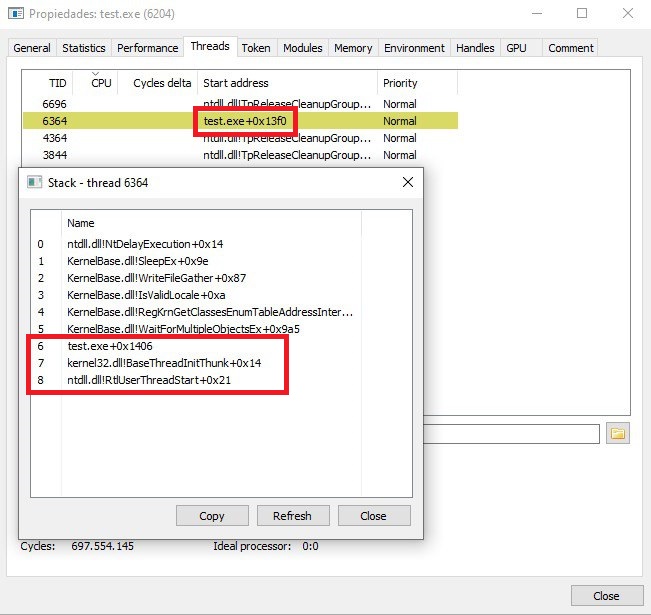
If you set the second parameter to true (both macros), the spoofing process will try to keep the thread start address' frame in the call stack to increase legitimacy.
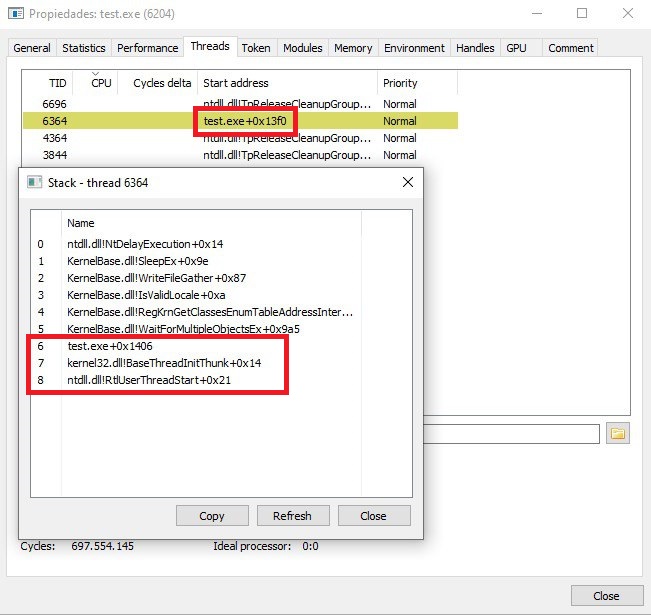
Sometimes, the thread's start function does not perform a call to a subsequent function (e.g. a jmp instruction is executed instead), meaning there is not return address pushed to the stack. In that scenario (and also if you set that second parameter to false), the spoofed call stack will start at BaseThreadInitThunk's frame.
