
Generator Guide: Comprehensive documentation for all 14 generator types.
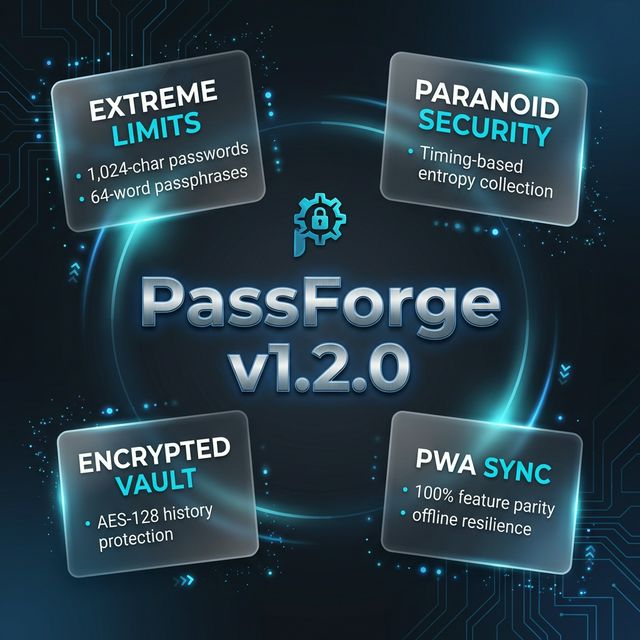
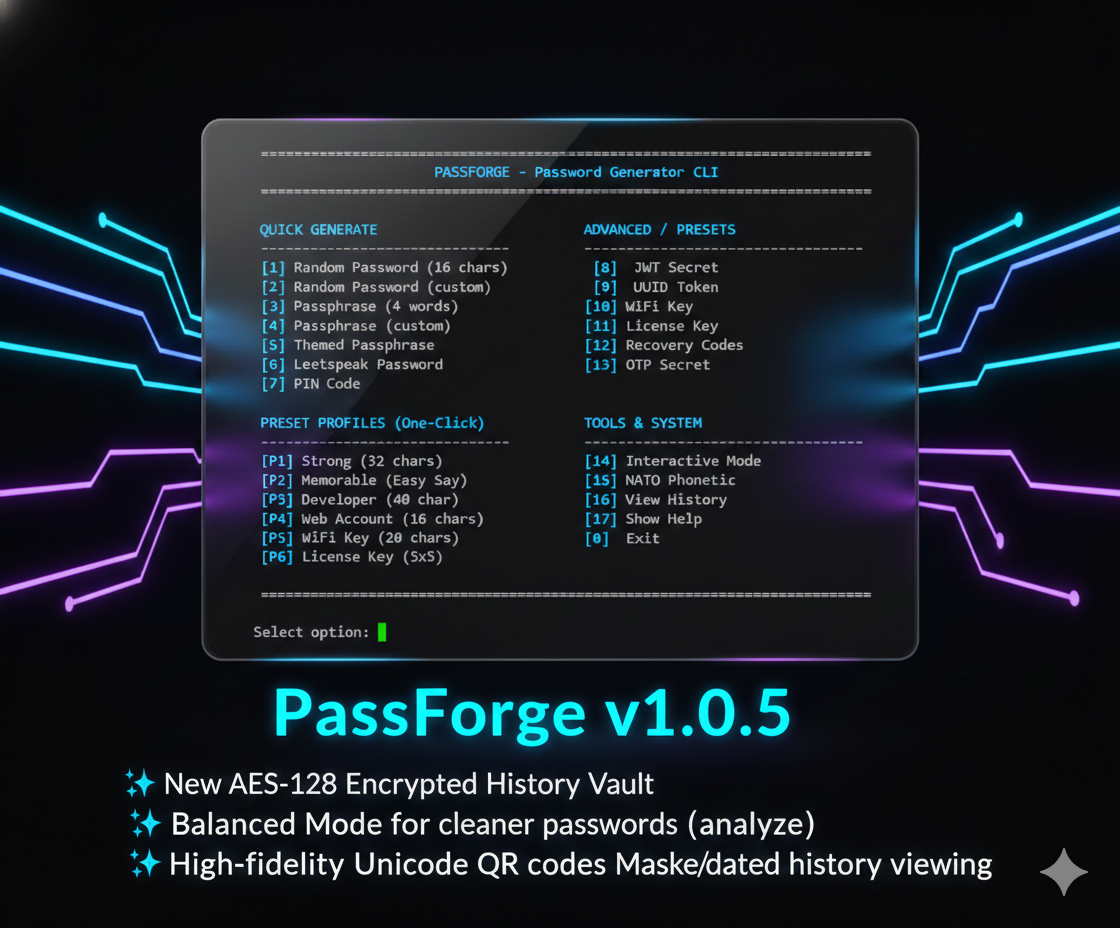
Encrypted History (Vault): Automatically encrypts saved passwords using AES-128 (Fernet).
Secure Vault Storage: Dedicated vault handles cryptographic keys via .env (recommended) or legacy .vault.key with strict 0600 file permissions
Zero-Leakage Architecture: 🛡️ Source code and logs are blocked from browser access in PWA mode; sensitive inputs are masked in CLI mode for entropy analysis.
Redacted Exports: Security-first history export with automatic password redaction by default
Zero-Indentation UI: Clean, professional left-aligned output for all modes
Smart Leetspeak: Probabilistic substitution for more natural, readable passwords
Robust Validation: Interactive prompts with default values and recursive error handling
Defensive PWA Frontend: 🛡️ Built-in safety checks for CDN assets to prevent initialization crashes.
Global Modifiers: --easy-read and --easy-say modes
Paranoid Mode: Optional manual entropy collection via keyboard timing jitter for maximum security.
Installation
root@kitploit:~
# Clone the repository
git clone https://github.com/krishnakanthb13/password_generator.git
cd password_generator
# Install dependencies (colorama, cryptography, pyperclip, etc.)
pip install -r requirements.txt
Quick Start
root@kitploit:~
# Generate a 20-character random password
python main.py random -l 20
# Generate a 4-word passphrase
python main.py phrase -w 4 --capitalize
# Generate a leetspeak passphrase
python main.py leet -w 3 -s _
# Generate with entropy analysis
python main.py --show-entropy random -l 16
# Launch interactive mode
python main.py --interactive
# Use a preset profile (Strong)
python main.py --preset strong --show-entropy
Usage Examples
Random Passwords
root@kitploit:~
# Basic 16-character password
python main.py random
# 24-character, letters only
python main.py random -l 24 --no-symbols --no-digits
# Easy to read (no 0/O, 1/l/I)
python main.py --easy-read random -l 20
# With minimum requirements
python main.py random -l 16 --min-upper 2 --min-digits 2 --min-symbols 1
# Balanced mode (mostly letters, fewer symbols)
python main.py random -l 24 --balanced
# JWT secret for HS256
python main.py jwt --bits 256
# Base64 API key
python main.py base64 -b 32 --url-safe
# UUID token (v4 Random)
python main.py uuid --upper
# UUID v7 (Time-based, sortable)
python main.py uuid --ver 7
# Or shortcut
python main.py uuid --v7
# Short UUID (Base58 encoded, ~22 chars)
python main.py uuid --short
# Generate a v7 UUID using the shortcut
python main.py u --v7
# Generate 10 short v4 UUIDs
python main.py uuid --v4 --short -n 10
# NATO Phonetic Conversion
python main.py phonetic --text "PassForge"
# Output: Papa-Alpha-Sierra-Sierra-Foxtrot-Oscar-Romeo-Golf-Echo
Security & Logging
root@kitploit:~
# Analyze an existing password
python main.py analyze "p@ssword123"
# Log to history
python main.py --log random -l 16
# View last 10 history entries (default)
python main.py history
# View all history entries (decrypted on the fly)
python main.py history --all
# View history with redacted passwords
python main.py history --redact
# Export history (Redacted by default)
python main.py history --export backup.json
# Export history (Plaintext - requires caution)
python main.py history --export secrets.csv --no-redact
# JSON output for scripts
python main.py --json jwt --bits 256
Command Reference
Flag
Description
--preset
Use a predefined security profile (strong, memorable, dev, pin, web, wifi, key)
-i, --interactive
Launch interactive menu mode
--paranoid
Enable Paranoid Mode (manual entropy collection)
--json
Output in JSON format
--show-entropy
Display entropy analysis (enabled by default in launchers)
--check-strength
Run zxcvbn pattern analysis
-c, --clipboard
Copy result to clipboard
--confirm-copy
Prompt to confirm copying result to clipboard
--clipboard-timeout
Auto-wipe clipboard after N seconds (default: 30)
--log
Log password to history (AES-128 encrypted)
--no-color
Disable colored output
--easy-read
Exclude ambiguous characters (0/O, 1/l/I)
--easy-say
Only pronounceable characters (no symbols)
Generator-Specific Options
Random (random, r)
Flag
Default
Description
-l, --length
16
Password length (4-1024)
--no-uppercase
-
Exclude uppercase letters
--no-lowercase
-
Exclude lowercase letters
--no-digits
-
Exclude digits
--no-symbols
-
Exclude symbols
--include
-
Additional characters to include
--exclude
-
Characters to exclude
--no-repeats
-
No repeated characters
--min-upper
0
Minimum uppercase characters
--min-lower
0
Minimum lowercase characters
--min-digits
0
Minimum digits
--min-symbols
0
Minimum symbols
--balanced
-
Balanced ratio (60/20/20)
-n, --count
1
Number to generate
Passphrase (phrase, p)
Flag
Default
Description
-w, --words
4
Number of words (2-64)
-s, --separator
-
Word separator
--capitalize
-
Capitalize each word
--uppercase
-
All words in uppercase
--alternate
-
Alternate case (aLtErNaTe)
--wordlist
-
Path to custom wordlist
-n, --count
1
Number to generate
Leetspeak (leet, l)
Flag
Default
Description
-w, --words
3
Number of words (2-64)
-s, --separator
-
Word separator ( - _ . , )
-n, --count
1
Number to generate
PIN (pin)
Flag
Default
Description
-l, --length
6
PIN length (4-64)
-n, --count
1
Number to generate
Pronounceable (pronounce, pr)
Flag
Default
Description
-l, --length
12
Password length (4-128)
-n, --count
1
Number to generate
UUID (uuid)
Flag
Default
Description
--ver
4
UUID Version (1, 4, 7)
--short
-
Short format (Base58)
--upper
-
Uppercase output (hex only)
-n, --count
1
Number to generate
Base64 (base64, b64)
Flag
Default
Description
-b, --bytes
32
Number of random bytes
--url-safe
-
Use URL-safe characters
JWT Secret (jwt)
Flag
Default
Description
--bits
256
Bit length (256, 384, 512)
--hex
-
Output as hex string
WiFi Key (wifi)
Flag
Default
Description
-l, --length
24
Key length (8-63, default: 24)
--simple
-
Alphanumeric only (no symbols)
License Key (license)
Flag
Default
Description
--segments
4
Number of segments (2-64)
--segment-length
4
Characters per segment (2-32)
Recovery Codes (recovery)
Flag
Default
Description
-n, --count
10
Number of codes (5-20, default: 10)
-l, --length
10
Code length (digits or words, default: 10/3)
--words
-
Use word-based codes
OTP Secret (otp)
Flag
Default
Description
--digits
6
Code length (6 or 8)
--period
30
Time period in seconds
--qr
-
Show QR code in terminal
Pattern (pattern)
Flag
Default
Description
--grid
3
Grid size (e.g. 3x3)
Phonetic (phonetic, ph)
Flag
Default
Description
--text
-
Text to convert to NATO alphabet
-l, --length
8
Random sequence length (4-64)
History (history)
Flag
Default
Description
--last
10
Show last N entries (1-100, default: 10)
--all, -a
-
Show all history entries (overrides --last)
--search
-
Filter history by keyword
--redact
-
Redact passwords in terminal output
--export
-
Export history to file (JSON/CSV)
--no-redact
-
Do not redact passwords in export (Caution!)
--clear
-
Clear all history entries
Entropy Guide
PassForge provides a comprehensive Entropy Report including the raw character pool size, Shannon bits, and brute-force time estimates.
Entropy (bits)
Strength
Use Case
< 28
Very Weak
Never use
28-36
Weak
Low-security only
36-60
Reasonable
Standard accounts
60-80
Strong
Sensitive data
80-128
Very Strong
High-security systems
> 128
Excellent
Critical infrastructure
Note: For a detailed explanation of each generator type, see LITERATURE.md.
# Run all tests
python -m pytest tests/ -v
# Run specific test class
python -m pytest tests/test_generators.py::TestRandomPasswordGenerator -v
# Run with coverage
python -m pytest tests/ --cov=src --cov-report=html
All 53 unit tests cover:
All 15 specialized generator modes
Entropy and zxcvbn strength calculators
Clipboard auto-wipe and secure storage
QR code ASCII generation logic
Configuration loading and presets
Configuration
PassForge supports configuration files in YAML or JSON format.
Config File Locations (searched in order):
./passforge.yaml or ./passforge.json
./.passforge.yaml or ./.passforge.json
~/.passforge/config.yaml or ~/.passforge/config.json
See passforge.example.json for all available options.
Building Standalone Executable
PassForge can be compiled to a single standalone executable using PyInstaller.
Windows
root@kitploit:~
# Using the build script
passforge_build.bat
# Or manually
pip install pyinstaller
pyinstaller --onefile --name passforge --console main.py
Linux/macOS
root@kitploit:~
# Using the build script
chmod +x passforge_build.sh
./passforge_build.sh
# Or manually
pip install pyinstaller
pyinstaller --onefile --name passforge --console main.py
The executable will be created in the dist/ folder (~7MB, zero dependencies).
🌐 PassForge Web (PWA Add-on)
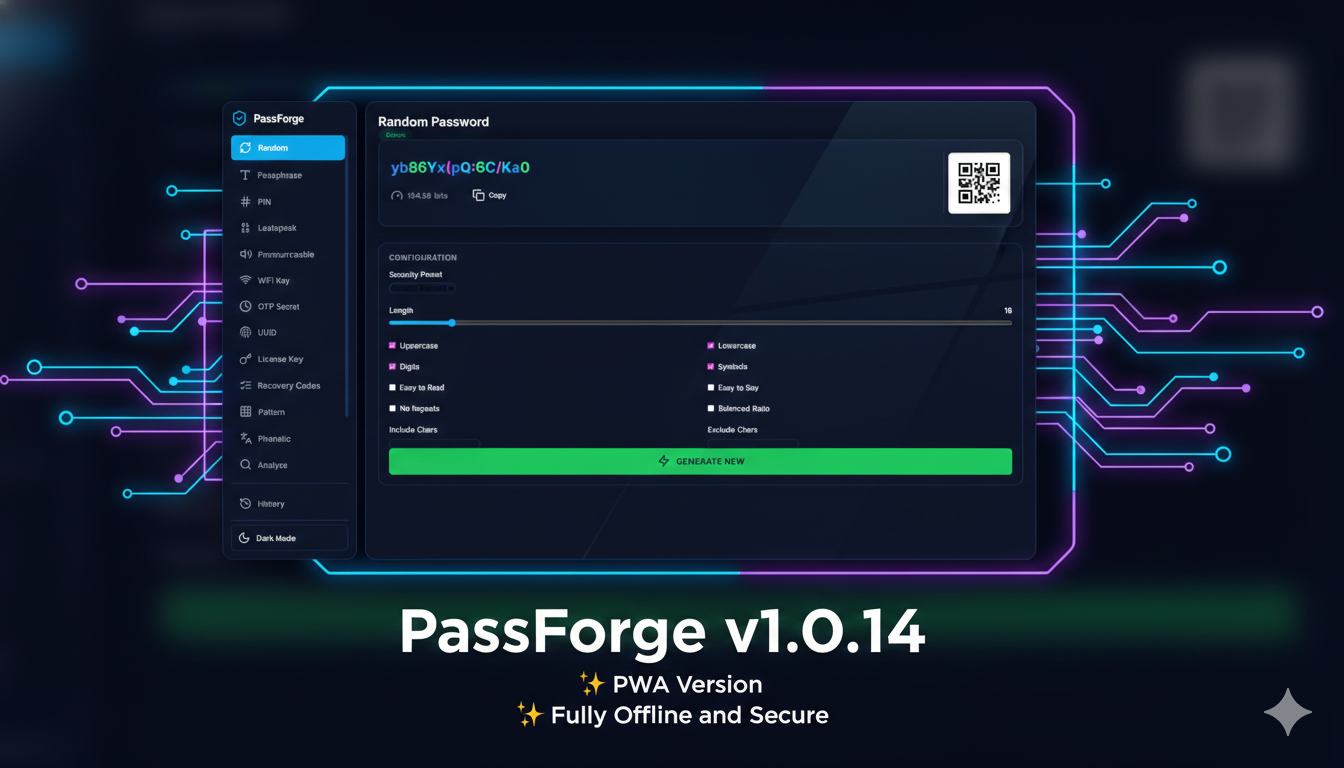
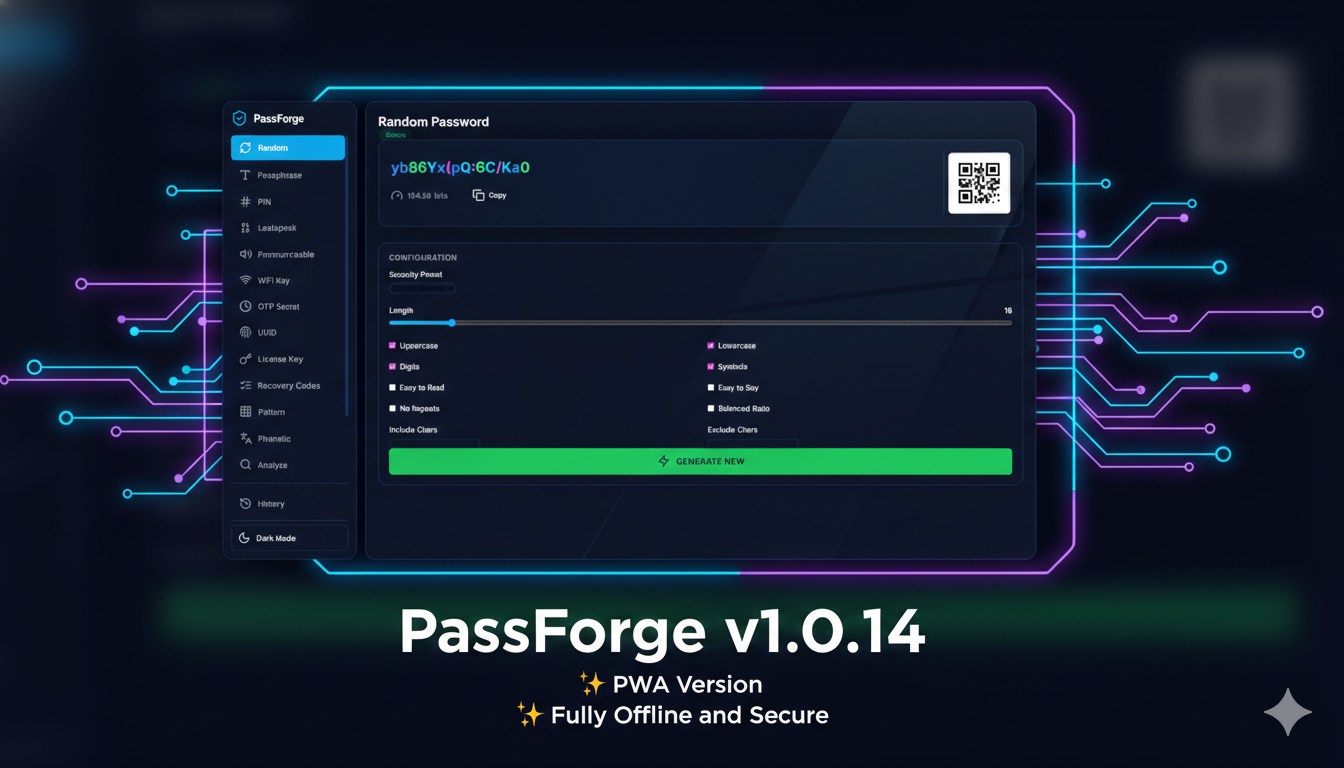
PassForge now includes a modern, responsive Web Interface (PWA) that provides a visual way to generate and manage passwords while maintaining full parity with the CLI version.
Key Features
Sidebar Interface: Easy navigation between all generator types.
Visual Sliders: Adjust lengths and word counts with interactive sliders.
QR Support: Instant QR code generation for sharing passwords or OTP secrets.
Dark/Light Mode: Premium aesthetics with system-aware theme switching.
Installable: Support for PWA installation on Windows, Linux, and mobile.
Shared History: Utilizes the same encrypted log file as the CLI.
Launching the PWA
To start the web interface, run the launcher script for your OS:
Windows: passforge_pwa.bat
Linux/macOS: passforge_pwa.sh
[!IMPORTANT]
Security Hardening (v34+): The PWA now utilizes a SecureStaticFiles handler that explicitly blocks browser access to Python source files, logs, and cryptographic keys. History access is protected via an internal API Key handshake. Frontend logic also includes defensive wrappers for external CDN assets to ensure functionality even if a CDN is blocked.
[!TIP]
Build Availability: The PWA files are included in the Source Code and ZIP/Tarball distributions. The PWA is not embedded in the single-file .exe binary.
The launcher will automatically install necessary dependencies (fastapi, uvicorn), start a local server at http://127.0.0.1:8093, and open your browser.