 knownsec/kunyu
Kunyu, more efficient corporate asset collection


English | 中文文档

Kunyu (kunyu), whose name is taken from , is actually a professional subject related to geographic information, which counts the geographic information of the sea, land, and sky. The same applies to cyberspace. The same is true for discovering unknown and fragile assets. It is more like a cyberspace map, which is used to comprehensively describe and display cyberspace assets, various elements of cyberspace and the relationship between elements, as well as cyberspace and real space. The mapping relationship. So I think "Kun Yu" still fits this concept.
Kunyu aims to make corporate asset collection more efficient and enable more security-related practitioners to understand and use cyberspace surveying and mapping technology.
For the use of kunyu, there can be many application scenarios, such as:
Need Python3 or higher support
git clone https://github.com/knownsec/Kunyu.git
cd Kunyu
pip3 install -r requirements.txt

Linux:
	python3 setup.py install
	kunyu console

Windows:
	cd kunyu
	python3 console.py

PYPI:
	pip3 install kunyu

P.S. Windows also supports python3 setup.py install.
When you run the program for the first time, enter the following command to initialize the operation. Other login methods are provided, and the API method is recommended (username/password login is deprecated).
kunyu init --apikey <your zoomeye key> --seebug <your seebug key>
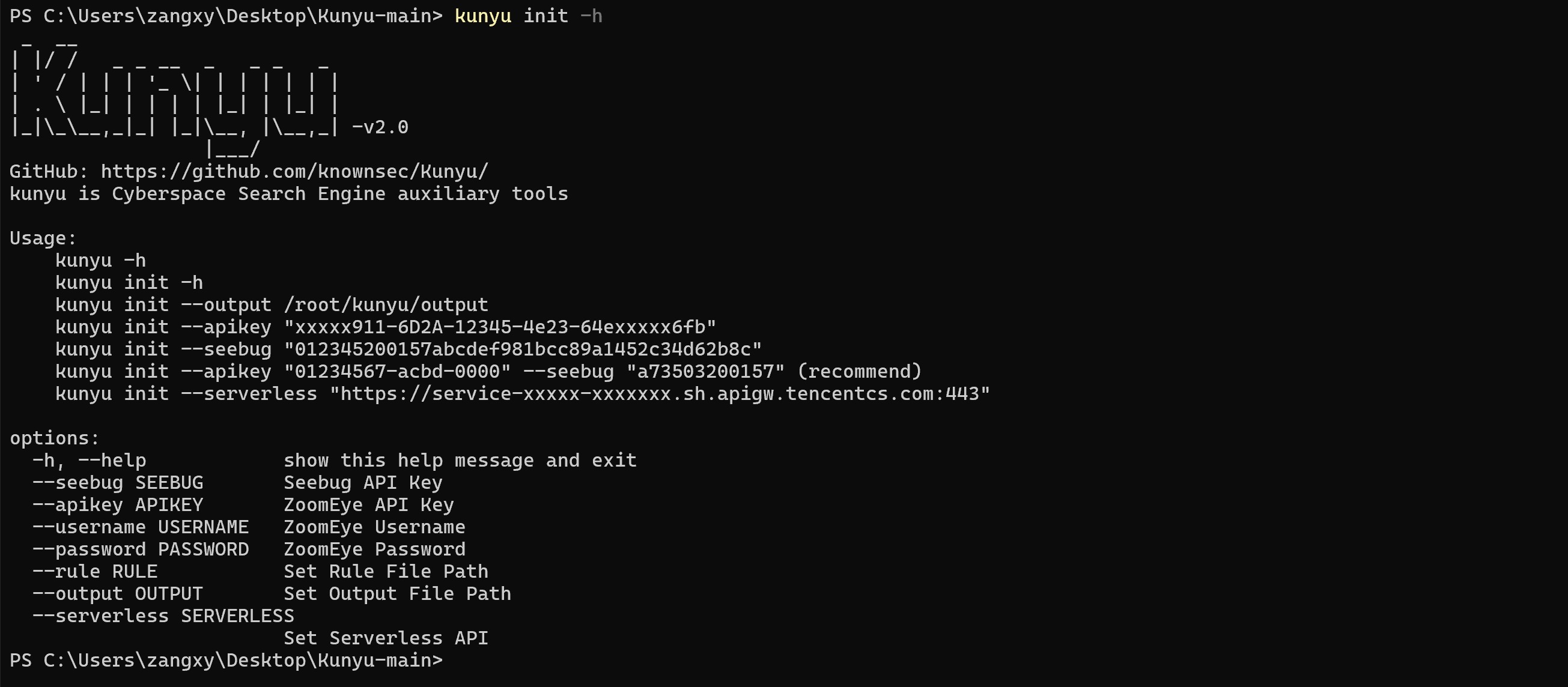
The first time you use it, you need to use ZoomEye login credentials to use the tool to collect information. Currently, ZoomEye API requires payment.
ZoomEye access address: https://www.zoomeye.org/
Seebug access address: https://www.seebug.org/
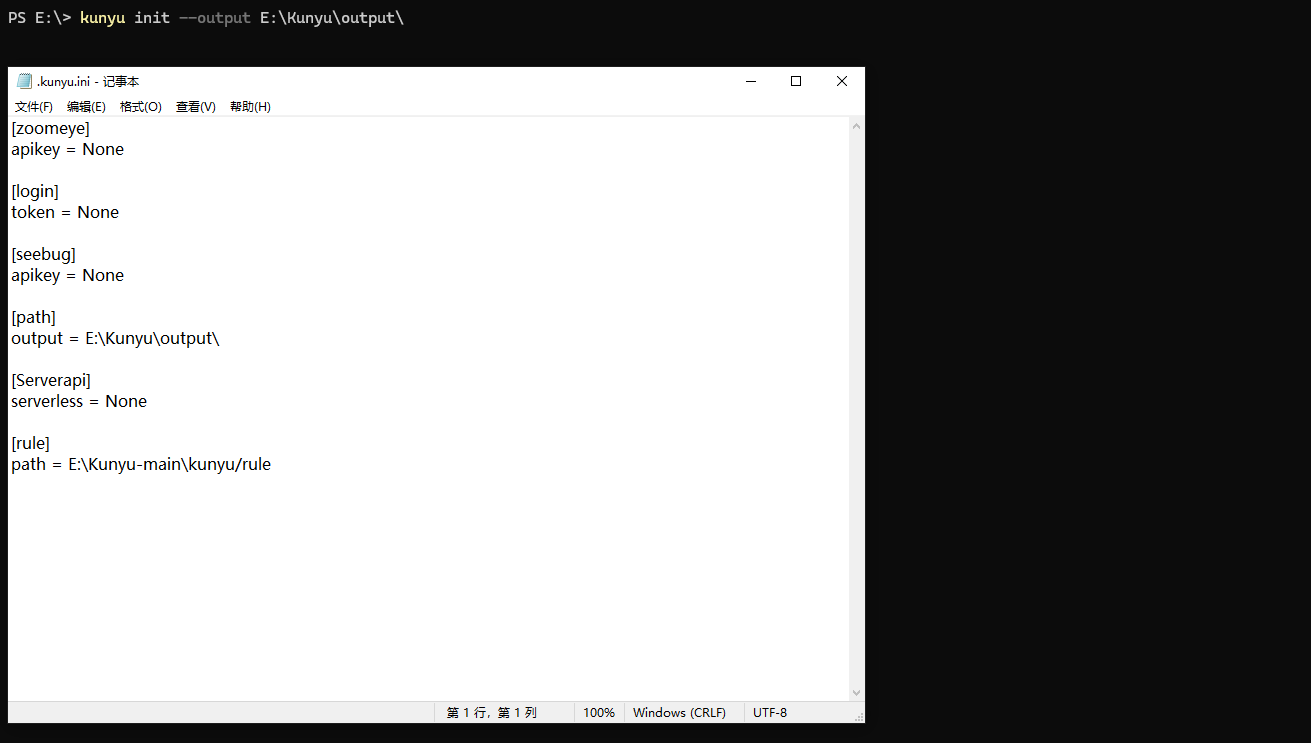
The output file path can be customized by the following command,The default output path is: C:/Users/active user/kunyu/output/ or /active user/kunyu/output
kunyu init --output C:\Users\风起\kunyu\output
kunyu console
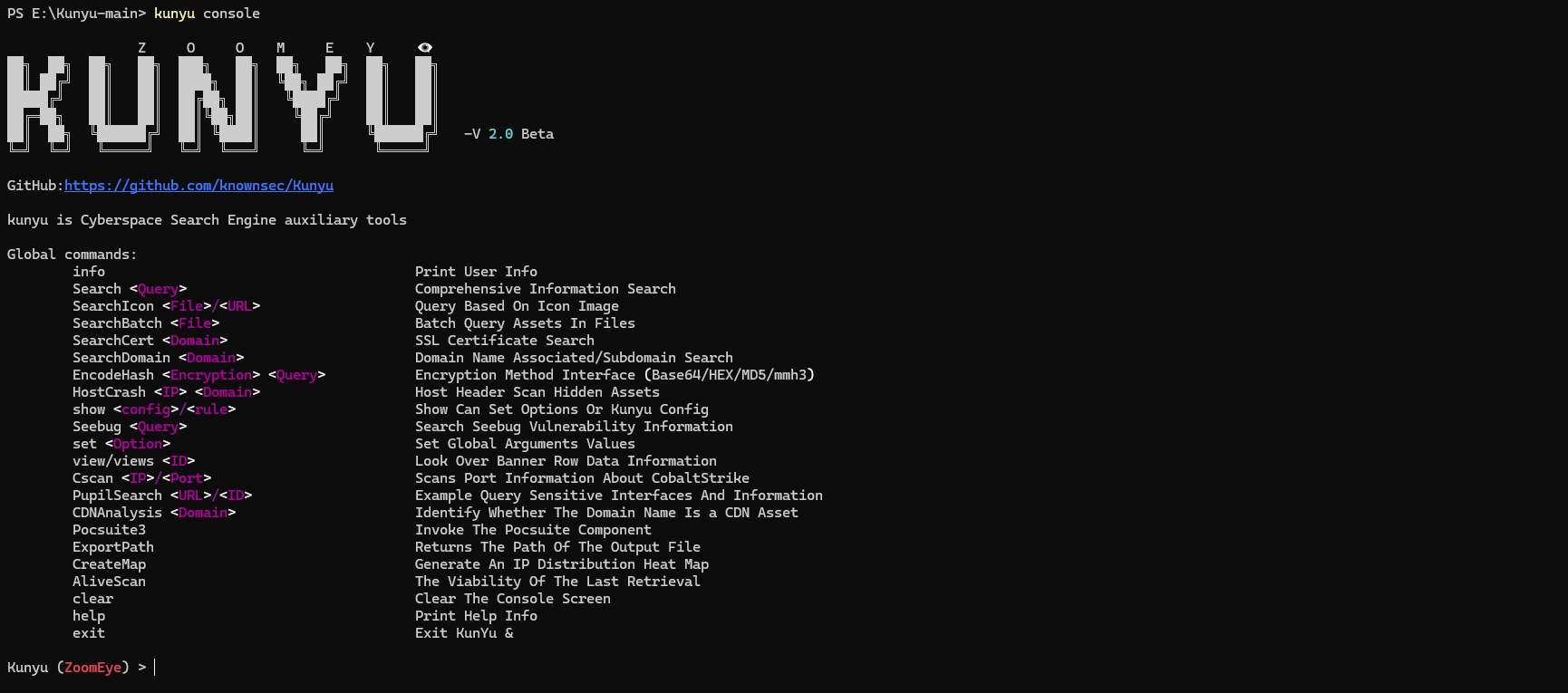
ZoomEye
Global commands:
        info                                      Print User Info
        Search <Query>                            Comprehensive Information Search
        SearchIcon <File>/<URL>                   Query Based On Icon Image
        SearchBatch <File>                        Batch Query Assets In Files
        SearchCert <Domain>                       SSL Certificate Search
        SearchDomain <Domain>                     Domain Name Associated/Subdomain Search
        EncodeHash <Encryption> <Query>           Encryption Method Interface (Base64/HEX/MD5/mmh3)
        HostCrash <IP> <Domain>                   Host Header Scan Hidden Assets
        show <config>/<rule>                      Show Can Set Options Or Kunyu Config
        Seebug <Query>                            Search Seebug Vulnerability Information
        set <Option>                              Set Global Arguments Values
        view/views <ID>                           Look Over Banner Row Data Information
        Cscan <IP>/<Port>                         Scans Port Information About CobaltStrike
        PupilSearch <URL>/<ID>                    Example Query Sensitive Interfaces And Information
        CDNAnalysis <Domain>                      Identify Whether The Domain Name Is a CDN Asset
        Pocsuite3                                 Invoke The Pocsuite Component
        ExportPath                                Returns The Path Of The Output File
        CreateMap                                 Generate An IP Distribution Heat Map
        AliveScan                                 The Viability Of The Last Retrieval
        clear                                     Clear The Console Screen
        help                                      Print Help Info
        exit                                      Exit KunYu &
OPTIONS
ZoomEye:
        page <Number>       		The number of pages returned by the query (default:1)
        size <Number>      		Set the number of searches per page (default:10)
        fields <fields>     		Set the response field information
        dtype <0/1>         		Query associated domain name/subdomain name
        stype <v4/v6>       		stype <v4/v6> Set to get data type IPV4 or IPV6
        btype <host/web>    		Set the API interface for batch query
        timeout <num>       		Set the timeout period of Kunyu HTTP request
        thread              		Set PupilSearch Thread Number(default is 10)
        deep                		Set PupilSearch Search Deep(default is 2)
        all                 		PupilSearch Add All Url To Check List
        fuzz                		PupilSearch Add Api To Check List
        proxy               		PupilSearch HTTP Proxy
*Kunyu usage tutorial is as follows *
User information query

Comprehensive search(NEW)
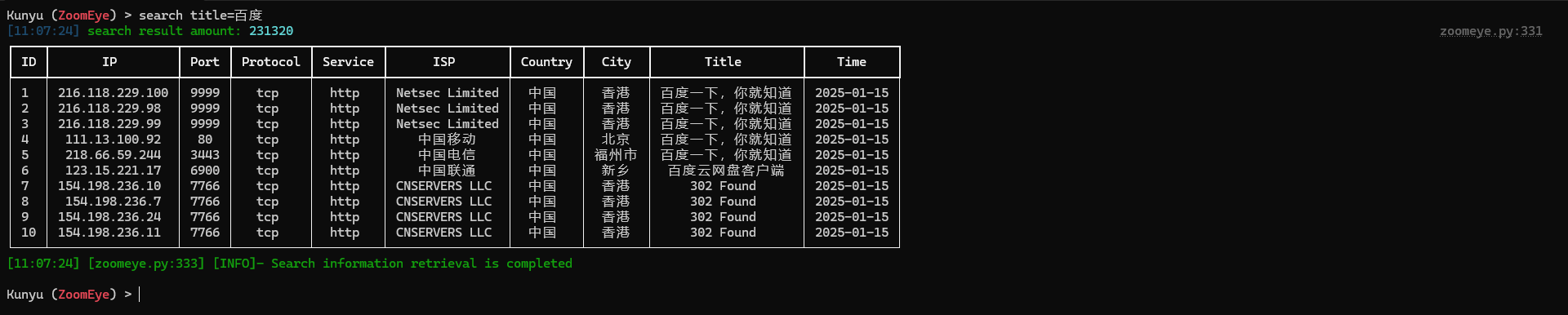
Custom output fields(NEW)
For specific supported output custom fields, please refer to the following:
| Field Name | Type | Description | Permission |
|---|---|---|---|
| ip | string | IP address (used when the web asset is incomplete) | All users |
| domain | string | Domain | All users |


