Security Report: CVE-2026-55200
📝 General Description
CVE-2026-55200 is a critical heap-based buffer overflow vulnerability (dynamic memory corruption) affecting the libssh2 library in versions up to 1.11.1.
It allows a malicious SSH server to compromise vulnerable clients that connect to it.
⚡ Technical Details
- Vulnerability type: Heap-based Buffer Overflow.
- Main impact: Remote Code Execution (RCE) and Denial of Service (DoS).
- Attack phase: Occurs before cryptographic authentication.
- Attack vector: A malicious or intercepted SSH server sends a packet with an excessive length, overflowing the allocated buffer on the client.
🏗️ Supply Chain Impact
This vulnerability has a massive reach because libssh2 is used by multiple popular tools and languages:
- curl (when compiled with SSH support via libssh2).
- Git (used in development environments and CI/CD pipelines).
- PHP (through extensions that consume this library).
⚠️ Critical note: Many of these tools integrate the library statically, meaning that updating the operating system does not always fix the problem in the application.
🛠️ Mitigation and Solutions
1. Software Update
- Install the corrected version of libssh2 that includes the patch from commit
7acf3df (or 97acf3dfda80c91c3a8c9f2372546301d4a1a7a8).
- Update and recompile static binaries, Docker containers, and third-party tools that bundle the library internally.
2. Network and Monitoring Measures
- Traffic restriction: Block or limit outbound SSH connections to unknown or untrusted external servers.
- Auditing: Monitor unexpected crashes of automation processes or Git/curl clients, which could indicate an exploitation attempt (DoS).
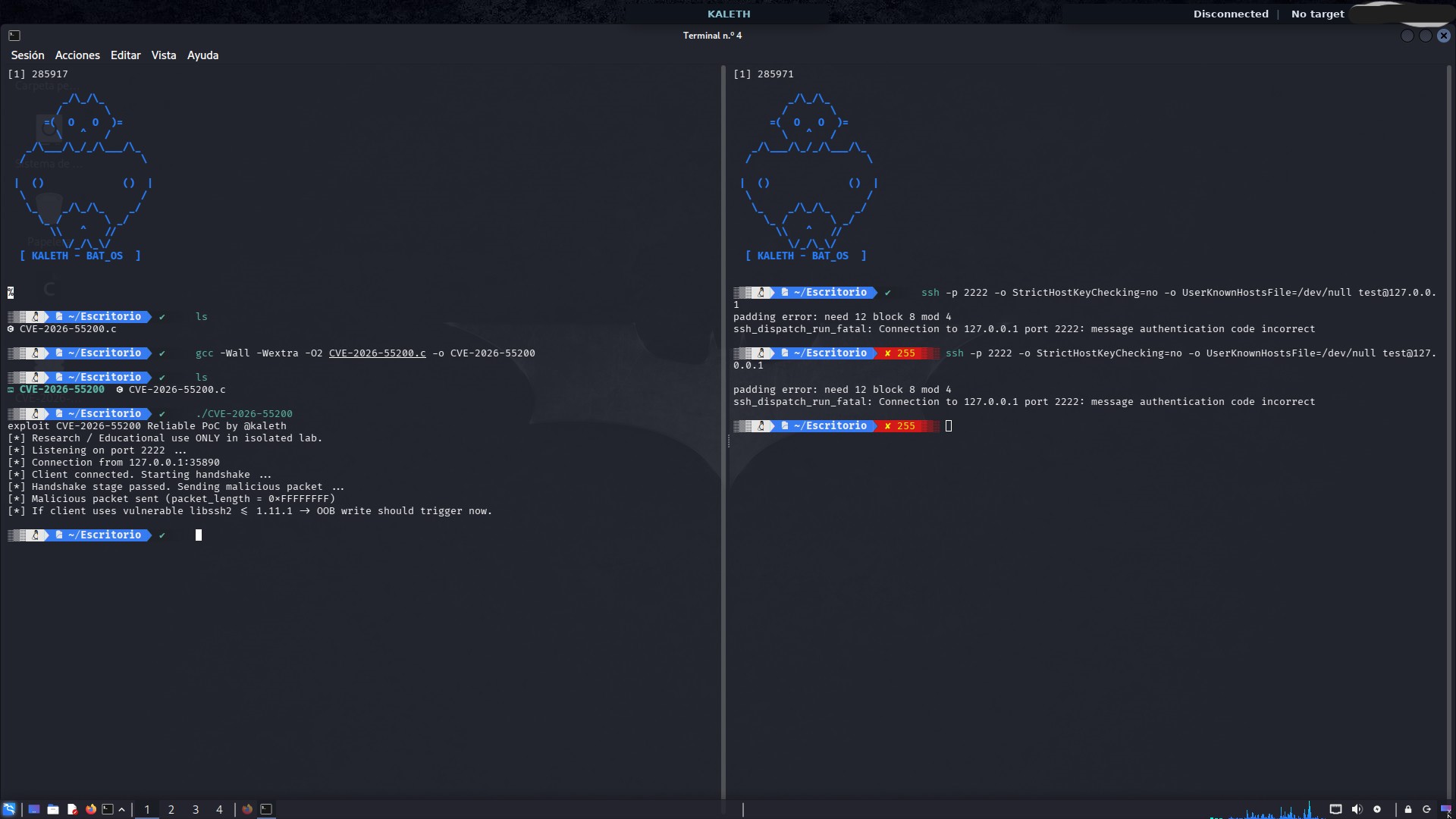
Proof of Concept
🔗 Official Sources
 kaleth4/cve-2026-55200
