 jsherman212/xnuspy
an iOS kernel function hooking framework for checkra1n'able devices

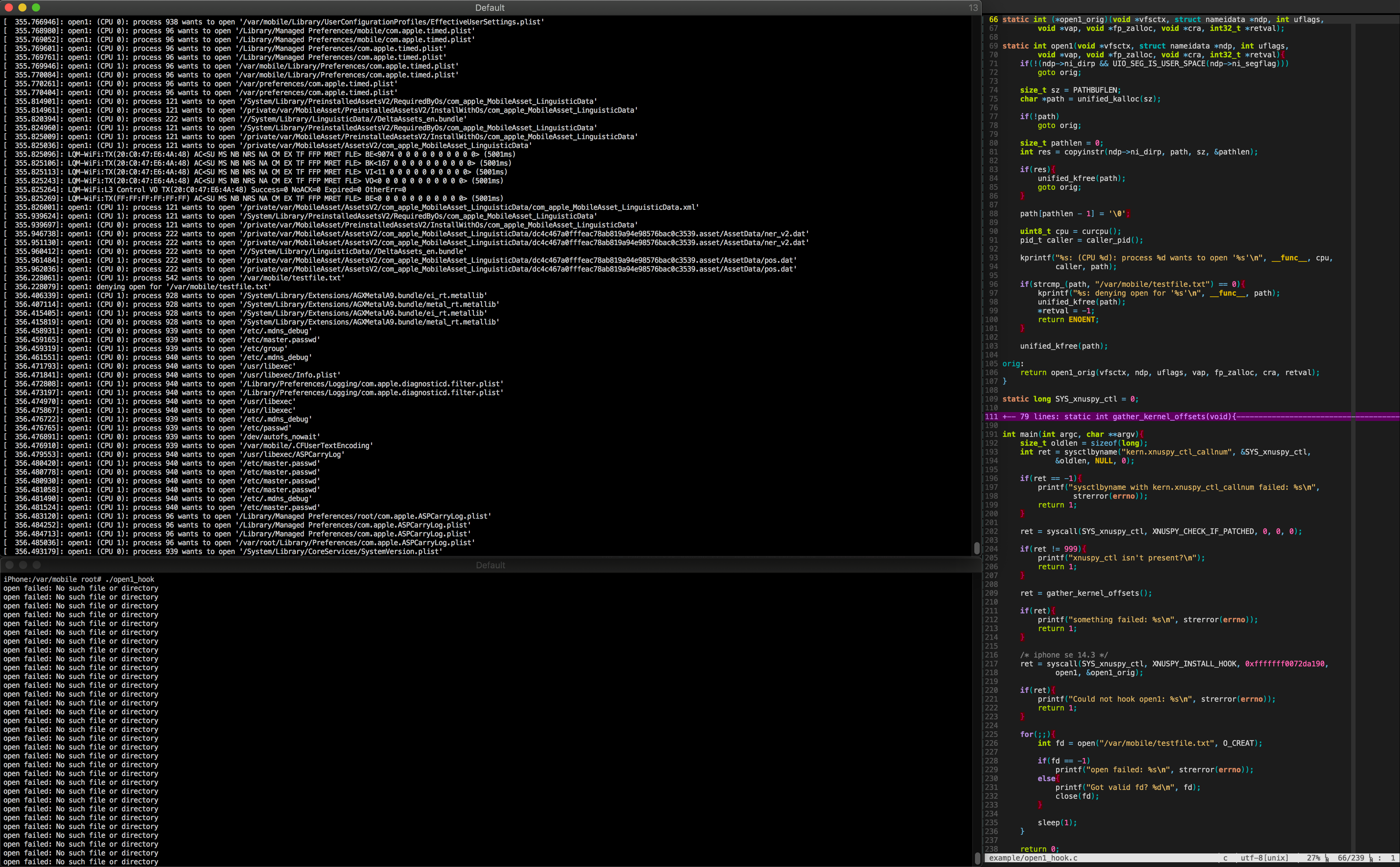
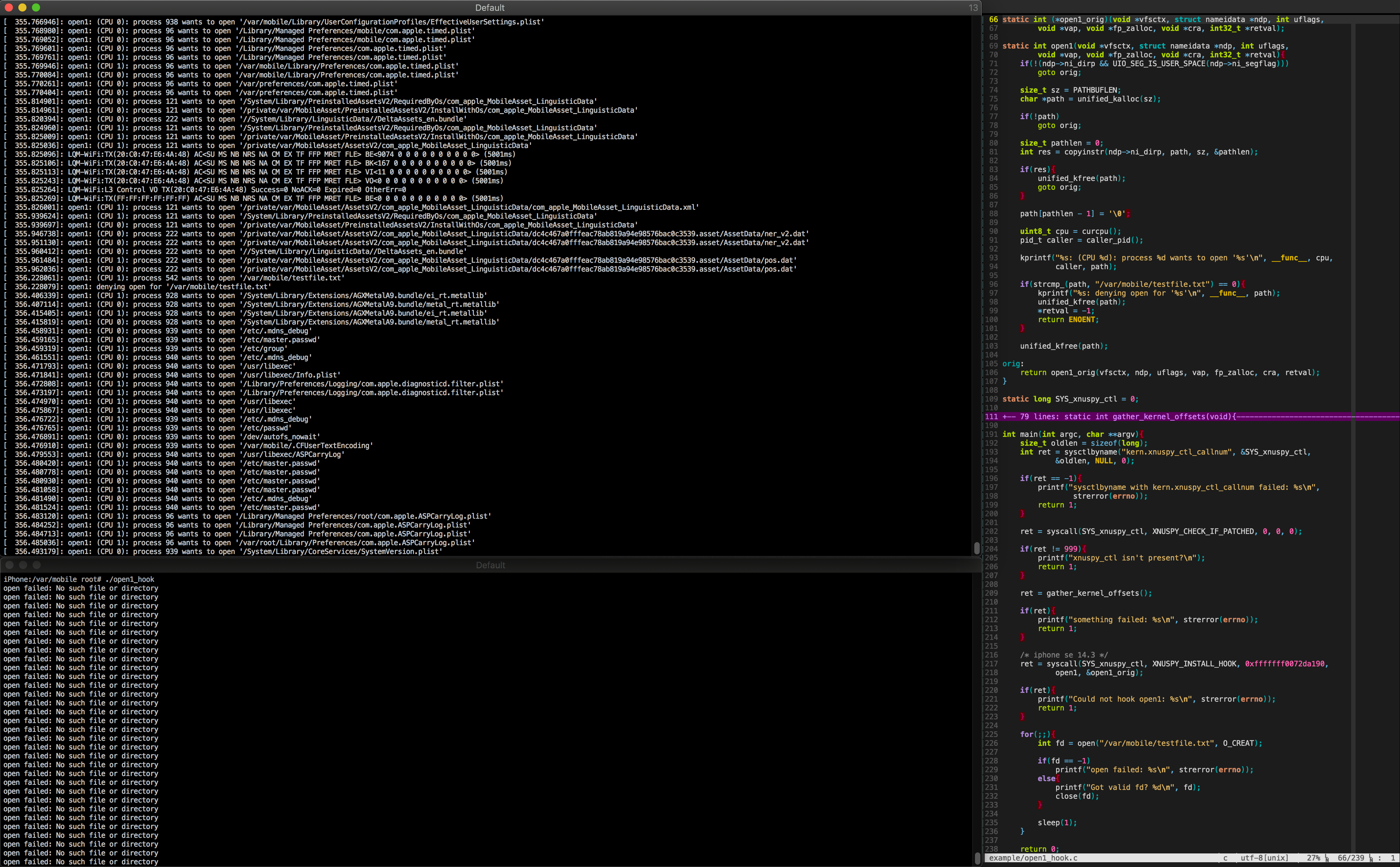
Output from the kernel log after compiling and running example/open1_hook.c
xnuspy is a pongoOS module that installs a new system call, xnuspy_ctl,
which allows you to hook kernel functions from userspace. It supports iOS 13.x,
iOS 14.x, and iOS 15.x on checkra1n 0.12.2 and up. 4K devices are not supported.
This module completely neuters KTRR/KPP and makes it possible to create RWX memory inside EL1. Do not use this on your daily driver.
Requires libusb: brew install libusb
Run make in the top level directory. It'll build the loader and the module.
Add these before make.
XNUSPY_DEBUG=1
kprintf).XNUSPY_SERIAL=1
IOLog.XNUSPY_LEAKED_PAGE_LIMIT=n
64. More info can
be found under Debugging Kernel Panics.XNUSPY_TRAMP_PAGES=n
XNUSPY_DEBUG and XNUSPY_SERIAL do not depend on each other.
After you've built everything, have checkra1n boot your device to a pongo
shell: /Applications/checkra1n.app/Contents/MacOS/checkra1n -p
In the same directory you built the loader and the module, do
loader/loader module/xnuspy. After doing that, xnuspy will do its thing and
in a few seconds your device will boot. loader will wait a couple more
seconds after issuing xnuspy-getkernelv in case SEPROM needs to be exploited.
Sometimes a couple of my phones would get stuck at "Booting" after checkra1n's KPF
runs. I have yet to figure out what causes this, but if it happens, try again.
Also, if the device hangs after bootx, try again. Finally, marking the
compiled xnuspy_ctl code as executable on my iPhone X running iOS 13.3.1 is
a bit spotty, but succeeds 100% of the time on my other phones. If you panic
with a kernel instruction fetch abort when you execute your hook program,
try again.
xnuspy will patch an enosys system call to point to xnuspy_ctl_tramp.
This is a small trampoline which marks the compiled xnuspy_ctl code as
executable and branches to it. You can find xnuspy_ctl's implementation at
module/el1/xnuspy_ctl/xnuspy_ctl.c and examples in the example directory.
Inside include/xnuspy/ is xnuspy_ctl.h, a header which defines constants
for xnuspy_ctl. It is meant to be included in all programs which hook
kernel functions.
You can use sysctlbyname to figure out which system call was patched:
size_t oldlen = sizeof(long);
long SYS_xnuspy_ctl = 0;
sysctlbyname("kern.xnuspy_ctl_callnum", &SYS_xnuspy_ctl, &oldlen, NULL, 0);
This system call takes four arguments, flavor, arg1, arg2, and arg3.
The flavor can either be XNUSPY_CHECK_IF_PATCHED, XNUSPY_INSTALL_HOOK,
XNUSPY_REGISTER_DEATH_CALLBACK, XNUSPY_CALL_HOOKME, XNUSPY_CACHE_READ,
XNUSPY_KREAD, XNUSPY_KWRITE, or XNUSPY_GET_CURRENT_THREAD.
The meaning of the next three arguments depend on the flavor.
XNUSPY_CHECK_IF_PATCHEDThis exists so you can check if xnuspy_ctl is present. Invoking it with this
flavor will cause it to return 999. The values of the other arguments are
ignored.
XNUSPY_INSTALL_HOOKI designed this flavor to match MSHookFunction's API.
arg1 is the UNSLID address of the kernel function you wish to hook. If you
supply a slid address, you will most likely panic. arg2 is a pointer to your
ABI-compatible replacement function. arg3 is a pointer for xnuspy_ctl to
copyout the address of a trampoline that represents the original kernel
function. This can be NULL if you don't intend to call the original.
XNUSPY_REGISTER_DEATH_CALLBACKThis flavor allows you to register an optional "death callback", a function xnuspy will call when your hook program exits. It gives you a chance to clean up anything you created from your kernel hooks. If you created any kernel threads, you would tell them to terminate in this function.
Your callback is not invoked asynchronously, so if you block, you're preventing xnuspy's garbage collection thread from executing.
arg1 is a pointer to your callback function. The values of the other arguments
are ignored.
XNUSPY_CALL_HOOKMEhookme is a small assembly stub which xnuspy exports through the xnuspy cache
for you to hook. Invoking xnuspy_ctl with this flavor will cause hookme to
get called, providing a way for you to easily gain kernel code execution without
having to hook an actual kernel function.
arg1 is an argument that will be passed to hookme when it is invoked.
This can be NULL.
XNUSPY_CACHE_READThis flavor gives you a way to read from the xnuspy cache. It contains many useful
things like kprintf, current_proc, kernel_thread_start, some libc functions,
and the kernel slide so you don't have to find them yourself. For a complete list
of cache IDs, check out example/xnuspy_ctl.h.
arg1 is one of the cache IDs defined in xnuspy_ctl.h and arg2 is a
pointer for xnuspy_ctl to copyout the address or value of what you requested.
The values of the other arguments are ignored.
XNUSPY_KREADThis flavor gives you an easy way to read kernel memory from userspace without tfp0.
arg1 is a kernel virtual address, arg2 is the address of a userspace buffer,
and arg3 is the size of that userspace buffer. arg3 bytes will be written
from arg1 to arg2.
XNUSPY_KWRITEThis flavor gives you an easy way to write to kernel memory from userspace without tfp0.
arg1 is a kernel virtual address, arg2 is the address of a userspace buffer,
and arg3 is the size of that userspace buffer. arg3 bytes will be written
from arg2 to arg1.
XNUSPY_GET_CURRENT_THREADThis flavor provides userspace the kernel address of the calling thread.
arg1 is a pointer for xnuspy_ctl to copyout the return value of
current_thread. The values of the other arguments are ignored.
For all flavors except XNUSPY_CHECK_IF_PATCHED, 0 is returned on success.
Upon error, -1 is returned and errno is set. XNUSPY_CHECK_IF_PATCHED
does not return any errors. XNU's mach_to_bsd_errno is used to convert a
kern_return_t to the appropriate errno.
XNUSPY_INSTALL_HOOKerrno is set to...
EEXIST if:
arg1.ENOMEM if:
unified_kalloc returned NULL.ENOSPC if:
xnuspy_tramp structs, a data structure internal to
xnuspy. This shouldn't happen unless you're hooking hundreds of kernel functions
at the same time. If you need more function hooks, check out Limits.ENOTSUP if:
ENOENT if:
mh_for_addr was unable to determine the Mach-O header corresponding to
arg2 inside the caller's address space.EFAULT if:
EIO if:
mach_make_memory_entry_64 did not return a memory entry for the entirety
of the determined Mach-O header's __TEXT and __DATA segments.errno also depends on the return value of vm_map_wire_external,
mach_vm_map_external, mach_make_memory_entry_64, copyin, copyout, and
if applicable, the one-time initialization function.
If this flavor returns an error, the target kernel function was not hooked.
If you passed a non-NULL pointer for arg3, it may or may not have been
initialized. It's unsafe to use if it was.
