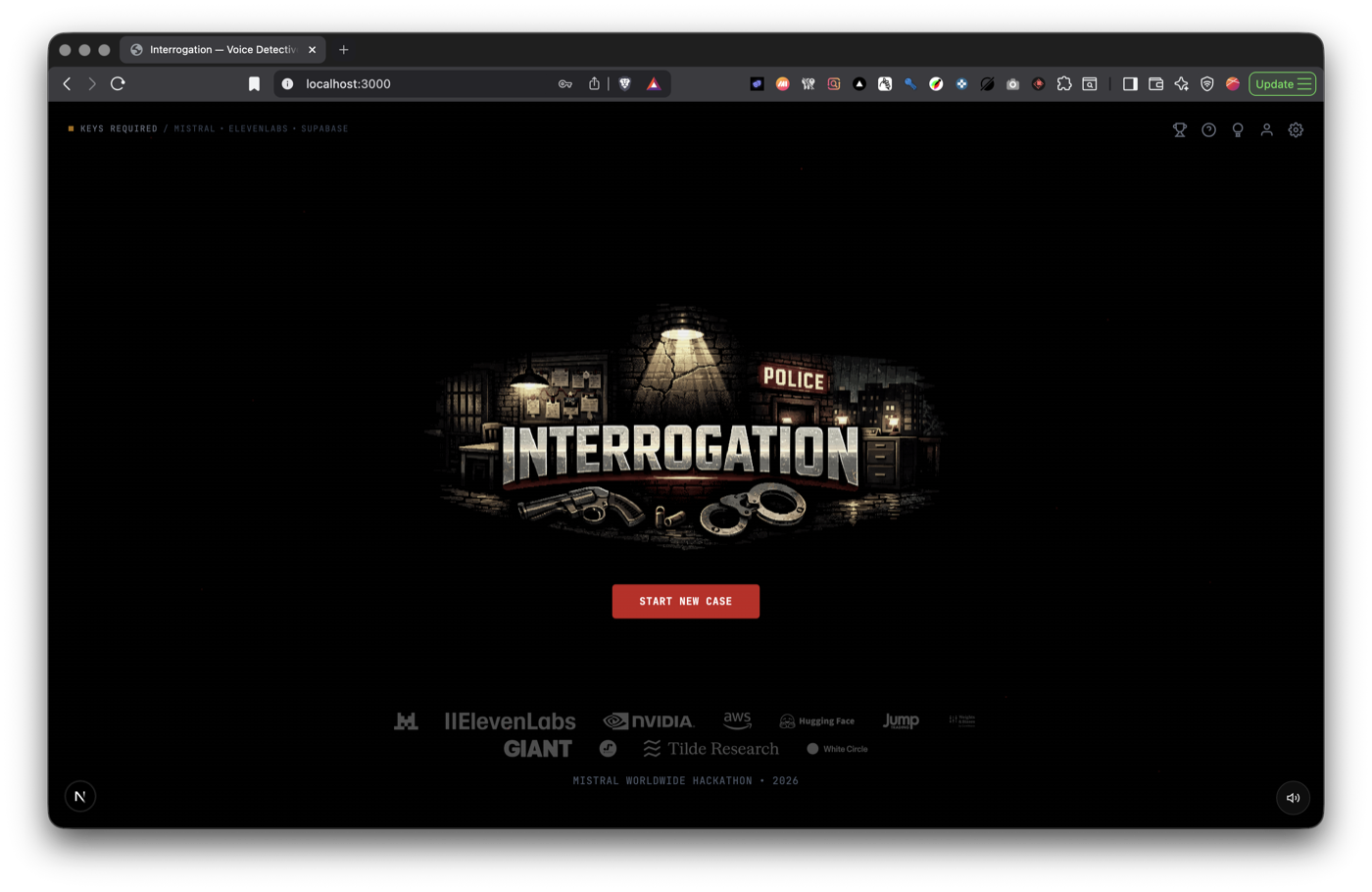
 jpoindexter/interrogation-game
Voice-based detective interrogation game. Mistral Large 3 + Voxtral STT + ElevenLabs TTS. Built for the Mistral Worldwide Hackathon 2026.

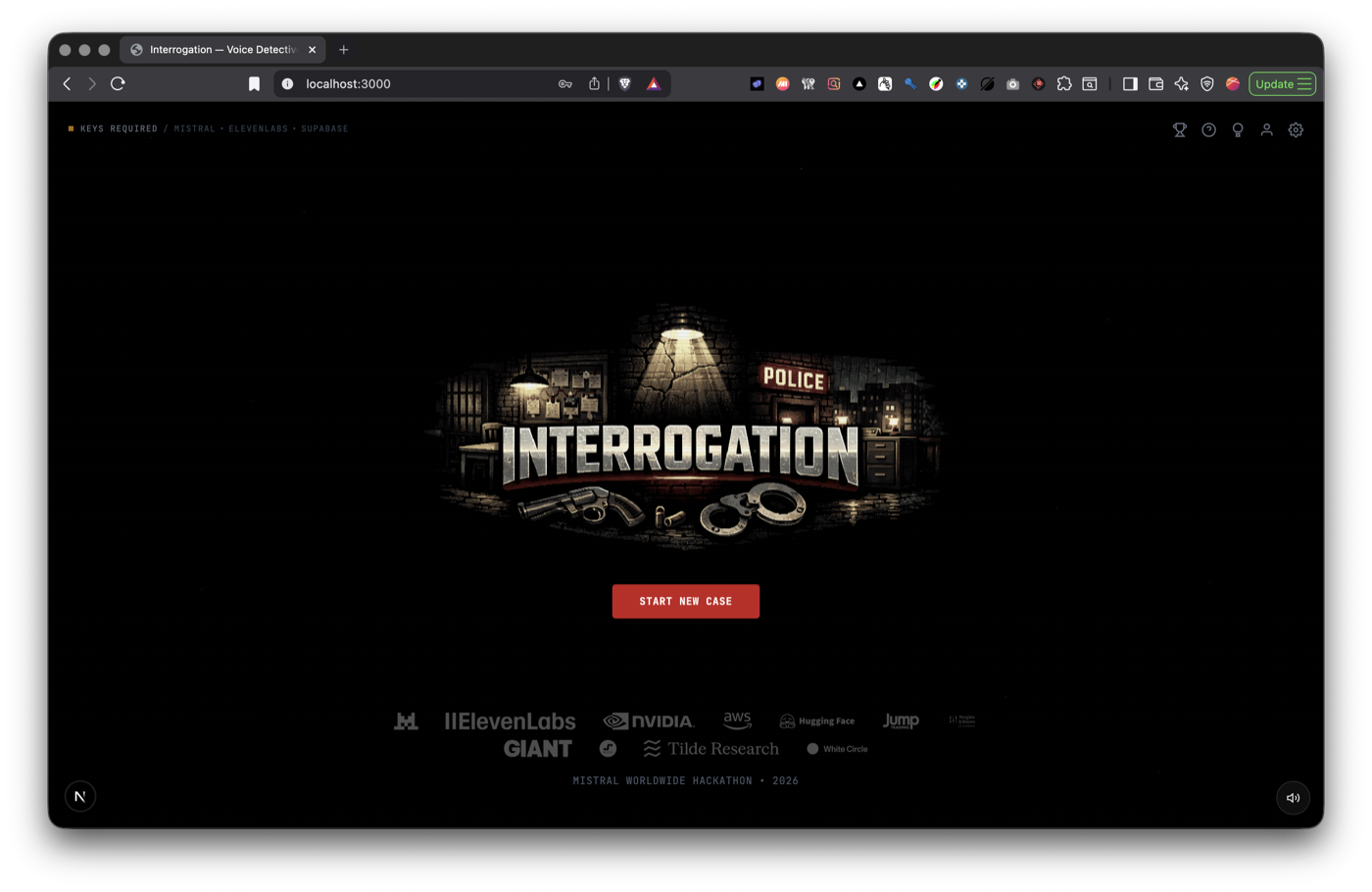
A voice-based detective interrogation game. You're a detective. Mistral is a suspect who's lying. Your job is to catch the lie through questioning alone.
Every case is procedurally generated — a unique white-collar crime, suspect, cover story, and one hidden lie. The suspect is played by Mistral Large, given a full backstory and instructed to defend it under adversarial pressure. No two cases are the same.
Built for the Mistral Worldwide Hackathon 2026 (Online Track).
"Mistral can reason. I made it lie. Your job is to catch it."
The AI is instructed to never confess, even at maximum stress. You win by making a specific, accurate accusation — not by getting the suspect to crack.
npm install
cp .env.example .env    # Fill in your API keys
npm run dev             # http://localhost:3000
MISTRAL_API_KEY=            # Required — case gen, interrogation, evaluation, STT
ELEVENLABS_API_KEY=         # Required — TTS for suspect voice
ELEVENLABS_VOICE_ID=        # Optional — specific ElevenLabs voice ID
NEXT_PUBLIC_SUPABASE_URL=   # Required — Supabase project URL
NEXT_PUBLIC_SUPABASE_ANON_KEY=  # Required — Supabase anon key (RLS-protected)
SUPABASE_SERVICE_ROLE_KEY=  # Optional — admin export endpoint
EXPORT_SECRET=              # Optional — admin export auth
API keys can also be configured in the Settings page at runtime — the app ships keyless and players bring their own keys.
npm run dev       # Dev server
npm run build     # Production build
npm run start     # Production server
npm run lint      # ESLint
| Level | Clues | Timer | Suspect Behavior |
|---|---|---|---|
| Easy | 2 | 5 min | Obvious lie, nervous |
| Medium | 3 | 7 min | Catchable lie, composed |
| Hard | 4 | 9 min | Subtle lie, skilled deflector |
| Expert | 5 | 10 min | Deeply buried lie, manipulative |
An unlimited timer mode is also available — on hard/expert, the suspect will lawyer up after 4 consecutive high-stress exchanges.
Clues unlock at stress thresholds spread across 1–9, gated by:
The Accuse button unlocks only after all required clues are collected.
score = timeScore x difficultyMultiplier x efficiencyBonus x hintPenalty x accusationPenalty

timeScore       = 1000 x sqrt(max(0, 1 - elapsed / (parTime x 2)))
multiplier      = easy 1.0x, medium 1.5x, hard 2.0x, expert 2.5x
efficiencyBonus = 1.0-1.5x (fewer questions than par = bonus)
hintPenalty     = 0.85^hintsUsed
accusePenalty   = max(0, 1 - wrongAccusations x 0.1)
Score is calculated server-side from frozen stats at win time — client values are ignored.
app/
├── page.tsx                     # Title screen
├── cases/                       # Case select — locations + difficulty
├── game/
│   ├── page.tsx                 # Main game orchestrator
│   ├── hooks/                   # useVoiceRecorder, useTTS, useGameTimer, useSfx, useSettings
│   ├── components/              # Dock, TopBar, CaseFile, SuspectZone, BriefingScreen, dialogs
│   ├── win/                     # Win screen + InitialsEntry
│   └── lose/                    # Lose screen
├── leaderboard/                 # Top 20, new-entry animation
├── settings/                    # API key config, export, preferences
├── help/                        # How to play, scoring, about
├── about/                       # Builder info
└── api/
    ├── generate-case/           # GET — Mistral case generation
    ├── interrogate/             # POST — player question → suspect response
    ├── accuse/                  # POST — accusation evaluation (separate judge)
    ├── evaluate/                # POST — win/loss analysis
    ├── hint/                    # POST — obfuscated stress trigger hints
    ├── tts/                     # POST — ElevenLabs TTS
    ├── transcribe/              # POST — Voxtral STT
    ├── leaderboard/             # GET/POST — Supabase leaderboard
    ├── patterns/                # GET/POST — cross-session learning patterns
    └── export/                  # GET — admin JSONL export

src/lib/
├── mistral/                     # Mistral client, interrogation, evaluation, case gen, embeddings
├── game-session.ts              # Server-side session store, win tokens, export
├── game-state.ts                # Type definitions
├── scoring.ts                   # Score calculation + detective ratings
├── sanitize.ts                  # Input validation, injection detection
├── db.ts                        # Supabase client
└── rate-limit.ts                # Per-IP rate limiting
The game runs adversarial AI against player input — security is a core feature, not an afterthought.
Input sanitization: 30+ regex injection patterns, Unicode normalization (NFKD), zero-width char stripping, base64 payload detection, gibberish/non-English blocking.
Output scanning: AI responses checked against case secrets with fuzzy matching (40% threshold, stop-word filtered). Leaked responses replaced with deflection.
Judge isolation: Accusation evaluation uses a separate Mistral call with dedicated system prompt, randomized boundary tokens, stripped injection markers. Judge calls never use player-provided API keys.
Stress enforcement: Server-side monotonic clamping — stress only goes up, max +1 per turn. Clue thresholds are server-enforced. AI cannot spike or drop stress to game gates.
Win tokens: 128-bit random, timing-safe comparison, single-use, 30-minute TTL. Score calculated from server-side stats snapshot — client-reported values ignored.
Session security: 192-bit random IDs, mutex locks, 1-hour TTL, 5000 max sessions with LRU eviction. Timer mode pinned at creation.
TTS validation: Requires active session. Text must match a recent assistant message. Prevents free TTS proxy abuse.
RAG poisoning defense: Cross-session learned tactics filtered through injection detection and sanitization before prompt inclusion.
