 jovanbulck/sgx-step
A practical attack framework for precise enclave execution control



SGX-Step is an open-source framework to facilitate side-channel attack research on Intel x86 processors in general and Intel SGX platforms in particular. SGX-Step consists of an adversarial Linux kernel driver and a small user-space operating system library that allows to configure untrusted page table entries and/or x86 APIC timer interrupts completely from user space. SGX-Step has been leveraged in our own research, as well as by independent researchers, to enable several new and improved enclaved execution attacks that gather side-channel observations at a maximal temporal resolution (i.e., by interrupting the victim enclave after every single instruction).
License. SGX-Step is free software, licensed under GPLv3. The SGX-Step logo is derived from Eadweard Muybridge's iconic public domain "Sallie Gardner at a Gallop" photo series, which, like our enclave single-stepping goal, breaks down the galloping horse dynamics into a series of individual photo frames to reveal overall horse gait properties.
| SGX-Step release | Changelog features |
|---|---|
| v1.5.0 | Stabilization fixes (KPTI, kernel ISR mapping); (experimental) Gramine port; IPI support. |
| v1.4.0 | Privileged interrupt/call gates (Plundervolt). |
| v1.3.0 | Transient-execution support (Foreshadow). |
| v1.2.0 | User-space interrupt handling and deterministic zero-step filtering (Nemesis). |
| v1.1.0 | IA32 support. |
| v1.0.0 | User-space page table manipulation and APIC timer single-stepping. |
Publications. SGX-Step has been employed by several independent research groups and has enabled a new line of high-resolution SGX attacks. A full up-to-date list of known projects using SGX-Step is included at the bottom of this README. A copy of the original paper is available here.
@inproceedings{vanbulck2017sgxstep,
    title     = {{SGX-Step}: A Practical Attack Framework for Precise Enclave Execution Control},
    author    = {Van Bulck, Jo and Piessens, Frank and Strackx, Raoul},
    booktitle = {2nd Workshop on System Software for Trusted Execution {(SysTEX)}},
    publisher = {{ACM}},
    pages     = {4:1--4:6},
    month     = Oct,
    year      = 2017,
}
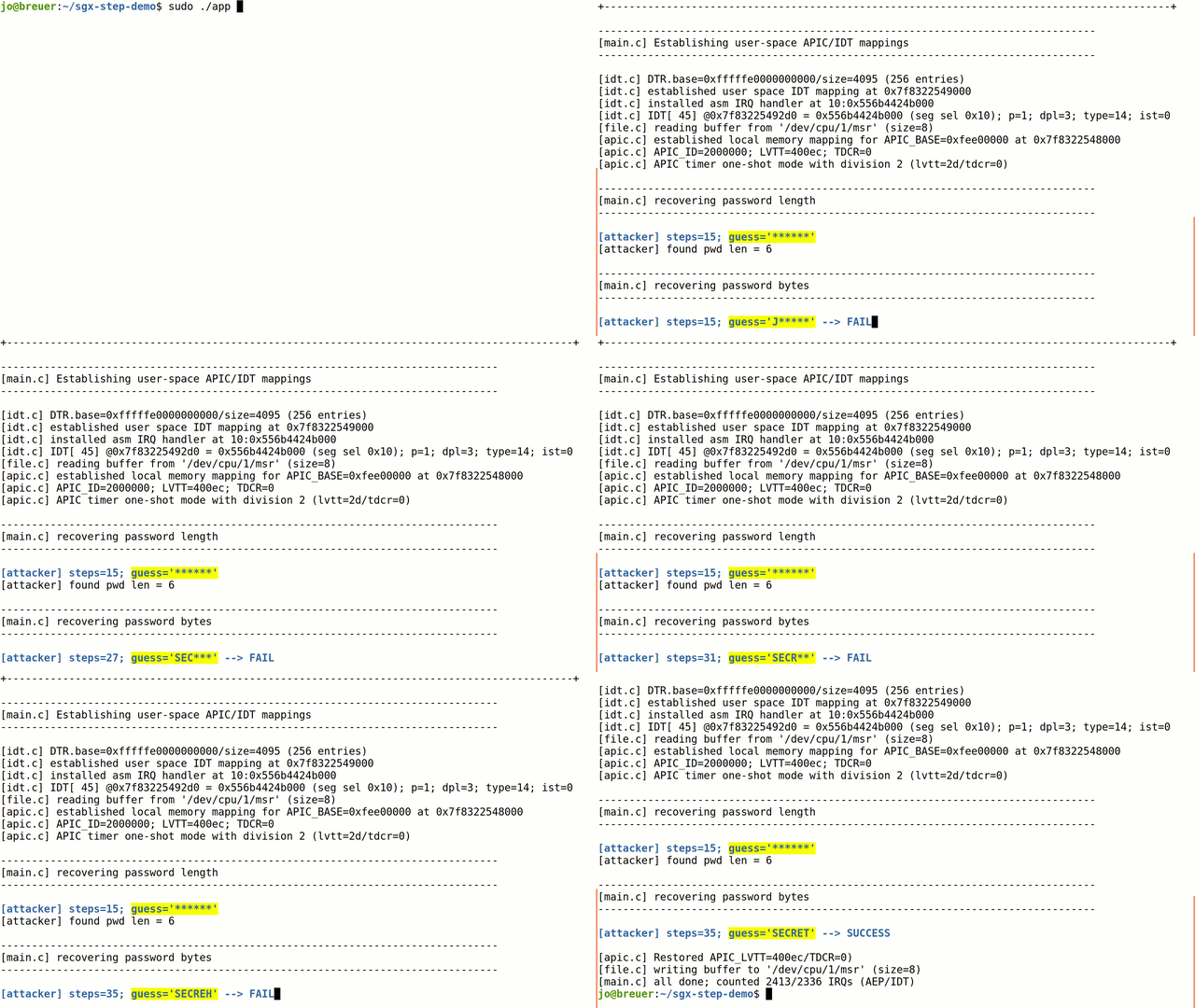
Demo. The app/memcmp directory contains a small demo application that
illustrates the power of SGX-Step attacks by single-stepping a sample enclave
that contains subtle, non-constant-time memcmp password comparison logic.
As opposed to traditional, notoriously noisy timing attacks, SGX-Step can
deterministically brute-force the password character-per-character in linear
time:
Crucial to the design of SGX-Step, as opposed to previous enclave preemption proposals, is the creation of user-space virtual memory mappings for physical memory locations holding page table entries, as well as for the local APIC memory-mapped I/O configuration registers and the x86 Interrupt Descriptor Table (IDT). This allows an untrusted, attacker-controlled host process to easily (i) track or modify enclave page table entries, (ii) configure the APIC timer one-shot/periodic interrupt source, (iii) trigger inter-processor interrupts, and (iv) register custom interrupt handlers completely within user space.
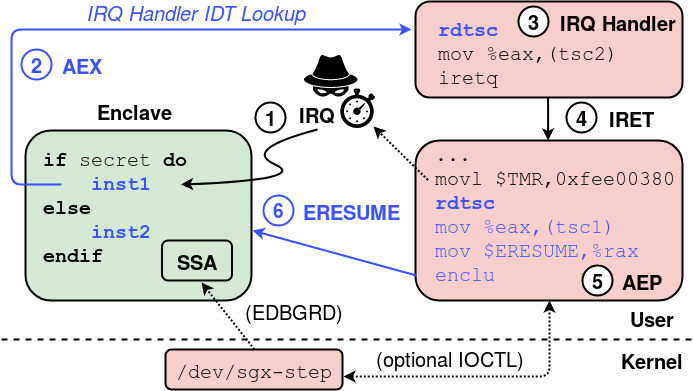
The above figure summarizes the sequence of hardware and software steps when interrupting and resuming an SGX enclave through our framework.
/proc/self/mem interface and the
EDBGRD instruction).ERESUME.This repository is organized as follows:
.
├── app        -- Collection of sample client applications using SGX-Step to
│                 attack different victim enclave scenarios.
├── doc        -- Papers and reference material.
├── kernel     -- Minimal dynamically loadable Linux kernel driver to export
│                 physical memory to user space and bootstrap `libsgxstep`.
├── libsgxstep -- Small user-space operating system library that implements the
│                 actual SGX-Step functionality, including x86 page-table and
│                 APIC timer manipulations.
└── sdk        -- Bindings to use SGX-Step with different SGX SDKs and libOSs.
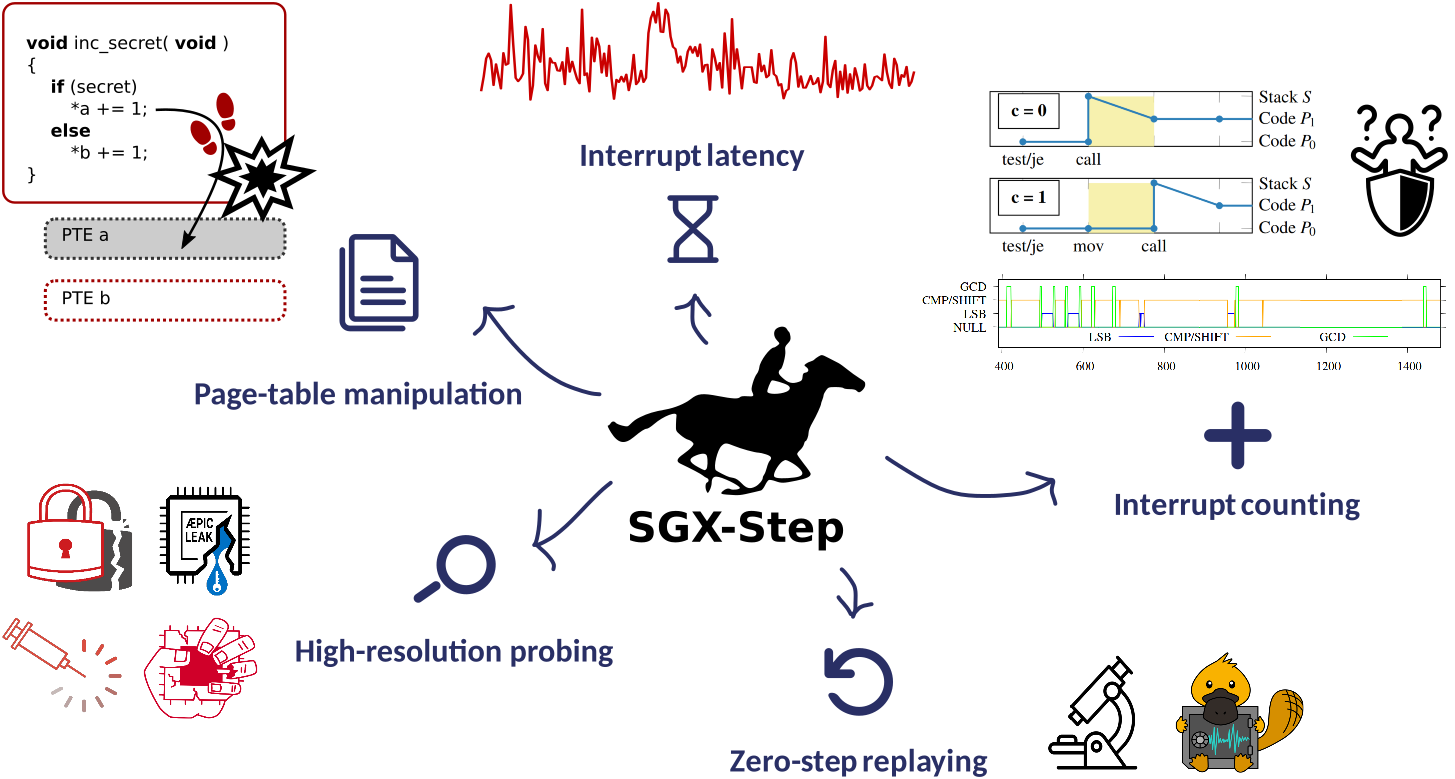
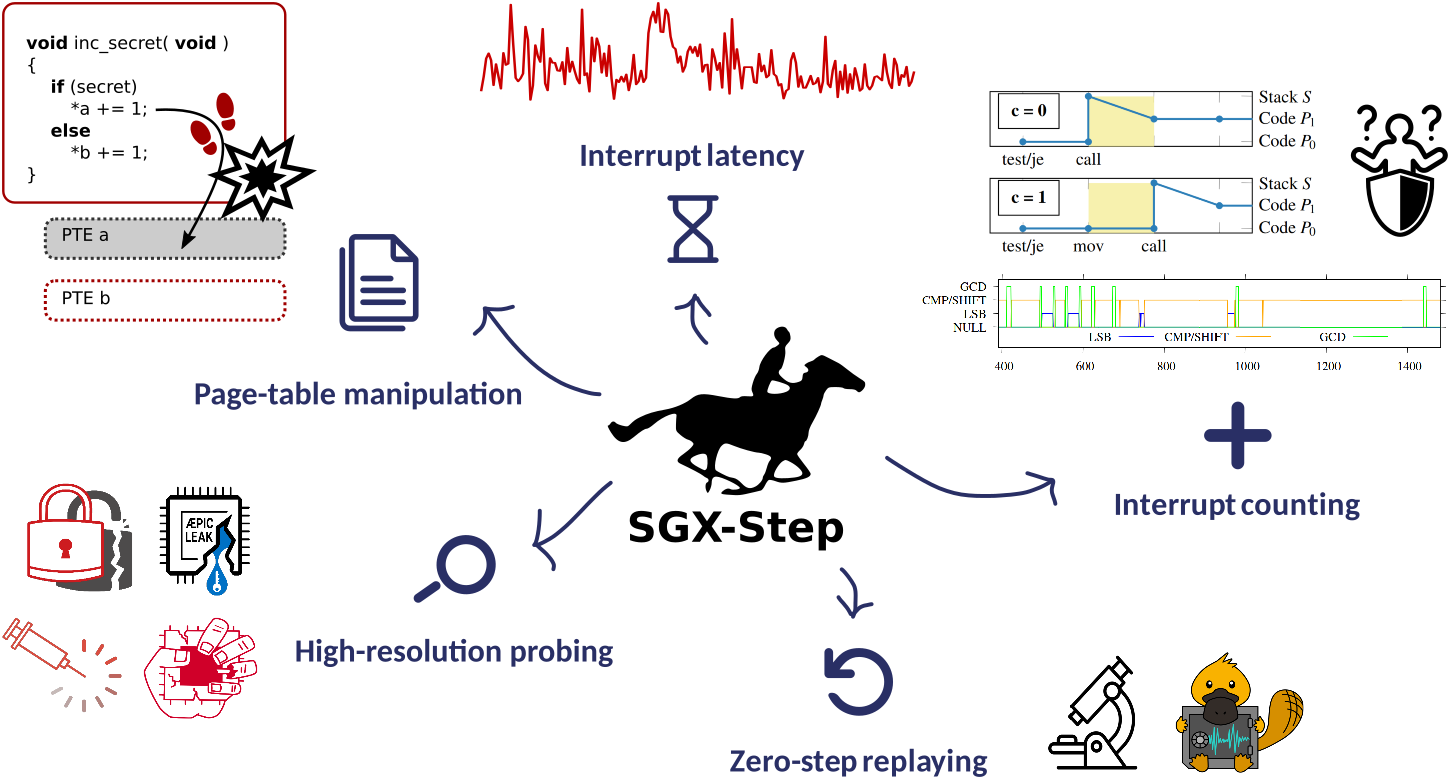
SGX-Step is a universal execution control framework that enables the precise interleaving of victim enclave instructions with arbitrary attacker code. Some of the main use cases of the SGX-Step framework are summarized in the figure below (see also the bottom of this README for an up-to-date list of publications using SGX-Step).
SGX-Step requires an SGX-capable Intel processor, and an off-the-shelf Linux kernel. Our original evaluation was performed on i7-6500U/6700 CPUs, running Ubuntu 18.04 with a stock Linux 4.15.0 kernel. More recent Linux kernels and distributions are also supported. We summarize Linux kernel parameters below.
