 jfrog/text4shell-tools
Detect and patch vulnerable Apache Commons Text in Java JAR/WAR artifacts; fingerprint classes and scan bytecode for CVE-2022-42889 (Text4Shell) call sites.

Click to find:
CVE-2022-42889 may pose a serious threat to a wide range of Java-based applications. The important questions a developer may ask in this context are:
commons-text? Which versions?Does the released code include commons-text? Which version of the library is included there? Answering these questions may not be immediate due to two factors:
Transitive dependencies: while commons-text may not be in the direct dependency list of the project, it may be used indirectly by some other dependency.
The code of this library may not appear directly as a separate file, but rather be bundled in some other code jar file.
JFrog is releasing a tool to help resolve this problem: scan_commons_text_versions. The tool looks for the class code of StringLookupFactory (regardless of containing .jar file names and content of pom.xml files), and attempts to fingerprint the versions of the objects to report whether the included version of commons-text is vulnerable.
commons-text functions?The question is relevant for the cases where the developer would like to verify if the calls to commons-text in the codebase may pass potentially attacker-controlled data. While the safest way to fix the vulnerability, as discussed in the advisories, is to apply the appropriate patches, controlling for and verifying the potential impact under assumption of unpatched commons-text may be valuable in many situations.
scan_commons_text_calls_jar.py, which locates the calls to the vulnerable functions in compiled .jars, and reports the findings as class name and method names in which each call appears.
commons-text jar files in my system, how can I quickly disable the dangerous behavior?Updating remains the best solution - this solution is intented for fast hot patching
In the context of CVE-2022-42889 vulnerability, the class org/apache/commons/text/lookup/ScriptStringLookup in commons-text enables execution of scripts which may be embedded in a string received from an attacker-controlled source through ${script}. Therefore, invocations of ScriptStringLookup.lookup function are indicative of the functionality being activated.
We provide a tool, Text4ShellPatch, allowing to patch this specific call so that the script execution functionality cannot be utilized. After applying the patch, the library will always execute a script returning a warning message (instead of the potentially attacker-controlled code)
Similarly, DNS and URL lookup can load untrusted content if controlled by an attacker through ${dns} and ${url}, thus, their respective lookup DnsStringLookup and UrlStringLookup respectively can be disabled through patch to return a warning message,
The patch can be applied to a specific jar file, for the script lookup only or script, dns and url for a better protection in case it is not meant to be used in the application,
A backup is generated in the same location as the original jar before being replaced with the patch one. The backup filename follows the following pattern: <original_jar_name>_YYYY.MM.DD_HH.mm.ss.orig.jar where YYYY, MM, DD are respectively the year, the month and the day, and HH, mm, ss are respectively the hour, the minutes and the second.
It is also possible to locate vulnerable versions of commons-text and patch them automatically as the next question answers to it.
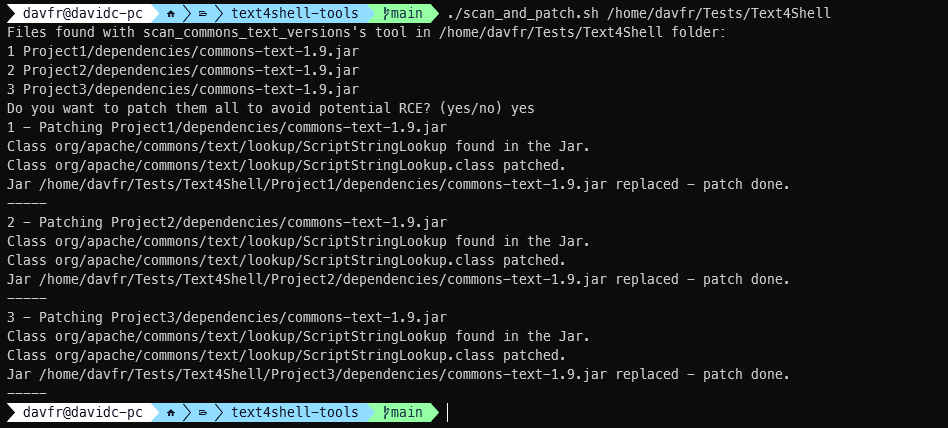
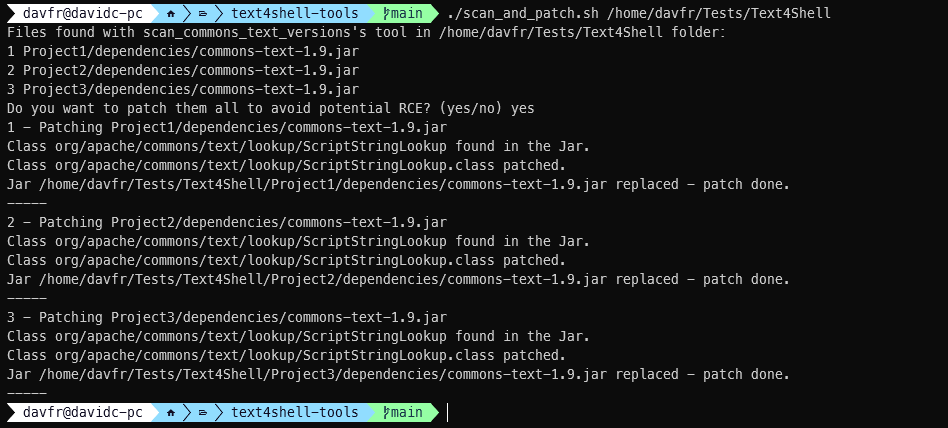
commons-text jar?Two of our tools together offers the ability to scan and patch the vulnerable commons-text jar files.
An example bash script is present in this Github repository under the name of scan_and_patch.sh. Basically, it is using the scan_commons_text_versions.py script to find under a specific root-folder the vulnerable commons-text jar files with a vulnerable version and run the Text4ShellPatch tool against them as follows.
scan_commons_text_versions.pypython scan_commons_text_versions.py root-folder [-quiet] [-exclude folder1 folder2 ..]
The tool will scan root_folder recursively for .jar and .war files; in each located file the tool looks for a StringLookupFactory.class (recursively in each .jar file). If at least one of the classes is found, the tool attempts to fingerprint its version (including some variations found in patches and backport patches) in order to report whether the code is vulnerable.
With -quiet flag, only version conclusions are printed out, and other messages (files not found/ archives failed to open/ password protected archives) are muted.
Folders appearing after -exclude (optional) are skipped.
scan_commons_text_calls_jar.pyThe tool requires python 3 and the following 3rd party libraries: jawa, tqdm, easyargs, colorama
pip install -r requirements.txt
The default use case:
python scan_commons_text_calls_jar.py root-folder
will recursively scan all .jar files in root-folder, for each printing out locations (class name and method name) of calls to lookup/replace/replaceIn methods of StringSubstitutor/StringLookup.
The tool may be configured for additional use cases using the following command line flags.
| Flag | Default value | Use |
|---|---|---|
--class_regex | (.*StringSubstitutor|.*StringLookup) | Regular expression for required class name |
--method_regex | (lookup|replace|replaceIn) | Regular expression for required method name |
--quickmatch_string | (StringLookup|StringSubstitutor) | Pre-condition for file analysis: .jar files not containing the specified regex will be ignored |
--class_existence | Not set | When not set, look for calls to class::method as specified by regexes. When set, --method_regex is ignored, and the tool will look for existence of classes specified by --class_regex in the jar. |
--no_quickmatch | Not set | When set, the value of --quickmatch_string is ignored and all jar files are analyzed |
--caller_block | .*org/apache/commons/text | If caller class matches this regex, it will not be displayed |
text_4_shell_patchjava -jar Text4ShellPatch.jar TARGET_JAR [PATCHING_MODE]
Where TARGET_JAR is the application to patch and PATCHING_MODE is
0 (default): Patch Script lookup
1: Patch Script + DNS + URL lookups
[Note: The original Jar will be kept in the same folder with the .orig.jar extension]
The tool will look for the org/apache/commons/text/lookup/ScriptStringLookup class in the commons-text jar given and replaces the lookup() function's content by a warning message and return out of the function. Thus, the eval will not exist in the new ScriptStringLookup class.
