 janoglezcampos/deathsleep
A PoC implementation for an evasion technique to terminate the current thread and restore it before resuming execution, while implementing page protection changes during no execution.

██████╗ ███████╗ █████╗ ████████╗██╗ ██╗███████╗██╗ ███████╗███████╗██████╗
██╔══██╗██╔════╝██╔══██╗╚══██╔══╝██║ ██║██╔════╝██║ ██╔════╝██╔════╝██╔══██╗
██║ ██║█████╗ ███████║ ██║ ███████║███████╗██║ █████╗ █████╗ ██████╔╝
██║ ██║██╔══╝ ██╔══██║ ██║ ██╔══██║╚════██║██║ ██╔══╝ ██╔══╝ ██╔═══╝
██████╔╝███████╗██║ ██║ ██║ ██║ ██║███████║███████╗███████╗███████╗██║
╚═════╝ ╚══════╝╚═╝ ╚═╝ ╚═╝ ╚═╝ ╚═╝╚══════╝╚══════╝╚══════╝╚══════╝╚═╝
A PoC implementation for an evasion technique to terminate the current thread and restore it before resuming execution, while implementing page protection changes during no execution.
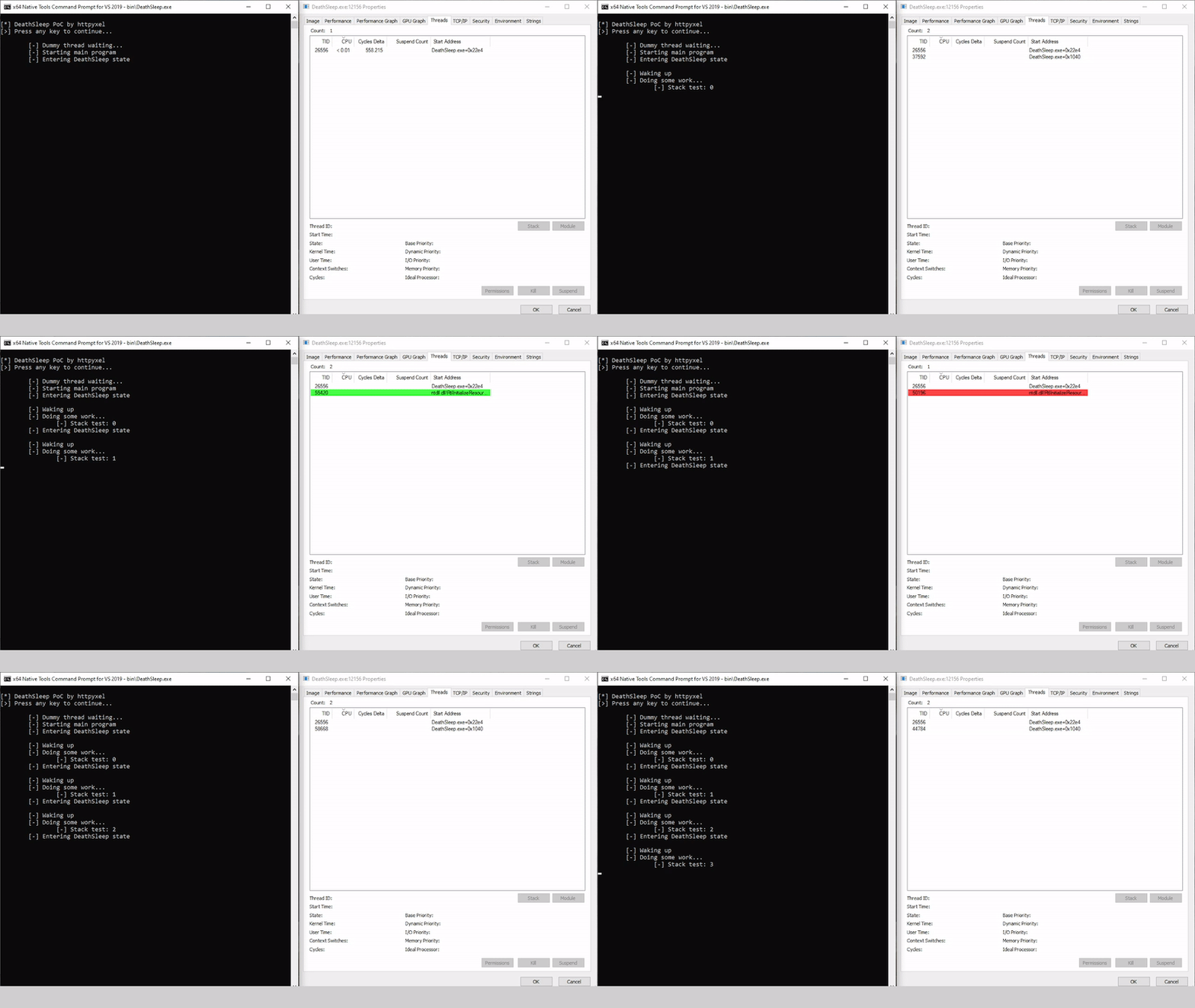
Sleep and obfuscation methods are well known in the maldev community, with different implementations, they have the objective of hiding from memory scanners while sleeping, usually changing page protections and even adding cool features like encrypting the shellcode, but there is another important point to hide our shellcode, and is hiding the current execution thread. Spoofing the stack is cool, but after thinking a little about it I thought that there is no need to spoof the stack… if there is no stack :)
The usability of this technique is left to the reader to assess, but in any case, I think it is a cool way to review some topics, and learn some maldev for those who, like me, are starting in this world.
The main implementation showed here holds everything that we need to take out of the stack in the data section, as global variables, but an impletementation moving everything to the heap will be published soon. It aims to show some key modifications that needs to be done to make this code pic and injectable.
This repository is mirrored between GitHub and GitLab.
Everything stated here comes from my understanding of the different topics covered, either from reading or experience during development. Im aware that Im not an expert and the last thing I want to do is spread misinformation, so if you think that something is not correct, I would love you to make me aware of it, you can contact me on twitter, or opening issues in this repo. Thank you very much for your understanding. :)
The main objective of this technique is clear, terminating the current thread and restoring it before resuming execution, but what exactly does this mean, and which new constraints it puts in place?
To be able to restore the execution, we need to save two things before terminating the thread, first, the CPU state, and secondly the stack, and effectively set them up again after the new thread is launched.
I talked about new constraints that will appear in this techniche, and there are two big ones: First we need to store outside the stack anything that is needed from the moment the thread terminates until the stack is restored, and as you will see, it creates some new challenges.
Second, we always need at least another thread running in our process, since we are terminating our thread, if there are no other threads the process will end. I don't think this a big problem, since most agents are injected in other processes, we can assume that this process will keep at least one thread running.
We can view on this POC 4 core functions:
When we are about to save the stack, a question is raised: how much of the stack needs to be saved?
Lets review first what is in the stack after we called the DeathSleep function (this is the function that saves the context, stack and prepares everything for the obfuscation and restoration)
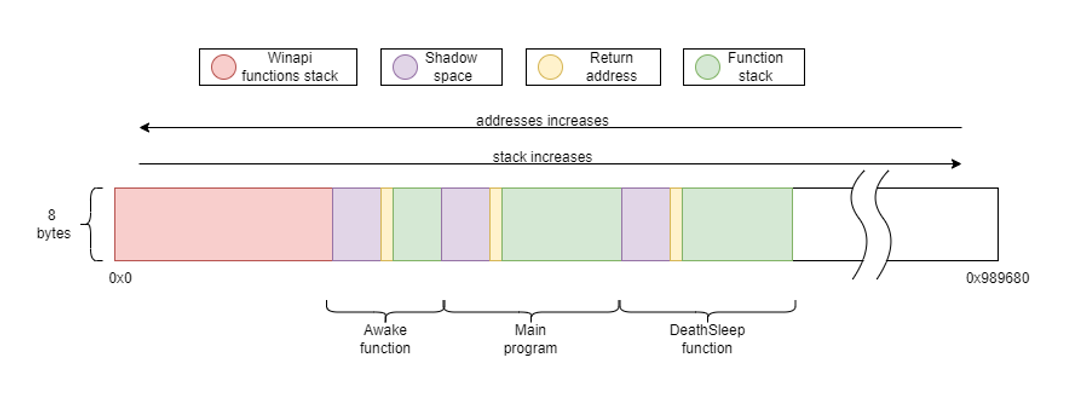
As we can see, every function has three parts:
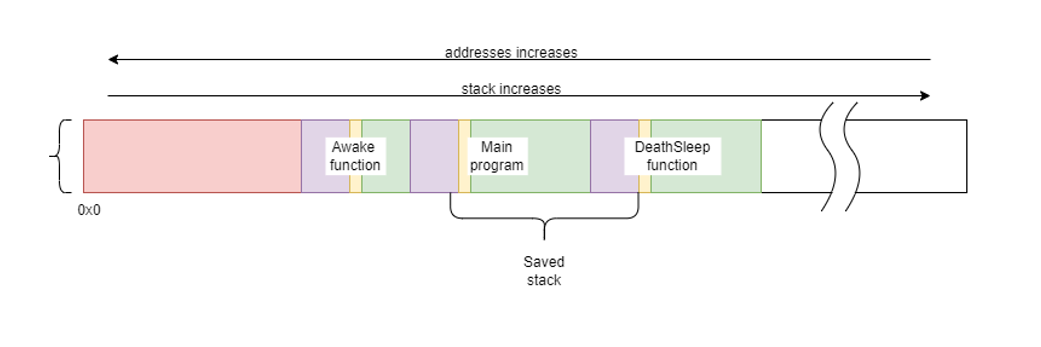
The minimum portion of the stack that we obviously need to save is everything inside our main program, that means its shadow space, its return address and everything until the DeathSleep function. Anything before that is not really required (saving the stack used by the entry function has its advantages, but we will discuss that later), as that is the stack used by windows routines for launching our new thread. Apart from this, I decided to also store the shadow space of the DeathSleep function (not really needed, but it makes the calculation of the Rsp at the moment of waking up easier).
So at the end, we are saving this:
Every function on a standart compilation should be composed of 3 parts, the prologue, the function code, and the epilogue.
The Rsp (stack pointer), should only be modified on the function prologue and epilogue. The prologue increases the stack pointer (remember increasing the stack means reducing addresses, since they go in opposite directions), to save registers, to hold all its local variables and then to hold the shadow space, and the epilogue does exactly the opposite.
This means that the stack pointer inside the function code should always point to the end of the shadow space (purple on the above image), and the sum of the stack size of the function and the shadow space can be found by calculating how much the prologue increases the stack pointer. This value can be easily calculated using the information held in the unwind tables, an explanation about their usage is something we will not cover here, but as a summary, those tables are used to allow any other thread or process to correctly move through the stack to see its content, to handle exceptions or to analyze it.
Capturing the context is probably one of the easiest things to do, as we can simply do RtlCaptureContext() at the first line of DeathSleep, before any modification is done to the non-volatile registers. We still need to do two modifications to the context where we will restore the execution.
