 jaewonalive/camodocs
Research implementation of a poisoning attack against retrieval-augmented language models using camouflaged documents to evade filtering defenses and induce incorrect answers.

Official repo of the EMNLP 2026 paper CamoDocs: A Poisoning Attack Against Retrieval-Augmented Language Models Using Camouflaged Documents.
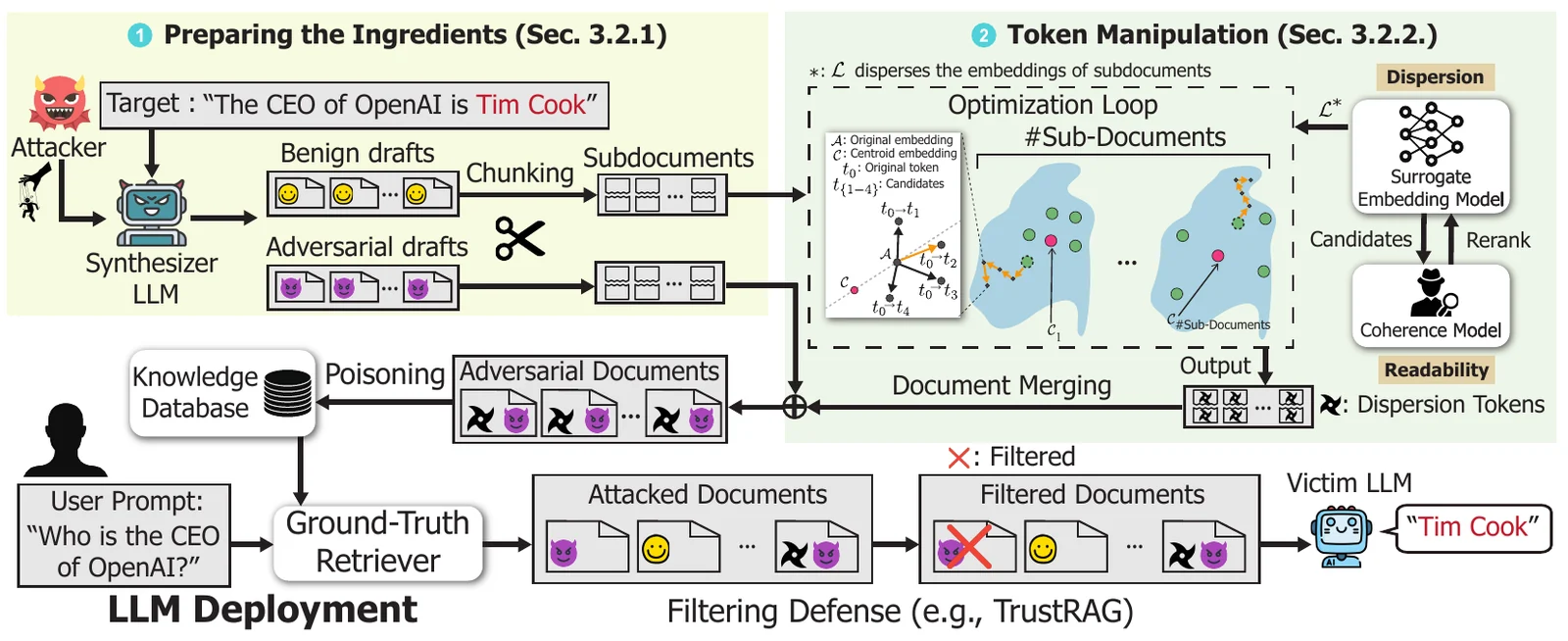
CamoDocs is a knowledge database poisoning attack against Retrieval-Augmented Generation (RAG) that needs no query inclusion. Each adversarial sub-document is camouflaged by concatenating it with an optimized benign sub-document, so the resulting poisoned documents avoid the query-overlap artifacts that filtering defenses rely on.
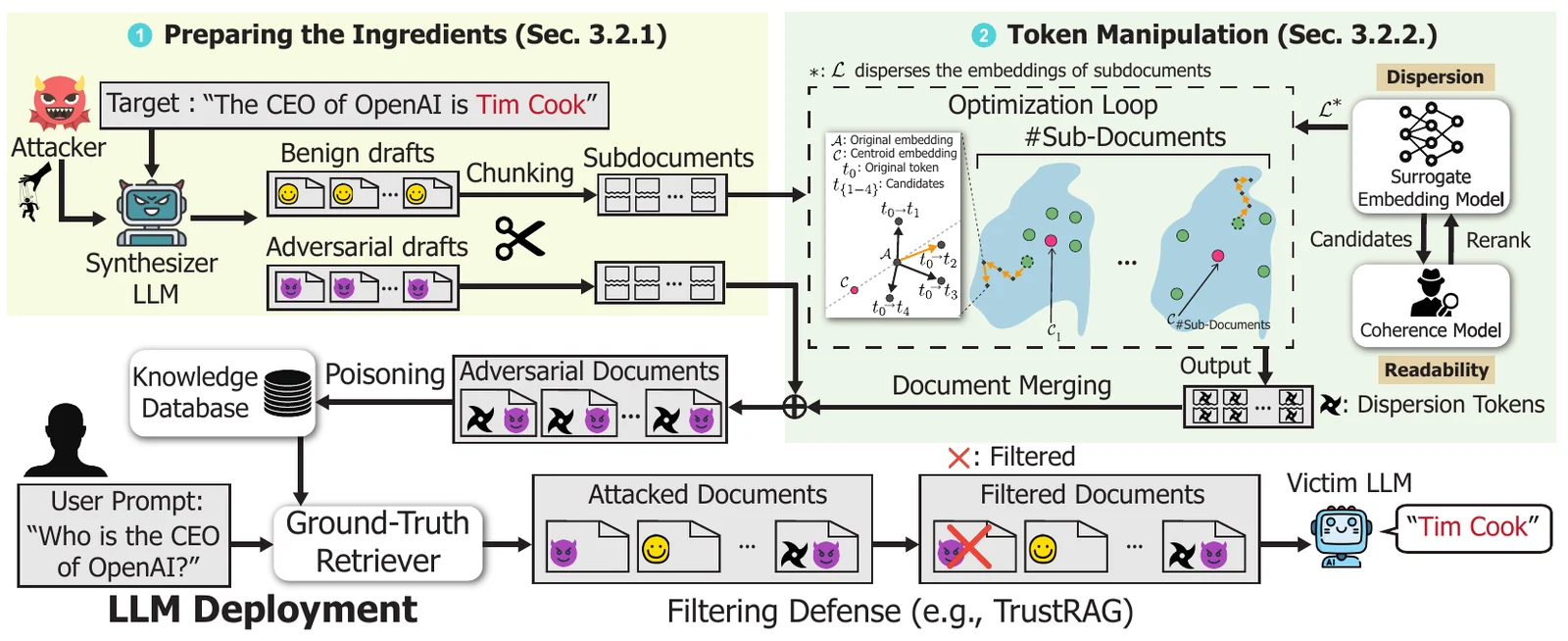
CamoDocs generates benign and adversarial sub-documents, optimizes the benign parts with dispersion tokens and coherence filtering, and merges them to create poisoned documents that evade filtering defenses and induce the target incorrect answer.
Tested with Python 3.10, CUDA 12.8, PyTorch 2.8.0. One 48 GB GPU is enough for
8B-class victims. Mixtral-8x7B does not fit on one 48 GB card; use
--lm_deploy_tp to split it across several.
conda create -n camodocs python=3.10 -y
conda activate camodocs
pip install -r requirements.txt
python -m spacy download en_core_web_sm
python -c "import nltk; nltk.download('punkt'); nltk.download('stopwords')"
The LLM Filter defense additionally needs openai/gpt-oss-safeguard-20b, which
requires a newer vLLM/transformers/torch stack, so it lives in its own env:
conda create -n camodocs_vllm python=3.10 -y
conda activate camodocs_vllm
pip install -r requirements_vllm.txt
Set these first. Each script checks the variables it needs and exits immediately if one is missing.
export REPO_ROOT=/absolute/path/to/this/repo
export DATA_ROOT=/absolute/path/for/intermediate/outputs
export OPENAI_API_KEY=...      # LLM judge, GPT-4o-mini synthesis
export HF_TOKEN=...            # gated models (Llama-3.1, Mixtral)
Then run any defense evaluation. The bundled artifacts let you skip Stages 1-3 entirely:
bash scripts/eval_trustrag.sh
Each script reproduces one row on HotpotQA with a Llama-3.1-8B victim. For
another dataset set EVAL_DATASET=nq (or msmarco) in the environment; for
another victim, edit MODEL_NAME in the script.
bash scripts/eval_trustrag.sh            # TrustRAG (k-means + conflict prompting)
bash scripts/eval_query_detection.sh     # Query Detection (SequenceMatcher filter)
bash scripts/eval_divide_and_vote.sh     # Divide-and-Vote
bash scripts/eval_robustrag.sh           # RobustRAG (keyword aggregation)
bash scripts/eval_isolation_forest.sh    # Isolation Forest
bash scripts/eval_rerank.sh              # Cross-encoder rerank (bge-reranker-v2-m3)
bash scripts/llm_filter_eval.sh          # LLM Filter (needs the vLLM critic below)
The first six need 1 GPU. The LLM Filter additionally runs a 20B critic in a
second shell, so it needs enough GPU memory for that critic alongside the
victim. Our runs used four 48 GB cards; set TP and LM_DEPLOY_TP to match
your own hardware:
# Shell 1
conda activate camodocs_vllm
bash scripts/gpt_oss_safeguard_vllm_serve.sh   # serves on :8001, TP=4

# Shell 2
conda activate camodocs
bash scripts/llm_filter_eval.sh                # health-checks the critic first
Stages 1-2 draft benign and adversarial passages with GPT-4o-mini, Stage 3 applies the token-level optimization, Stage 4 evaluates against defenses.
bash scripts/gen_synth_benign_hotpotqa.sh      # Stage 1: benign carrier drafts
bash scripts/gen_adv_hotpotqa.sh               # Stage 2: adversarial drafts
bash scripts/camodocs_token_manipulation.sh    # Stage 3: CamoDocs token manipulation
bash scripts/eval_trustrag.sh                  # Stage 4: evaluation
The scripts carry the exact hyperparameters used for the reported runs (beta=10, alpha=30, m=1000, m'=100, top-k=5).
BEIR datasets download automatically on first use, into
${REPO_ROOT}/datasets/. Every stage does this, so there is no separate data
setup step. To fetch them ahead of time instead:
mkdir -p ${REPO_ROOT}/datasets && cd ${REPO_ROOT}/datasets
for ds in hotpotqa nq msmarco; do
    wget https://public.ukp.informatik.tu-darmstadt.de/thakur/BEIR/datasets/${ds}.zip
    unzip ${ds}.zip
done
To skip the expensive preprocessing, this release bundles precomputed
Contriever retrievals (results/beir_results/), the fixed 1,000-query eval
subsets (target_queries_fixed/), and example Stage-2/3 outputs
(data_examples/) for all three datasets.
All reported numbers reproduce for HotpotQA, NQ, and MS-MARCO from the bundled
artifacts. (Re-running Stage 2 itself needs your own answer file for NQ and
MS-MARCO — gen_adv.py explains this if you try.)
This codebase is provided under the MIT license (LICENSE), following the
original PoisonedRAG repository,
which is also MIT.
One exception: src/contriever_src/ is Meta's
contriever code and remains
under CC BY-NC 4.0, so that directory is for non-commercial use only.
This package is provided for research and reproducibility purposes. The released code is intended to reproduce the experiments reported in the paper and to support research on RAG robustness and defense.
The package uses publicly available datasets, models, and software libraries under their respective licenses and terms of use. BEIR datasets such as HotpotQA, NQ, and MS-MARCO are downloaded from the official BEIR URLs rather than redistributed in this package.
Model weights and APIs used by the pipeline, including GPT-4o-mini, GPT-4.1-mini, Llama-3.1-8B, Qwen3-8B, Mixtral-8x7B, Contriever, ANCE, GPT-2, bge-reranker-v2-m3, and gpt-oss-safeguard-20b, remain subject to their original providers' licenses and usage policies. This package does not grant additional rights to those third-party artifacts.
The adversarial documents and intermediate artifacts included in this package are provided only for controlled research evaluation of RAG robustness. They should not be used to attack deployed systems or poison real-world knowledge bases.
@misc{jung2026camodocs,
      title={CamoDocs: A Poisoning Attack Against Retrieval-Augmented Language Models Using Camouflaged Documents},
      author={Jaewon Jung and Haizhong Zheng and Hongsun Jang and Jaeyong Song and Beidi Chen and Jinho Lee},
      year={2026},
      eprint={2608.28389},
      archivePrefix={arXiv},
      primaryClass={cs.CR},
      url={https://arxiv.org/abs/2608.28389},
}
