 iteride/cve-2025-32433
test

This document presents a study of the vulnerability CVE-2025-32433, affecting the built-in SSH server implementation in the Erlang/OTP platform.
This vulnerability is a Remote Code Execution (RCE) opportunity without authentication and affects several Erlang/OTP branches before patches:
Erlang/OTP is widely used as the foundation for scalable distributed systems and is part of the stack of many well-known projects (e.g., messengers, message brokers, high-load web services).
The presence of a critical RCE vulnerability in the core SSH library endangers infrastructure that uses Erlang/OTP as a server or component with open SSH access.
To examine the vulnerability step by step and demonstrate the full research cycle:
Collection and structuring of materials:
Find and organize publicly available data about CVE-2025-32433, describe its essence and potential impact.
Definition of CPE and configuration conditions:
Provide a list of CPEs and configuration conditions for which the vulnerability is relevant.
Development of PoC/Exploit:
Create and demonstrate a working exploitation prototype in a test environment.
Safe mass verification methods:
Describe three ways to check vulnerable hosts:
This research is conducted solely for educational and ethical purposes and has been performed only in a controlled test environment.
The author is not responsible for any misuse of the provided information.
Use this information only for learning and improving the security of your own systems.
Erlang is a programming language designed for building highly parallel and fault-tolerant systems.
Its platform Open Telecom Platform (OTP) has been used for many years in critical infrastructures — from telecommunications to the financial sector.
In OT (operational technology) environments and 5G networks, Erlang/OTP is valued for its scalability and ability to ensure continuous system operation with minimal downtime.
For remote administration, such networks often use the built-in SSH implementation in Erlang/OTP.
This is precisely what makes the CVE-2025-32433 vulnerability particularly dangerous for such environments.
Secure interaction in Erlang/OTP is provided by its own SSH implementation, which:
A vulnerability in this implementation allows an attacker with network access to execute arbitrary code without authentication, creating a direct threat to vulnerable assets.
According to global internet scanning data (Cortex Xpanse, April 2025), vulnerable Erlang/OTP SSH services are widely available on the internet and operate not only on standard ports but also, for example, on TCP port 2222.
This port is often used by outdated industrial automation components and the Ethernet/IP implicit messaging protocol, expanding the potential attack vector.
The vulnerability is associated with SSH versions included in Erlang/OTP releases.
The distribution of vulnerable services on ports characteristic of various industries creates a significant global attack surface.
Telemetry showed that over 85% of exploitation attempts were recorded on firewalls in the OT segment of the following sectors:
At the same time, despite a high dependence on OT, in sectors:
no factors were identified that would contribute to the active spread of this particular threat.
CVE-2025-32433 is registered in the NVD database with the following typical CPEs (Common Platform Enumeration):
cpe:2.3:a:erlang:otp:25:*:*:*:*:*:*:*cpe:2.3:a:erlang:otp:26:*:*:*:*:*:*:*cpe:2.3:a:erlang:otp:27:*:*:*:*:*:*:*Minor releases below the following patch versions are considered vulnerable:
- 25.x — up to 25.3.2.20 inclusive
- 26.x — up to 26.2.5.11 inclusive
- 27.x — up to 27.3.3 inclusive
ssh:daemon/2), not an external openssh.22 or custom, e.g., 2222) must be accessible for remote connections from the attacker's network.ssh:daemon/2 options.⚠️ If Erlang/OTP is used only as a client library without an SSH server, or if the server is isolated in a closed network, the vulnerability is not reachable.
The vulnerability arises because the built-in SSH server in Erlang/OTP incorrectly handles the pre-authentication process.
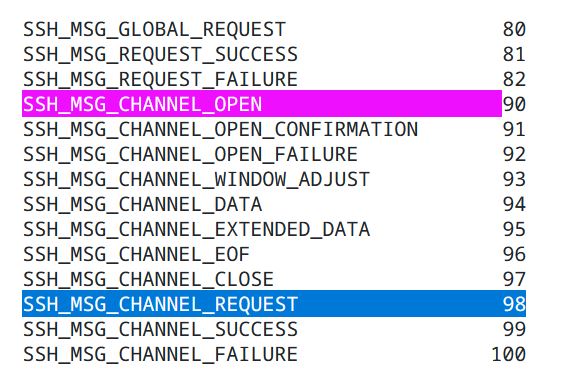
Two types of connection protocol messages play a key role — SSH_MSG_CHANNEL_OPEN and SSH_MSG_CHANNEL_REQUEST.
According to the standard RFC 4254, such messages should only be accepted after successful user authentication.
Any attempt to send them earlier should immediately result in connection termination.
In the case of CVE-2025-32433, the SSH daemon does not enforce this rule, allowing an attacker to open a session channel and send an exec request with an arbitrary command without providing valid credentials.
In other words, this leads to unauthenticated remote code execution (RCE) — the attacker can take control of the server without knowing the username, password, or key.
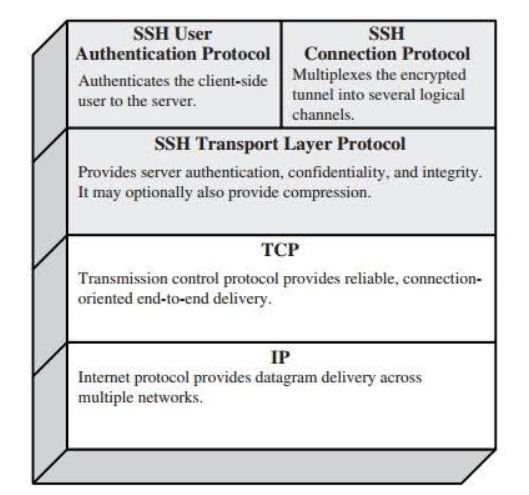
The SSH Connection protocol operates above the transport and authentication layers of SSH.
It provides interactive login, remote command execution, and port forwarding functions.
In the vulnerable SSH implementation in Erlang/OTP, these two messages — SSH_MSG_CHANNEL_OPEN and SSH_MSG_CHANNEL_REQUEST, necessary for channel initiation and command requests — become the attack point:
an attacker can send specially crafted traffic that tricks the system into executing arbitrary code before authentication.