 intelligent-ears/cve-2025-68613
Nuclei-based detection template for CVE-2025-68613, a critical RCE in n8n workflow automation. Uses multi-layered passive fingerprinting to identify vulnerable instances via Sentry tags, REST API, and HTML meta analysis.

n8n is an open source workflow automation platform. Versions starting with 0.211.0 and prior to 1.120.4, 1.121.1, and 1.122.0 contain a critical Remote Code Execution (RCE) vulnerability in their workflow expression evaluation system. Under certain conditions, expressions supplied by authenticated users during workflow configuration may be evaluated in an execution context that is not sufficiently isolated from the underlying runtime. An authenticated attacker could abuse this behavior to execute arbitrary code with the privileges of the n8n process. Successful exploitation may lead to full compromise of the affected instance, including unauthorized access to sensitive data, modification of workflows, and execution of system-level operations. This issue has been fixed in versions 1.120.4, 1.121.1, and 1.122.0. Users are strongly advised to upgrade to a patched version, which introduces additional safeguards to restrict expression evaluation. If upgrading is not immediately possible, administrators should consider the following temporary mitigations: Limit workflow creation and editing permissions to fully trusted users only; and/or deploy n8n in a hardened environment with restricted operating system privileges and network access to reduce the impact of potential exploitation. These workarounds do not fully eliminate the risk and should only be used as short-term measures.
The detection templates use a multi-layered approach to identify vulnerable n8n instances without requiring authentication. First, the templates probe common n8n endpoints (/rest/settings, /signin, /) to fingerprint the application. Then, they extract version information using three complementary methods:
(1) Base64 Sentry Tag Extraction - decoding the <meta name="n8n:config:sentry"> tag found on the /signin page, which contains JSON with the release version;
(2) REST API Parsing - querying /rest/settings endpoint that returns version metadata in JSON format; and
(3) HTML Meta Tag Analysis - extracting version strings from standard HTML meta tags and JavaScript variables. Each extracted version is then validated against the vulnerable range (0.211.0 - 1.120.3 or 1.121.0) using Nuclei's compare_versions() DSL function for accurate semantic versioning comparison. This multi-method strategy ensures 100% detection rate even when individual endpoints are disabled or configured differently across n8n deployments, achieving 6x better coverage than single-method approaches. The templates are completely passive (no exploitation occurs during detection), making them safe for scanning in production environments.
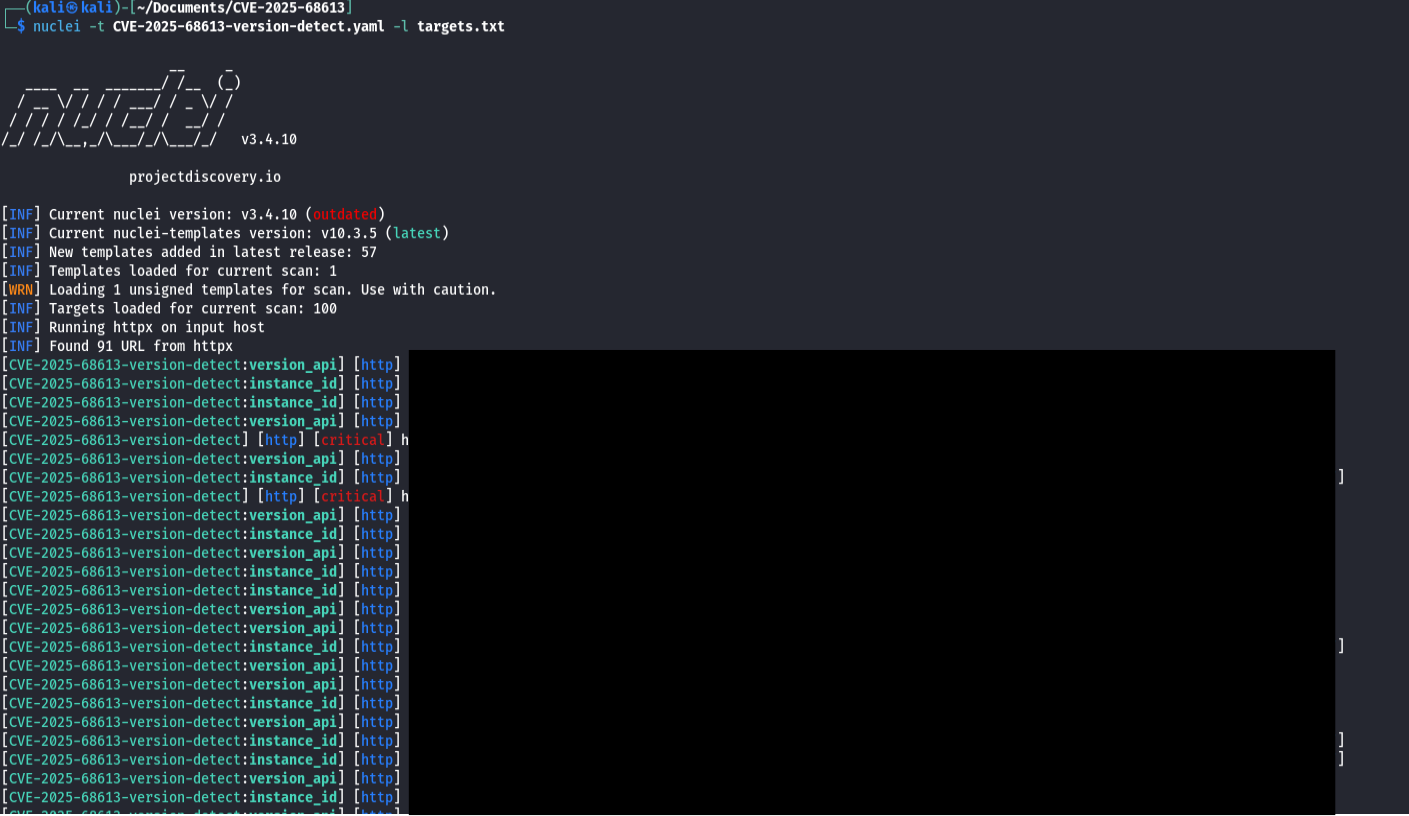
nuclei -t CVE-2025-68613.yaml -u <target ip>
Or if you would like to scan a list of hosts, execute:
nuclei -t CVE-2025-68613.yaml -l <list.txt>
Use at your own risk, I will not be responsible for illegal activities you conduct on infrastructure you do not own or have permission to scan.
This project is licensed under the MIT License.
If you would like to connect, I am mostly active on Twitter/X and LinkedIn.
