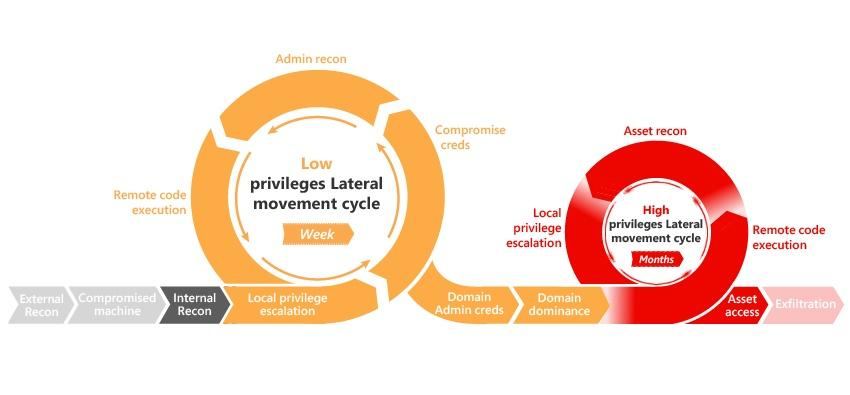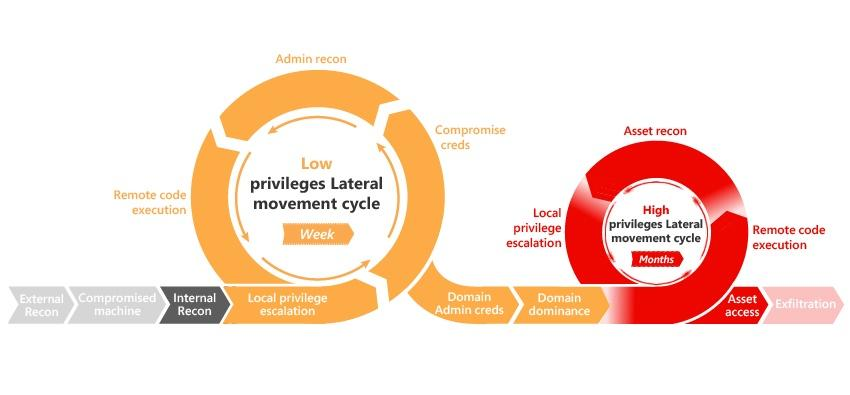

This document was designed to be a useful, informational asset for those looking to understand the specific tactics, techniques, and procedures (TTPs) attackers are leveraging to compromise active directory and guidance to mitigation, detection, and prevention. And understand Active Directory Kill Chain Attack and Modern Post Exploitation Adversary Tradecraft Activity.
BadSuccessor - This repository contains tooling related to the BadSuccessor attack - a novel Active Directory privilege escalation technique that abuses a vulnerability in a feature introduced in Windows Server 2025.
AD_Miner - AD Miner is an Active Directory audit tool that leverages cypher queries to crunch data from the #Bloodhound graph database to uncover security weaknesses.
Certify - Certify is a C# tool to enumerate and abuse misconfigurations in Active Directory Certificate Services (AD CS).
PSPKIAudit - PowerShell toolkit for auditing Active Directory Certificate Services (AD CS).
Impacket - Impacket is a collection of Python classes for working with network protocols
aclpwn.py - Active Directory ACL exploitation with BloodHound
CrackMapExec - A swiss army knife for pentesting networks
ADACLScanner - A tool with GUI or command linte used to create reports of access control lists (DACLs) and system access control lists (SACLs) in Active Directory
zBang - zBang is a risk assessment tool that detects potential privileged account threats
SafetyKatz - SafetyKatz is a combination of slightly modified version of @gentilkiwi's Mimikatz project and @subTee's .NET PE Loader.
SharpDump - SharpDump is a C# port of PowerSploit's Out-Minidump.ps1 functionality.
PowerUpSQL - A PowerShell Toolkit for Attacking SQL Server
Rubeus - Rubeus is a C# toolset for raw Kerberos interaction and abuses
ADRecon - A tool which gathers information about the Active Directory and generates a report which can provide a holistic picture of the current state of the target AD environment
Mimikatz - Utility to extract plaintexts passwords, hash, PIN code and kerberos tickets from memory but also perform pass-the-hash, pass-the-ticket or build Golden tickets
Grouper - A PowerShell script for helping to find vulnerable settings in AD Group Policy.
Powermad - PowerShell MachineAccountQuota and DNS exploit tools
RACE - RACE is a PowerShell module for executing ACL attacks against Windows targets.
DomainPasswordSpray - DomainPasswordSpray is a tool written in PowerShell to perform a password spray attack against users of a domain.
MailSniper - MailSniper is a penetration testing tool for searching through email in a Microsoft Exchange environment for specific terms (passwords, insider intel, network architecture information, etc.)
LAPSToolkit - Tool to audit and attack LAPS environments.
CredDefense - Credential and Red Teaming Defense for Windows Environments
ldapdomaindump - Active Directory information dumper via LDAP
SpoolSample - PoC tool to coerce Windows hosts authenticate to other machines via the MS-RPRN RPC interface
adconnectdump - Azure AD Connect password extraction
o365recon - Script to retrieve information via O365 with a valid cred
ROADtools - ROADtools is a framework to interact with Azure AD. I
Stormspotter - Stormspotter creates an “attack graph” of the resources in an Azure subscription.
AADInternals - AADInternals is PowerShell module for administering Azure AD and Office 365
MicroBurst: A PowerShell Toolkit for Attacking Azure - MicroBurst includes functions and scripts that support Azure Services discovery, weak configuration auditing, and post exploitation actions such as credential dumping.
sam-the-admin - Exploiting CVE-2021-42278 and CVE-2021-42287 to impersonate DA from standard domain user
Invoke-TrimarcADChecks - The Invoke-TrimarcADChecks.ps1 PowerShell script is designed to gather data from a single domain AD forest to performed Active Directory Security Assessment (ADSA).
Create-Tiers in AD - Project Title Active Directory Auto Deployment of Tiers in any environment
SAMRi10 - Hardening SAM Remote Access in Windows 10/Server 2016
PingCastle - A tool designed to assess quickly the Active Directory security level with a methodology based on risk assessment and a maturity framework
Reset the krbtgt account password/keys - This script will enable you to reset the krbtgt account password and related keys while minimizing the likelihood of Kerberos authentication issues being caused by the operation
Sysmon - System Monitor (Sysmon) is a Windows system service and device driver that, once installed on a system, remains resident across system reboots to monitor and log system activity to the Windows event log.
SysmonSearch - Investigate suspicious activity by visualizing Sysmon's event log
ClrGuard - ClrGuard is a proof of concept project to explore instrumenting the Common Language Runtime (CLR) for security purposes.
Get-InjectedThread - Get-InjectedThread looks at each running thread to determine if it is the result of memory injection.
SilkETW - SilkETW & SilkService are flexible C# wrappers for ETW, they are meant to abstract away the complexities of ETW and give people a simple interface to perform research and introspection.
Sparrow - Sparrow.ps1 was created by CISA's Cloud Forensics team to help detect possible compromised accounts and applications in the Azure/m365 environment.
DFIR-O365RC - The DFIR-O365RC PowerShell module is a set of functions that allow the DFIR analyst to collect logs relevant for Office 365 Business Email Compromise investigations.
ADTimeline - The ADTimeline script generates a timeline based on Active Directory replication metadata for objects considered of interest.
Locksmith - A small tool built to find and fix common misconfigurations in Active Directory Certificate Services.
FalconHound - FalconHound is a blue team multi-tool. It allows you to utilize and enhance the power of BloodHound in a more automated fashion. It is designed to be used in conjunction with a SIEM or other log aggregation tool.
“Audit: Force audit policy subcategory settings (Windows Vista or later) to override audit policy category settings”
Enable PowerShell module logging (“*”) & forward logs to central log server (WEF or other method).
Enable CMD Process logging & enhancement (KB3004375) and forward logs to central log server.
SIEM or equivalent to centralize as much log data as possible.
User Behavioural Analysis system for enhanced knowledge of user activity (such as Microsoft ATA).
Security Pro’s Checks
Identify who has AD admin rights (domain/forest).
Identify who can logon to Domain Controllers (& admin rights to virtual environment hosting virtual DCs).
Scan Active Directory Domains, OUs, AdminSDHolder, & GPOs for inappropriate custom permissions.
Ensure AD admins (aka Domain Admins) protect their credentials by not logging into untrusted systems (workstations).
Limit service account rights that are currently DA (or equivalent).
Important Security Updates
CVE
Title
Description
Link
CVE-2020-1472
Netlogon Elevation of Privilege Vulnerability
An elevation of privilege vulnerability exists when an attacker establishes a vulnerable Netlogon secure channel connection to a domain controller, using the Netlogon Remote Protocol (MS-NRPC). An attacker who successfully exploited the vulnerability could run a specially crafted application on a device on the network.
A tampering vulnerability exists in Microsoft Windows when a man-in-the-middle attacker is able to successfully bypass the NTLM MIC (Message Integrity Check) protection, aka 'Windows NTLM Tampering Vulnerability'.
Active Directory Elevation of Privilege Vulnerability
An elevation of privilege vulnerability exists in Active Directory Forest trusts due to a default setting that lets an attacker in the trusting forest request delegation of a TGT for an identity from the trusted forest, aka 'Active Directory Elevation of Privilege Vulnerability'.
A remote code execution vulnerability exists in Remote Desktop Services formerly known as Terminal Services when an unauthenticated attacker connects to the target system using RDP and sends specially crafted requests, aka 'Remote Desktop Services Remote Code Execution Vulnerability'.
Microsoft Exchange Server Elevation of Privilege Vulnerability
An elevation of privilege vulnerability exists in Microsoft Exchange Server, aka "Microsoft Exchange Server Elevation of Privilege Vulnerability." This affects Microsoft Exchange Server.
4742: A computer account was changed 5137: A directory service object was created 5141: A directory service object was deleted 4929: An Active Directory replica source naming context was removed
Skeleton Keys
4673: A privileged service was called 4611: A trusted logon process has been registered with the Local Security Authority 4688: A new process has been created 4689: A new process has exited
4688: A new process has been created 4689: A process has exited 4624: An account was successfully logged on 4625: An account failed to log on
DNSAdmin
770: DNS Server plugin DLL has been loaded 541: The setting serverlevelplugindll on scope . has been set to <dll path> 150: DNS Server could not load or initialize the plug-in DLL
DCSync
4662: An operation was performed on an object
Password Spraying
4625: An account failed to log on 4771: Kerberos pre-authentication failed 4648: A logon was attempted using explicit credentials
The SMBv1 server in Microsoft Windows Vista SP2; Windows Server 2008 SP2 and R2 SP1; Windows 7 SP1; Windows 8.1; Windows Server 2012 Gold and R2; Windows RT 8.1; and Windows 10 Gold, 1511, and 1607; and Windows Server 2016 allows remote attackers to execute arbitrary code via crafted packets, aka "Windows SMB Remote Code Execution Vulnerability." This vulnerability is different from those described in CVE-2017-0144, CVE-2017-0145, CVE-2017-0146, and CVE-2017-0148.
The SAM and LSAD protocol implementations in Microsoft Windows Vista SP2, Windows Server 2008 SP2 and R2 SP1, Windows 7 SP1, Windows 8.1, Windows Server 2012 Gold and R2, Windows RT 8.1, and Windows 10 Gold and 1511 do not properly establish an RPC channel, which allows man-in-the-middle attackers to perform protocol-downgrade attacks and impersonate users by modifying the client-server data stream, aka "Windows SAM and LSAD Downgrade Vulnerability" or "BADLOCK."
Vulnerability in Kerberos Could Allow Elevation of Privilege (3011780)
The Kerberos Key Distribution Center (KDC) in Microsoft Windows Server 2003 SP2, Windows Vista SP2, Windows Server 2008 SP2 and R2 SP1, Windows 7 SP1, Windows 8, Windows 8.1, and Windows Server 2012 Gold and R2 allows remote authenticated domain users to obtain domain administrator privileges via a forged signature in a ticket, as exploited in the wild in November 2014, aka "Kerberos Checksum Vulnerability."
Vulnerability in Group Policy Preferences could allow elevation of privilege
The Group Policy implementation in Microsoft Windows Vista SP2, Windows Server 2008 SP2 and R2 SP1, Windows 7 SP1, Windows 8, Windows 8.1, and Windows Server 2012 Gold and R2 does not properly handle distribution of passwords, which allows remote authenticated users to obtain sensitive credential information and consequently gain privileges by leveraging access to the SYSVOL share, as exploited in the wild in May 2014, aka "Group Policy Preferences Password Elevation of Privilege Vulnerability."