
Skip to content
KitploitKITPLOIT
ToolsBlog
Submit
ToolsBlog
Submit

Hacking, PenTest, and Cybersecurity Tools for Your Security Arsenal!

Kitploit is a directory of hacking, cybersecurity, and pentesting tools. Discover the latest project updates to find vulnerabilities, analyze systems, automate testing, and strengthen your security.

··Feeds·Contact·Privacy·© 2026 Kitploit

Tool Directory

Categories

View all categories
Loading categories
CyberQRM — An implementation of the FAIR CRQ Framework | Kitploit
Tools/GitHubGitHub/iiamit/cyberqrm
Vulnerability AnalysisThreat IntelligenceMachine LearningLearning & EducationCurated Resources
GitHubiiamit/cyberqrm

CyberQRM

An implementation of the FAIR CRQ Framework

View Repository
334 months agoNot yet reviewed

Most Popular

View all →

Discover the most used tools by our community.

Explore all tools

Browse our collection of tools

View all tools →
Share

CyberQRM – Cyber Quantitative Risk Management

A local, open-source platform for quantitative cybersecurity risk assessment using the FAIR v3.1 (Factor Analysis of Information Risk) framework. Model threats, run Monte Carlo simulations, measure control effectiveness, and manage risk portfolios — all from your browser, no cloud account required.


Features

  • FAIR-based risk modelling — define Threat Event Frequency, Vulnerability, Asset Value, and Loss Event Impact for each scenario using triangular, lognormal, or point distributions
  • Multi-basis Asset Valuation — model asset value as a sum of multiple dimensions (replacement cost, revenue impact, regulatory exposure, business interruption, reputational value) each with its own distribution
  • Primary & Secondary Loss — FAIR-standard split of loss magnitude into Primary loss forms (Productivity, Response, Replacement) and Secondary loss forms (Fines & Judgements, Reputational Damage, Competitive Advantage), separated by a Secondary Loss Event Frequency (SLEF). Formula: LM = PLM + SLEF × SLEM
  • MITRE ATT&CK integration — browse and select ATT&CK techniques on the TEF and Vulnerability steps; receive active range suggestions based on technique prevalence tiers and mitigation coverage
  • Monte Carlo simulation engine — 10,000-iteration simulations with configurable seeds for reproducible results
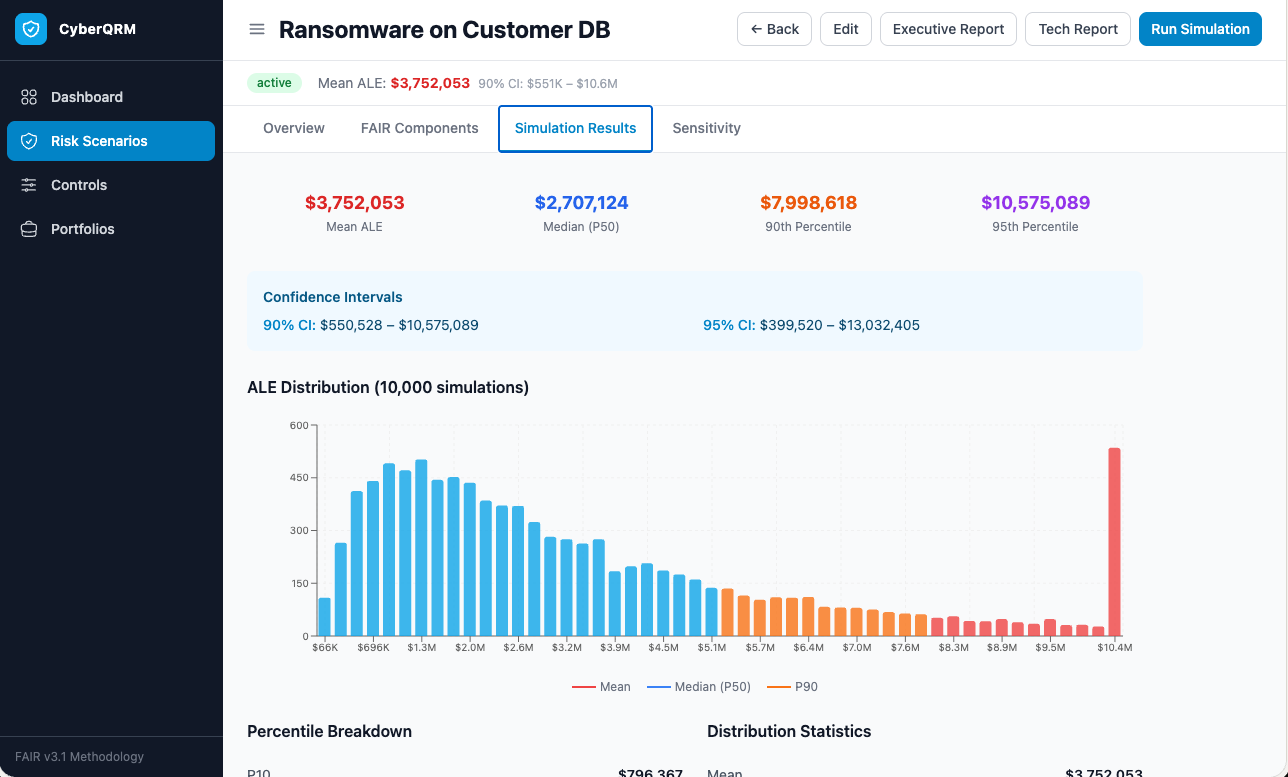
  • Annualised Loss Expectancy (ALE) analytics — mean, median, percentiles (P10–P99), and 90 %/95 % confidence intervals
  • Sensitivity / tornado charts — identify which FAIR components drive the most risk
  • Control effectiveness analysis — model current and proposed controls; calculate ALE reduction, ROI, and payback period
  • Portfolio management — aggregate multiple scenarios to understand organisation-wide risk
  • Persistent local storage — SQLite database, no data leaves your machine
Download Tool
  • Fully offline — no internet connection required after installation (ATT&CK dataset downloaded once at install time)

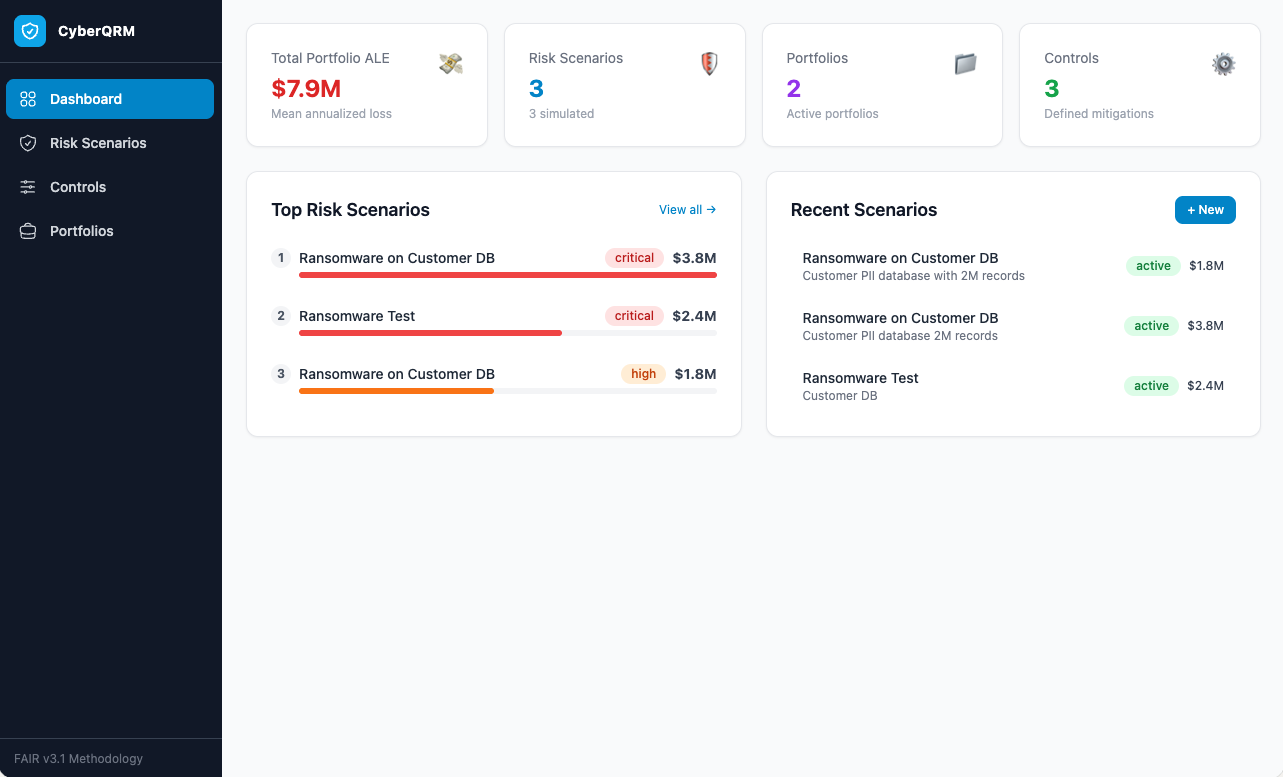
  • Screenshots

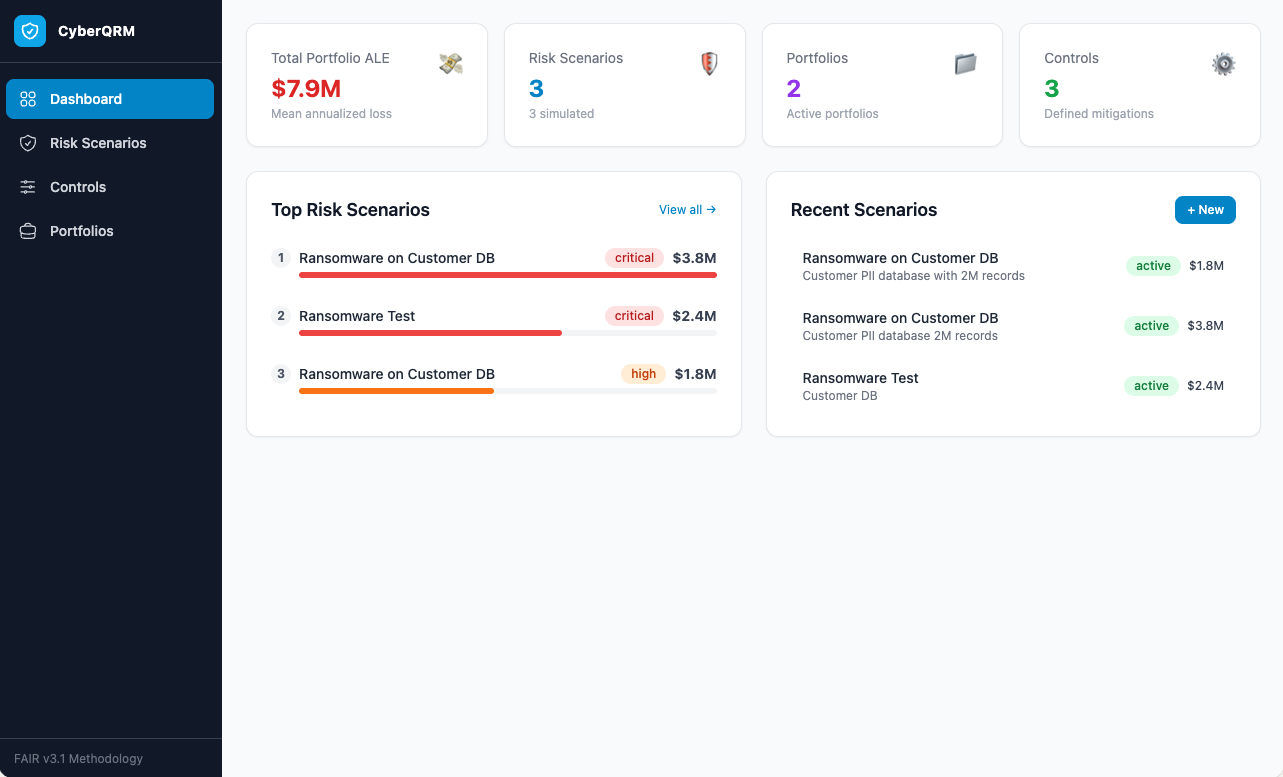
    Dashboard

    Simulation Results


    Prerequisites

    RequirementVersionNotes
    Node.js22.5 or laterUses the built-in node:sqlite module introduced in v22.5
    npmships with Node.jsNo separate install needed

    Installing Node.js

    • Official installer (recommended): nodejs.org/en/download — choose the "Current" or "LTS ≥ 22" release
    • macOS via Homebrew: brew install node
    • Any platform via nvm: nvm install 22 && nvm use 22
    • Windows via winget: winget install OpenJS.NodeJS

    Installation

    macOS / Linux

    root@kitploit:~
    # Clone the repository
    git clone https://github.com/iiamit/CyberQRM.git
    cd CyberQRM
    
    # Run the installer (checks Node version, installs all dependencies, downloads ATT&CK data)
    chmod +x install.sh
    ./install.sh
    

    Windows

    root@kitploit:~
    REM Clone the repository (Git Bash, PowerShell, or any terminal)
    git clone https://github.com/iiamit/CyberQRM.git
    cd CyberQRM
    
    REM Run the installer (double-click or run from a terminal)
    install.bat
    

    The installer will:

    1. Verify Node.js 22.5+ is present and print a helpful error if it isn't
    2. Install root, backend, and frontend npm dependencies
    3. Create the backend/data/ directory for the SQLite database
    4. Download the MITRE ATT&CK Enterprise dataset (~30 MB) — if the download fails the app still works; ATT&CK features will show "data unavailable" until the file is present

    Running the App

    macOS / Linux

    root@kitploit:~
    ./start.sh
    

    This opens two terminal windows (or background processes on Linux without a desktop) — one for the backend API and one for the frontend dev server — then opens your browser automatically.

    Windows

    root@kitploit:~
    start.bat
    

    Two console windows will open (backend and frontend). Your browser will open automatically after 5 seconds.

    Once running, access the app at:

    ServiceURL
    Frontendhttp://localhost:5173
    Backend APIhttp://localhost:3001
    Health checkhttp://localhost:3001/api/health

    If port 5173 is already in use, Vite will automatically switch to 5174.


    How It Works

    CyberQRM implements the FAIR v3.1 methodology in four steps:

    1. Define a scenario — name the asset, threat actor, and business context
    2. Set FAIR parameters — enter distributions for TEF, Vulnerability, Asset Value, and Loss Impact
    3. Run simulation — the engine samples each distribution 10,000 times and computes ALE
    4. Analyse results — review ALE percentiles, sensitivity drivers, and control ROI

    Advanced Scenario Modelling

    Multi-basis Asset Valuation — toggle "Advanced: use multiple valuation bases" on the Asset Value step to define separate distributions for each value dimension. The simulation sums all bases per iteration.

    Primary & Secondary Loss — toggle "Advanced: split into Primary & Secondary loss" on the Loss Impact step to model primary direct costs and secondary stakeholder-imposed costs (fines, reputational damage, competitive loss) with a conditional SLEF probability. All amounts are in absolute USD.

    MITRE ATT&CK — on the TEF and Vulnerability steps, open the technique browser to filter by tactic, search by name or ID, and select relevant techniques. The platform suggests TEF ranges based on real-world prevalence tiers (sourced from Red Canary / CTID sightings) and vulnerability ranges based on how many ATT&CK mitigations you have implemented.

    The database is created automatically on first run (backend/data/cyberqrm.db). All data stays on your local machine.


    Project Structure

    root@kitploit:~
    CyberQRM/
    ├── backend/               # Express.js + TypeScript API
    │   ├── src/
    │   │   ├── index.ts       # Server entry point (port 3001)
    │   │   ├── db/            # SQLite adapter, schema & migrations
    │   │   ├── routes/        # REST endpoints (scenarios, controls, portfolios, ATT&CK)
    │   │   ├── services/      # Business logic, Monte Carlo engine & ATT&CK service
    │   │   ├── data/          # attack-prevalence.json (bundled TEF tier data)
    │   │   └── middleware/    # Error handling
    │   └── data/              # SQLite database + ATT&CK STIX file (auto-created)
    ├── frontend/              # React 18 + Vite + TypeScript
    │   └── src/
    │       ├── pages/         # Dashboard, Scenarios, Controls, Portfolios
    │       ├── components/    # Charts, forms, UI primitives
    │       │   └── forms/     # ScenarioForm, AttackTechniqueSelector,
    │       │                  #   ValuationBasisList, PrimarySecondaryLossForm
    │       ├── store/         # Zustand state management
    │       └── utils/         # API client, formatting, report generator
    ├── shared/                # Shared TypeScript types (FAIR data model)
    ├── install.sh             # macOS/Linux installer
    ├── install.bat            # Windows installer
    ├── start.sh               # macOS/Linux launcher
    └── start.bat              # Windows launcher
    

    Tech Stack

    LayerTechnology
    Frontend frameworkReact 18, TypeScript, Vite
    StylingTailwind CSS
    State managementZustand, TanStack React Query
    ChartsRecharts
    Backend frameworkExpress.js, TypeScript
    DatabaseSQLite via Node.js built-in node:sqlite
    ValidationZod
    Threat intelligenceMITRE ATT&CK Enterprise (STIX 2.1)

    Development

    To work on the code with hot-reloading:

    root@kitploit:~
    # Install dependencies (if not done already)
    ./install.sh        # macOS/Linux
    install.bat         # Windows
    
    # Start both services with live reload
    npm run dev         # from the project root (requires npm-run-all)
    
    # Or start them individually
    npm run dev:backend
    npm run dev:frontend
    

    To build a production bundle:

    root@kitploit:~
    npm run build
    # Then run the compiled backend:
    cd backend && npm start
    # Serve frontend/dist with any static file server
    

    Contributing

    Contributions are welcome. Please open an issue first to discuss significant changes.

    1. Fork the repository
    2. Create a feature branch (git checkout -b feature/your-feature)
    3. Commit your changes
    4. Open a pull request

    License

    MIT — see LICENSE for details.


    Acknowledgements

    This project implements the FAIR™ (Factor Analysis of Information Risk) ontology. FAIR is a trademark of the FAIR Institute.

    ATT&CK® is a registered trademark of The MITRE Corporation. ATT&CK content is used under the ATT&CK Terms of Use.