 hxlxmj/cve-2022-3590-wordpress-vulnerability-scanner
This repository contains a Python script that checks WordPress websites for the CVE-2022-3590 vulnerability, which exploits an unauthenticated blind Server-Side Request Forgery (SSRF) in the WordPress pingback feature.

This Python script is designed to check whether a WordPress website is vulnerable to the CVE-2022-3590 vulnerability. The vulnerability exploits an unauthenticated blind Server-Side Request Forgery (SSRF) in the pingback feature of WordPress.
These instructions will guide you on how to use this script.
This script requires Python 3 and the requests library. You can install the necessary requirements using pip:
pip install -r requirements.txt
You can run the script from the command line with the following syntax:
python3 CVE-2022-3590.py [-u URL | -f FILE] [-d DOMAIN]
Here is what each argument does:
-u URL or --url URL: The URL of the WordPress website to check.-f FILE or --file FILE: A file containing a list of URLs of WordPress websites to check.-d DOMAIN or --domain DOMAIN: The domain controlled by the attacker.
(You can use public.requestbin.com or app.interactsh.com)To scan a single website:
python3 CVE-2022-3590.py -u https://example.com
To scan multiple websites from a file:
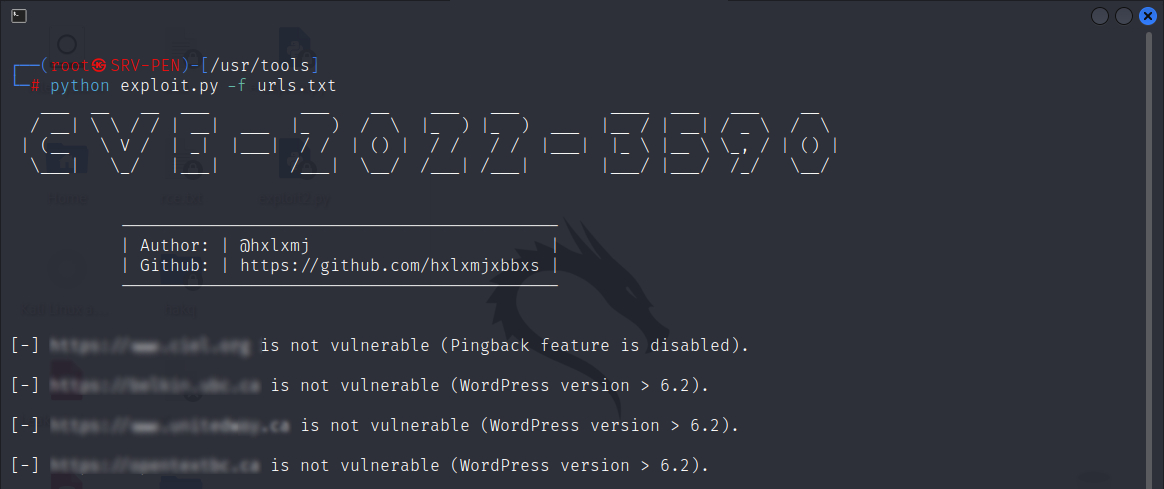
python3 CVE-2022-3590.py -f urls.txt
The script will output whether each scanned website is vulnerable to the CVE-2022-3590 vulnerability.
This project is licensed under the MIT License.
https://blog.sonarsource.com/wordpress-core-unauthenticated-blind-ssrf/
https://cve.mitre.org/cgi-bin/cvename.cgi?name=CVE-2023-2745
https://wpscan.com/vulnerability/c8814e6e-78b3-4f63-a1d3-6906a84c1f11
https://blog.sonarsource.com/wordpress-core-unauthenticated-blind-ssrf/
