
 ht0ruial/cve-2019-0708poc-batchscanning
Batch scanning tool for CVE-2019-0708 (BlueKeep) vulnerability detection on Windows systems, supporting single and multi-IP scanning with custom IP lists and output storage.

This batch detection is based on the public non-destructive detection tool from 360 (0708detector.exe), with the following functions:
双击0708detector-全自动批量版.exe即可使用!
Batch detection supports custom IP list to be scanned, and custom storage location for the set of vulnerable IPs.
A drawback of batch detection is that the thread count is 1, which makes it very slow when the target IP list is large. However, the advantage is that it is very easy to use – as long as the system is Windows, you can run it without installing anything.
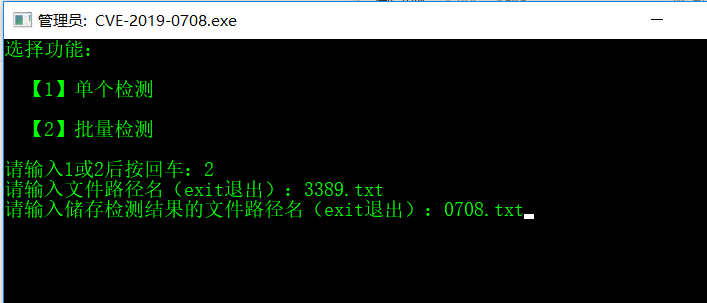
3389.txt and 0708.txt here are relative paths. You can also set your own file locations arbitrarily.
3389.txt is the list of IPs to be scanned.
The format is:
192.168.80.1
192.168.80.3
192.168.80.16
xxx.xx.xx.xxx
Just make sure each line contains one IP.
Sometimes we need to batch scan a subnet to check if hosts have this vulnerability. I personally prefer using msf's db_nmap to scan port 3389, then search -S open, copy the results and apply regex processing. That way, the IP list for scanning can be prepared very quickly.
