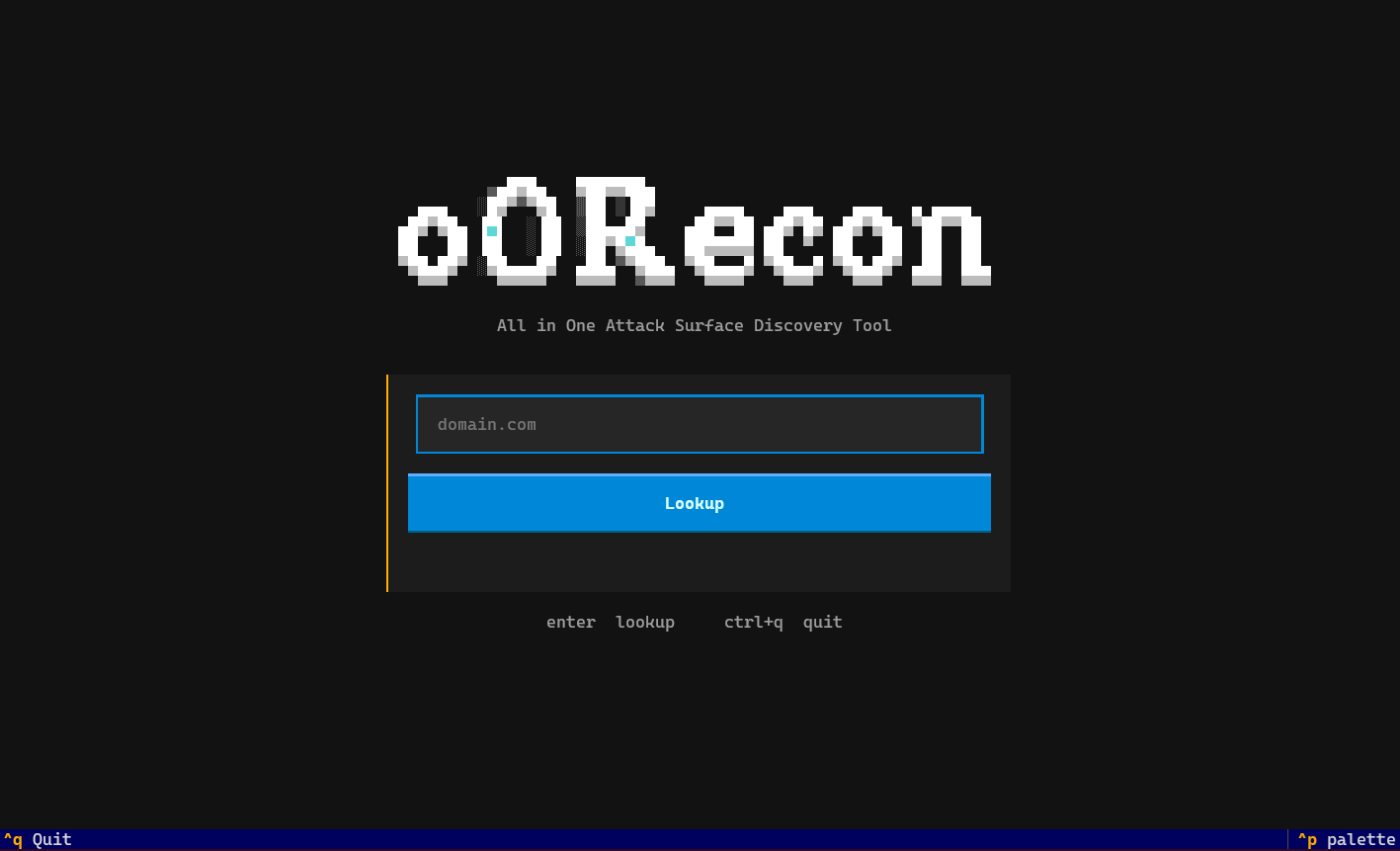


Terminal UI for attack surface discovery: DNS recon, subdomain enumeration, port scanning, reverse IP, leaked login URLs, and JavaScript secret mining.
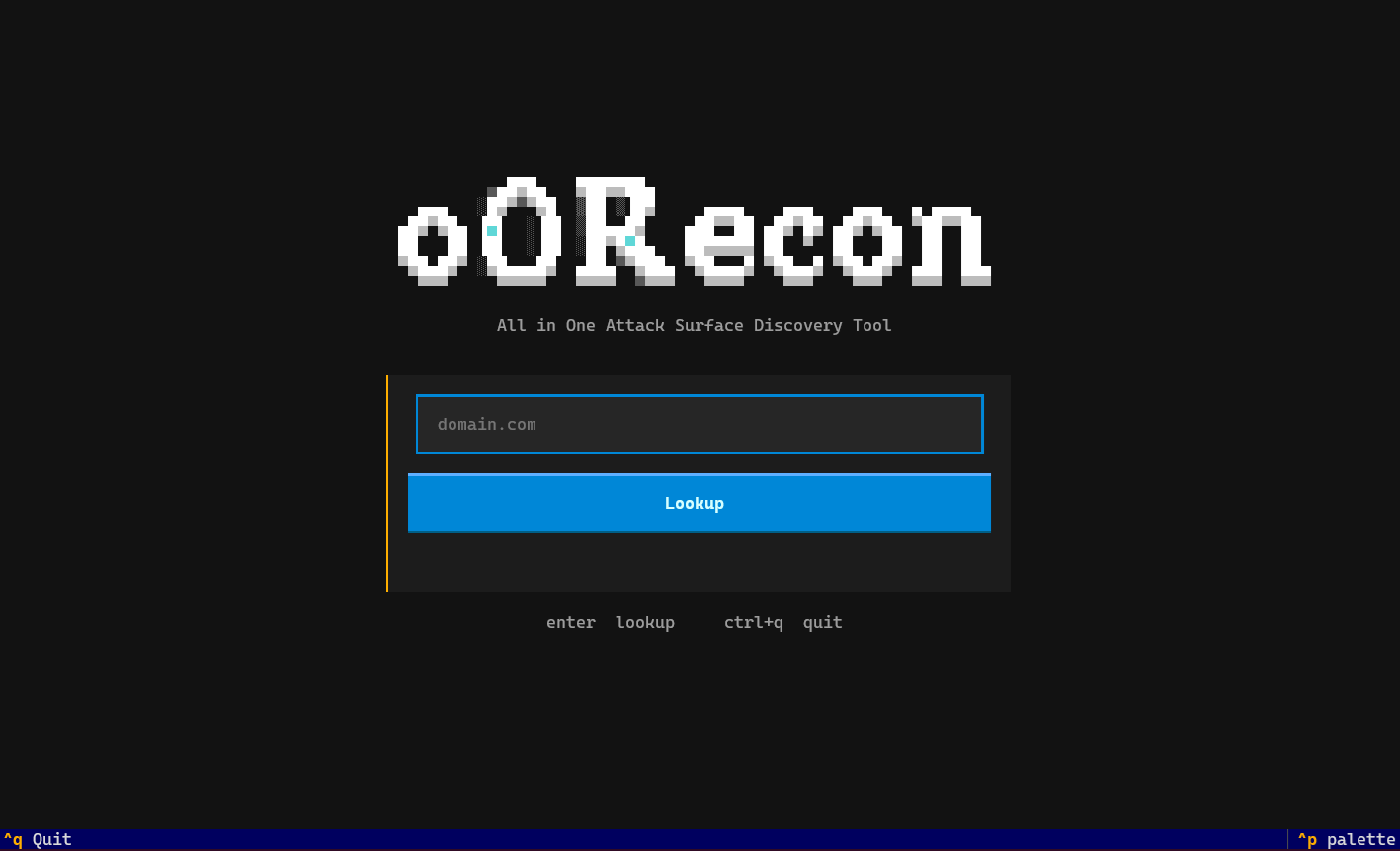
oORecon is an open-source Python terminal UI for web reconnaissance and attack surface discovery. It helps bug bounty hunters, penetration testers, and OSINT researchers map a domain quickly: DNS recon, subdomain enumeration, port scanning, reverse IP lookup, leaked login URLs, plus per-host sitemap, directory brute-force, and JavaScript endpoint / secret mining.
If you are looking for an all-in-one recon TUI instead of chaining many CLIs, oORecon runs the main checks one after another after you enter an apex domain.
This is AI slop. Every line was generated by an AI, and none of it was typed by hand — there wasn't time for that. Treat the code as machine output and use it anyway.
oORecon is a Textual-based TUI that turns a single domain into a live recon dashboard. On lookup it:
Open any live host to continue with content discovery (sitemaps, directories) and JavaScript analysis (endpoints, URLs, and likely secrets with neighbor context).
Domain input is normalized automatically: https://, paths, ports, and leading www. are stripped so you always work from the apex domain.
| Module | What it does |
|---|---|
| DNS recon | Resolve A, AAAA, NS, MX, SOA and related DNS records |
| Subdomain finder | Certificate-transparency names + HTTPS alive check (Chrome TLS impersonation) |
| Port scanner | Large port set against the target domain |
| Reverse IP lookup | Shared-host discovery from DNS A / AAAA |
| Leaked Login URL | Stealer-log style login / credential URLs (read-only) |
Shows the looked-up domain’s DNS surface in one board so you can see exposed IPs and mail/name infrastructure before scanning further.
Pulls certificate names for the apex, then checks each host over HTTPS. Filter by status class (2xx / 3xx / 4xx / 5xx / down) or by host prefix (mixrank.com matches only hosts that start with that string).
Runs a broad port pass on the domain you entered (not every subdomain) and lists open ports with service / banner detail.
Takes only the apex DNS A and AAAA addresses and looks up related certificate hostnames, then checks each one over HTTPS for status and Cloudflare. Does not fan out to every subdomain IP.
Lists leaked login-related URLs tied to the domain. The table is read-only (no click-through).
| Tool | What it does |
|---|---|
| Sitemap crawler | robots.txt + XML sitemaps (.xml / .xml.gz) |
| Directory brute-force | Content discovery with a SecLists-style wordlist |
| JS Miner | Endpoints and URLs from JavaScript; secret-like findings with match + neighbor context |
Discovers sitemap endpoints from robots and common paths, then follows nested sitemap indexes. Only confirmed XML sitemap URLs are shown.
Bruteforces common paths against the host. Useful for admin panels, backups, and forgotten endpoints.
Fetches page scripts, extracts URLs/endpoints, and scans script bodies for likely API keys and secrets. script / endpoint / url rows are list-only; other kinds open a detail window with the match and surrounding characters.
pip install -r requirements.txt
python main.py
Pass a domain on the CLI:
python main.py example.com
Requires: Python 3.10+
Controls: Ctrl+Q quit · Esc back · Enter open host / secret detail · / filter subdomains
main.py                 Entrypoint
ui/app.py               Recon dashboard (lookup order lives here)
ui/phases/              DNS, reverse IP, leaked URLs, ports, subdomains
ui/workspace.py         Per-host sitemap / dirs / JS miner
ui/styles.py            Dashboard CSS
ui/format.py            DNS board and status cell rendering
models.py               Shared result models
utils.py                Domain normalize, curl_cffi thread sessions
tools/                  One module per recon tool (dnsinfo, certsub, ports, …)
requirements.txt        Python dependencies
assets/                 Banner, demo GIF, and banner.ans
