
Skip to content
KitploitKITPLOIT
ToolsBlog
Submit
ToolsBlog
Submit

Hacking, PenTest, and Cybersecurity Tools for Your Security Arsenal!

Kitploit is a directory of hacking, cybersecurity, and pentesting tools. Discover the latest project updates to find vulnerabilities, analyze systems, automate testing, and strengthen your security.

··Feeds·Contact·Privacy·© 2026 Kitploit

Tool Directory

Categories

View all categories
Loading categories
iTop-CVEs-exploit — This repository contains exploits for iTOP CVE-2024-52002, 52000, 31998, 31448 that involve CSRF+XSS chaining to get RCE | Kitploit
Tools/GitHubGitHub/harshit-mashru/itop-cves-exploit
Phishing ToolsVulnerability AnalysisExploitationWeb Application ExploitationPenetration TestingLearning & Education
GitHubharshit-mashru/itop-cves-exploit

iTop-CVEs-exploit

This repository contains exploits for iTOP CVE-2024-52002, 52000, 31998, 31448 that involve CSRF+XSS chaining to get RCE

View Repository
1 year agoNot yet reviewed

Most Popular

View all →

Discover the most used tools by our community.

Explore all tools

Browse our collection of tools

View all tools →
Share

iTop-CVEs-exploit

This repository contains exploits for iTOP CVE-2024-52002, 52000, 31998, 31448 that involve CSRF+XSS chaining to get admin privileges on the software.

Set up

  1. Download the vulnerable iTOP version from docker
root@kitploit:~
sudo docker run -d -p 8090:80 --name=my-itop2 vbkunin/itop:3.1.1 
  1. Navigate to localhost:8090 and perform the standard installation
  2. Use the command below to get the password
root@kitploit:~
sudo docker logs my-itop2 | grep -A7 -B1 "Your MySQL user 'admin' has password"
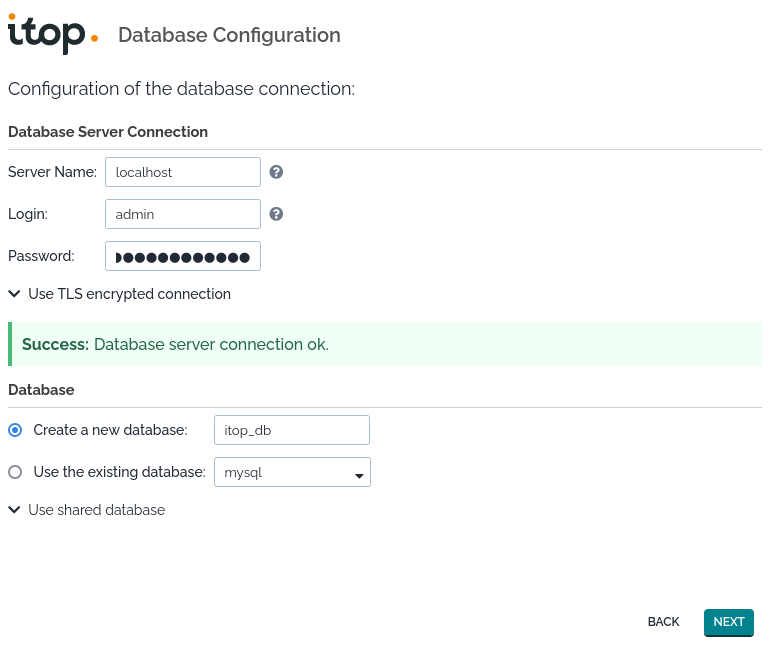
image It should look something like this

  1. Now continue with standard installation steps
  2. This will conclude the set up phase and now you can enter iTOP image

Exploitation

Feel free to explore the iTOP software.

As an attacker the most valuable thing would be to get access to the software remotely via admin login located at http://localhost:8090/pages/UI.php?c%5Bmenu%5D=UserAccountsMenu

XSS

Let's start by testing XSS exploit, you can use the xss.csv in this github repo to test this.

  1. Navigate to http://localhost:8090/pages/csvimport.php?c%5Bmenu%5D=CSVImport
  2. Click on Select a File and upload the xss.csv
  3. Continue with standard options till Step 3
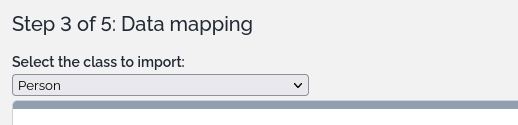
  4. On Step 3 select Person as the import type image
  5. Clicking on Simulate the import we can see the XSS image

  6. This proves the presence of XSS.
  7. This alone doesn't have a lot of value we will come back to this.

CSRF

Let's explore CSRF as the CVE pages tell us that there are CSRF on multiple pages. Both CSRF & XSS alone don't give us much but together we could do something to eventually create an admin account.

  1. Let's perform a simple test, looking at burpsuite for all the parameters, we will create a simple test html file and host it on python server. (first_step_import_data.html) python3 -m http.server 9001
  2. This file exploits the CSRF and XSS from above to alert us with the CSRF token required to complete the import task.
  3. We explored that this token is not tied to any action, so we receive this token, we can make the user complete some other operation by getting the token from XSS vulnerable page.
  4. When you host the html file above and click on it as a logged in user, you will see that the token is alerted in the browser.
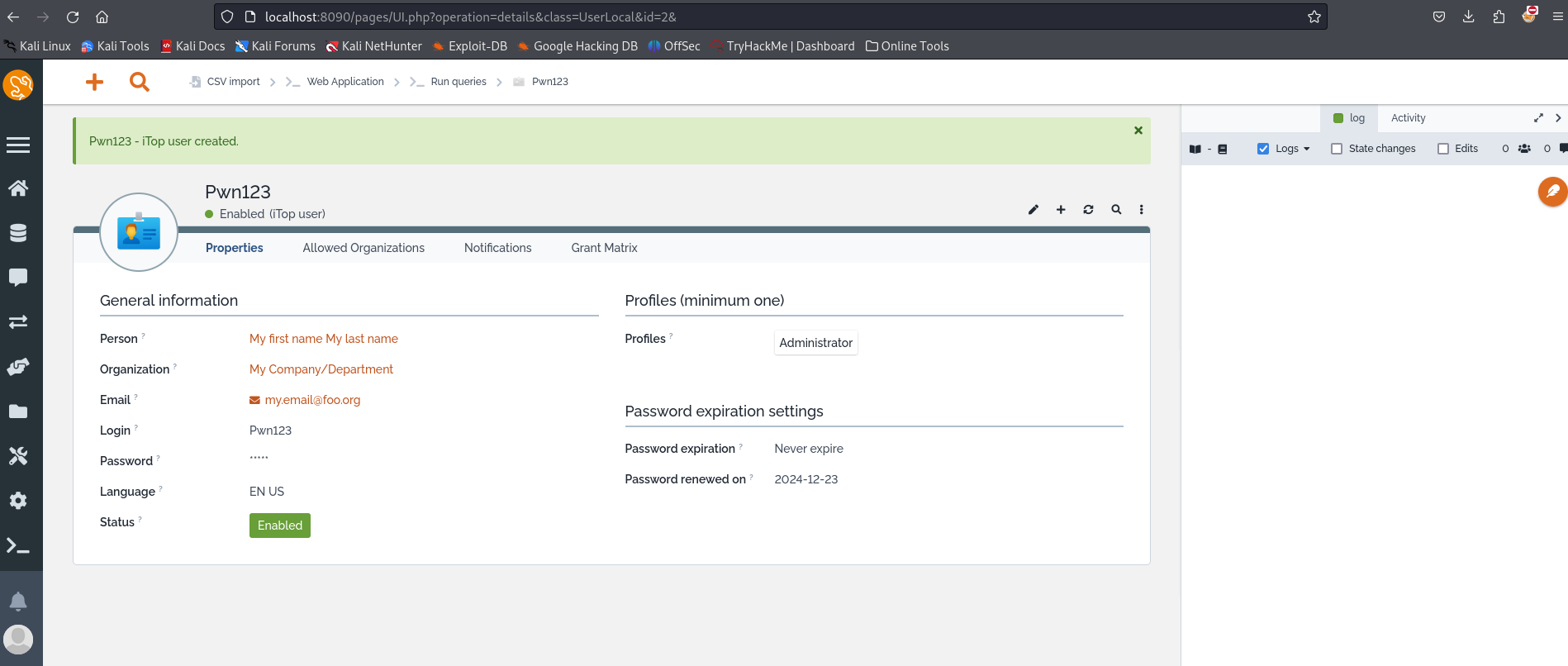
  5. We shall now tweak this exploit to call our server with the token which will be then chained to the other part of the exploit where it will be used to create a user. first_step_add_user.html and last_step_add_user.html
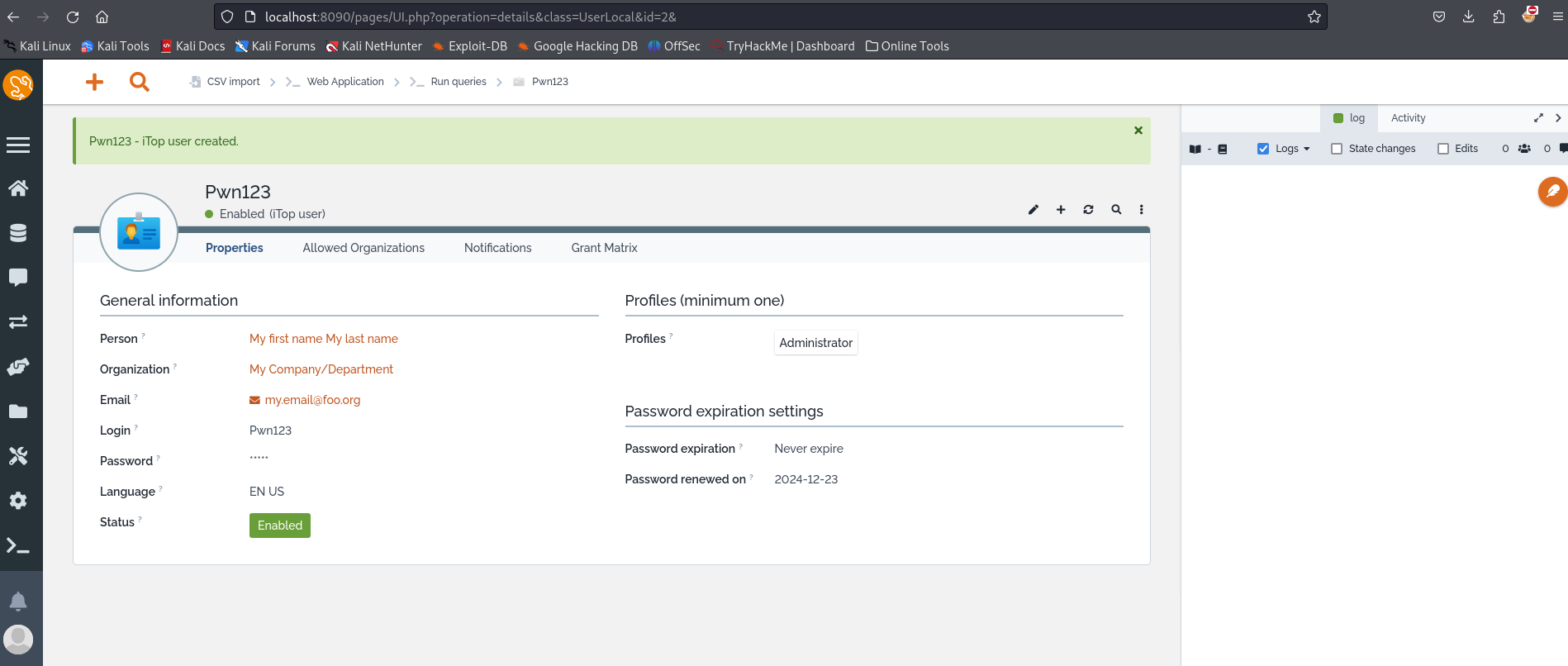
image

We can see that when user clicks on the link first_step_add_user.html it first uses the CSRF+XSS to get the action token and then uses that to create the user by chaining. Essentially it becomes CSRF+XSS+CSRF

The vulnerable link can be sent to the user using a sample phishing email added in the github repo.

References

  • https://nvd.nist.gov/vuln/detail/cve-2024-52002
  • https://nvd.nist.gov/vuln/detail/cve-2024-52000
  • https://nvd.nist.gov/vuln/detail/CVE-2024-31998
  • https://nvd.nist.gov/vuln/detail/CVE-2024-31448
  • https://owasp.org/www-community/HttpOnly
  • https://bugbase.ai/blog/how-to-bypass-csrf-protection
  • https://medium.com/sessionstack-blog/how-javascript-works-5-types-of-xss-attacks-tips-on-preventing-them-e6e28327748a
  • https://www.sitepoint.com/get-url-parameters-with-javascript/
  • https://portswigger.net/web-security/csrf#how-to-construct-a-csrf-attack
  • https://developer.mozilla.org/en-US/docs/Web/HTTP/CORS
Download Tool