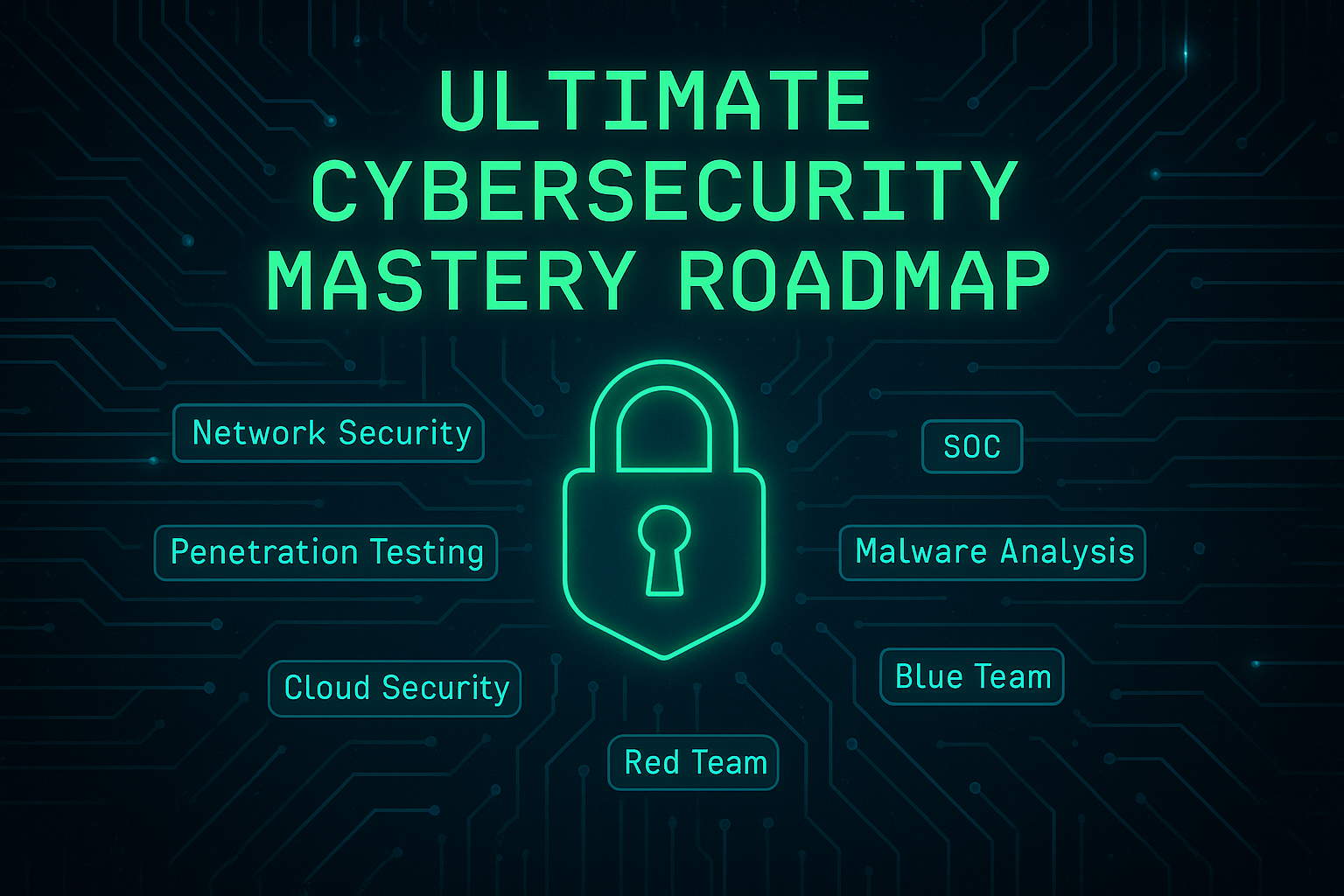
Cybersecurity-Mastery-Roadmap — A comprehensive, step-by-step guide to mastering cybersecurity from beginner to expert level with curated resources, tools, and career guidance | Kitploit
cybersecurity-mastery-roadmap
hamed233/cybersecurity-mastery-roadmap Cybersecurity-Mastery-Roadmap A comprehensive, step-by-step guide to mastering cybersecurity from beginner to expert level with curated resources, tools, and career guidance
3.2k 455 28 days agoDiscover the most used tools by our community.
Last 7 Days Last 30 Days
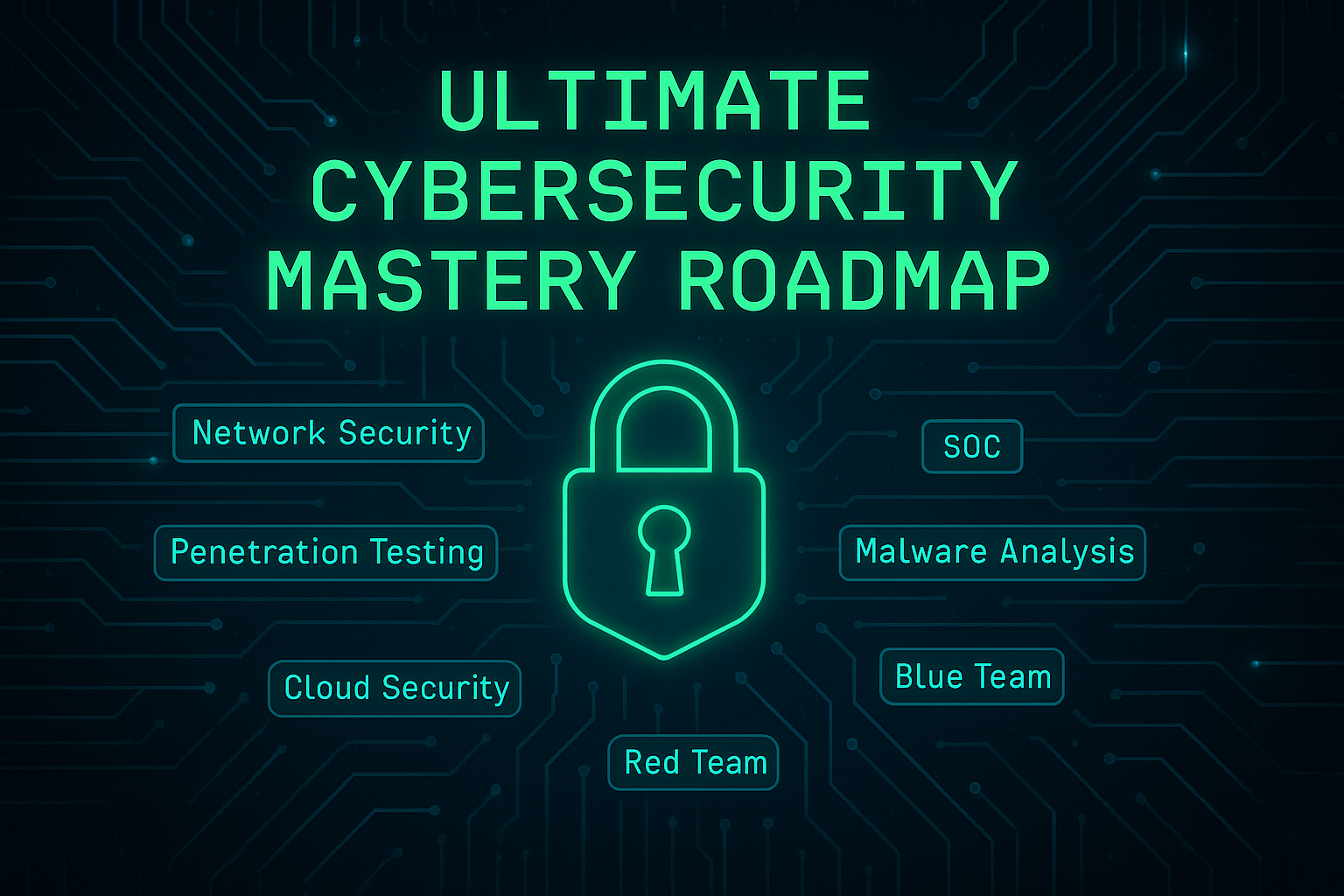
🛡️ Ultimate Cybersecurity Mastery Roadmap
A comprehensive, step-by-step guide to mastering cybersecurity from beginner to expert level with curated resources, tools, and career guidance
📋 Table of Contents
Introduction
Welcome to the Ultimate Cybersecurity Mastery Roadmap! This comprehensive guide is designed to help you navigate the complex world of cybersecurity, providing a clear path from beginner to expert level. Whether you're just starting your journey or looking to advance your existing skills, this roadmap will guide you through the essential knowledge, skills, and certifications needed to succeed in the cybersecurity field.
Cybersecurity is a vast and rapidly evolving field that requires continuous learning and adaptation. This roadmap is designed to provide structure to your learning journey, helping you build a solid foundation before moving on to more specialized areas.
How to Use This Roadmap This roadmap is divided into phases, each building upon the previous one. For each topic, you'll find:
Description : Brief explanation of the topic
Learning Resources : Recommended courses, books, tutorials, and videos
Practical Exercises : Hands-on activities to reinforce your learning
Milestones : Key indicators that you've mastered the topic
Tools : Relevant tools to practice with
Progress through each phase sequentially, but feel free to dive deeper into topics that interest you or are relevant to your career goals. Remember that practical experience is crucial in cybersecurity, so make sure to supplement your theoretical knowledge with hands-on practice.
Roadmap Overview
Learning Path Progression
Foundation Phase - Build core knowledge in computing, networking, and basic security principles
Technical Skills Phase - Develop practical security skills across various domains
Specialization Phase - Focus on offensive or defensive security specializations
Advanced Phase - Master advanced topics and specialized security domains
Professional Development - Continuous learning and career advancement
Foundation Phase
1. Computer Fundamentals
Operating Systems
Networking Basics
Programming Fundamentals
Linux Fundamentals
Technical Skills Phase
4. Network Security
5. System Security
6. Web Application Security
Specialization Phase
7. Offensive Security
8. Defensive Security
9. Cloud Security
Advanced Phase
10. Advanced Topics
11. Specialized Security Domains
Professional Development
12. Career Development
Learning Resources
Books
Beginner
"Cybersecurity for Beginners" by Raef Meeuwisse
"The Art of Invisibility" by Kevin Mitnick
"Social Engineering: The Science of Human Hacking" by Christopher Hadnagy
"Practical Malware Analysis" by Michael Sikorski and Andrew Honig
"Cryptography for Dummies" by Chey Cobb
"Computer Security: Principles and Practice" by William Stallings and Lawrie Brown
"Network Security Essentials" by William Stallings
Intermediate
"The Web Application Hacker's Handbook" by Dafydd Stuttard and Marcus Pinto
"Blue Team Handbook" by Don Murdoch
"Penetration Testing: A Hands-On Introduction to Hacking" by Georgia Weidman
"The Tangled Web: A Guide to Securing Modern Web Applications" by Michal Zalewski
"Threat Modeling: Designing for Security" by Adam Shostack
"Reversing: Secrets of Reverse Engineering" by Eldad Eilam
"The Hacker Playbook 3" by Peter Kim
Advanced
"The Art of Memory Forensics" by Michael Hale Ligh et al.
"Gray Hat Hacking: The Ethical Hacker's Handbook" by Allen Harper et al.
"The Shellcoder's Handbook" by Chris Anley et al.
"Practical Reverse Engineering" by Bruce Dang et al.
"Advanced Penetration Testing" by Wil Allsopp
"Black Hat Python" by Justin Seitz
"Windows Internals" by Mark Russinovich et al.
Specialized
"Cloud Security: A Comprehensive Guide" by Chris Dotson
"Industrial Network Security" by Eric D. Knapp and Joel Thomas Langill
"iOS Application Security" by David Thiel
"Android Security Internals" by Nikolay Elenkov
"Container Security" by Liz Rice
"Applied Cryptography" by Bruce Schneier
"Intelligence-Driven Incident Response" by Scott J. Roberts and Rebekah Brown
Learning Platforms
Practice Environments
YouTube Channels
Nmap - Network discovery and security auditing
Shodan - Search engine for Internet-connected devices
Recon-ng - Web reconnaissance framework
theHarvester - Email, subdomain and name harvester
Maltego - Open source intelligence and forensics
SpiderFoot - OSINT automation tool
Amass - In-depth attack surface mapping and asset discovery
Sublist3r - Subdomain enumeration tool
OWASP Maryam - Open-source intelligence framework
Vulnerability Assessment
OpenVAS - Open-source vulnerability scanner
Nessus - Vulnerability scanner
Nikto - Web server scanner
Qualys - Cloud-based security and compliance
Nexpose - Vulnerability management
Acunetix - Web vulnerability scanner
Netsparker - Web application security scanner
Nuclei - Vulnerability scanner based on templates
Vulners Scanner - NSE script using Vulners.com API
Web Application Security
Burp Suite - Web vulnerability scanner and proxy
OWASP ZAP - Web application security scanner
Sqlmap - Automatic SQL injection tool
Wfuzz - Web application fuzzer
Dirsearch - Web path scanner
Nikto - Web server scanner
Skipfish - Active web application security reconnaissance tool
w3af - Web Application Attack and Audit Framework
Arachni - Web application security scanner framework
Exploitation
Metasploit - Penetration testing framework
BeEF - Browser Exploitation Framework
Empire - Post-exploitation framework
Cobalt Strike - Adversary simulation software
PowerSploit - PowerShell post-exploitation framework
Pupy - Cross-platform remote administration and post-exploitation tool
Covenant - .NET command and control framework
Sliver - Cross-platform adversary emulation framework
Password Attacks
Forensics & Incident Response
Wireshark - Network protocol analyzer
Snort - Intrusion detection system
OSSEC - Host-based intrusion detection
Wazuh - Security monitoring solution
Security Onion - Security monitoring platform
Suricata - Network IDS/IPS
Zeek - Network security monitor
Sysmon - Windows system monitoring
YARA - Pattern matching for malware detection
Cloud Security
Mobile Security
MobSF - Mobile security testing framework
Frida - Dynamic instrumentation toolkit
Objection - Mobile runtime exploration
Drozer - Android security assessment
QARK - Android app vulnerability scanner
idb - iOS app security assessment tool
Needle - iOS security testing framework
Apktool - Android APK reverse engineering
Jadx - Dex to Java decompiler
Certifications Guide
Entry-Level Certifications
CompTIA Security+ - Foundational cybersecurity certification
Focus Areas : Network security, threats and vulnerabilities, identity management, cryptography
Prerequisites : None, but Network+ and 2 years of experience recommended
Exam Format : 90 questions, 90 minutes, performance-based and multiple choice
Validity : 3 years, renewable with continuing education
Career Paths : Security specialist, security administrator, security consultant
CompTIA Network+ - Networking fundamentals
Focus Areas : Network concepts, infrastructure, operations, security, troubleshooting
Prerequisites : None, but A+ and 9-12 months of experience recommended
Exam Format : 90 questions, 90 minutes, performance-based and multiple choice
Validity : 3 years, renewable with continuing education
Career Paths : Network administrator, network technician, help desk technician
CompTIA A+ - IT fundamentals
Focus Areas : Hardware, operating systems, software troubleshooting, networking, security
Prerequisites : None, but 9-12 months of experience recommended
Exam Format : Two exams: Core 1 and Core 2, 90 minutes each
Validity : 3 years, renewable with continuing education
Career Paths : Help desk technician, desktop support analyst, field service technician
Certified Information Systems Security Professional (CISSP) Associate - Entry-level version of CISSP
Focus Areas : Same as CISSP but for those without the required experience
Prerequisites : Pass the CISSP exam but have less than 5 years of experience
Exam Format : Same as CISSP
Validity : Indefinite until requirements for full CISSP are met
Career Paths : Stepping stone to security analyst, security consultant roles
CompTIA CySA+ - Cybersecurity analyst
Focus Areas : Threat detection, security monitoring, incident response, vulnerability management
Prerequisites : Network+ and Security+ recommended, 4+ years of experience
Exam Format : 85 questions, 165 minutes, performance-based and multiple choice
Validity : 3 years, renewable with continuing education
Career Paths : Security analyst, threat intelligence analyst, security operations center (SOC) analyst
CompTIA PenTest+ - Penetration testing
Focus Areas : Planning and scoping, information gathering, vulnerability identification, attacks and exploits, reporting
Prerequisites : Network+ and Security+ recommended, 3+ years of experience
Exam Format : 85 questions, 165 minutes, performance-based and multiple choice
Validity : 3 years, renewable with continuing education
Career Paths : Penetration tester, vulnerability assessment analyst, security consultant
Certified Ethical Hacker (CEH) - Ethical hacking and countermeasures
Focus Areas : Ethical hacking methodology, tools, techniques, countermeasures
Prerequisites : 2 years of experience or official training
Exam Format : 125 questions, 4 hours, multiple choice
Validity : 3 years, renewable with continuing education
Career Paths : Ethical hacker, security analyst, penetration tester
GIAC Security Essentials (GSEC) - Security essentials
Focus Areas : Security administration, risk management, cryptography, access controls
Prerequisites : None
Exam Format : 180 questions, 5 hours, multiple choice and performance-based
Validity : 4 years, renewable with continuing education
Career Paths : Security administrator, security analyst, security engineer
Advanced Certifications
Offensive Security Certified Professional (OSCP) - Penetration testing with Kali Linux
Focus Areas : Hands-on penetration testing, exploitation, privilege escalation
Prerequisites : Strong understanding of networking, Linux, and scripting
Exam Format : 24-hour practical exam with report submission
Validity : Lifetime
Career Paths : Penetration tester, red team operator, security consultant
Certified Information Systems Security Professional (CISSP) - Security management
Focus Areas : Security and risk management, asset security, security architecture, network security, identity management, security assessment, security operations, software development security
Prerequisites : 5 years of experience in at least 2 domains
Exam Format : 100-150 questions, 3 hours, adaptive testing
Validity : 3 years, renewable with continuing education
Career Paths : Security manager, security architect, CISO, security consultant
Certified Information Security Manager (CISM) - Information security management
Focus Areas : Information security governance, risk management, program development, incident management
Prerequisites : 5 years of experience in information security management
Exam Format : 150 questions, 4 hours, multiple choice
Validity : 3 years, renewable with continuing education
Career Paths : Security manager, security director, CISO
GIAC Certified Incident Handler (GCIH) - Incident handling
Focus Areas : Incident handling process, computer crime investigation, hacker techniques
Prerequisites : None
Exam Format : 115 questions, 3 hours, multiple choice
Validity : 4 years, renewable with continuing education
Career Paths : Incident responder, SOC analyst, security analyst
Specialized Certifications
Certified Cloud Security Professional (CCSP) - Cloud security
Focus Areas : Cloud concepts, architecture, design, security, operations, legal compliance
Prerequisites : 5 years of IT experience, 3 years in security, 1 year in cloud security
Exam Format : 125 questions, 3 hours, multiple choice
Validity : 3 years, renewable with continuing education
Career Paths : Cloud security architect, cloud security engineer, cloud security manager
GIAC Certified Forensic Analyst (GCFA) - Digital forensics
Focus Areas : Digital forensics techniques, incident response, malware analysis
Prerequisites : None
Exam Format : 115 questions, 3 hours, multiple choice
Validity : 4 years, renewable with continuing education
Career Paths : Digital forensic analyst, incident responder, malware analyst
Offensive Security Certified Expert (OSCE) - Advanced penetration testing
Focus Areas : Advanced exploitation techniques, custom exploit development
Prerequisites : OSCP recommended
Exam Format : 48-hour practical exam with report submission
Validity : Lifetime
Career Paths : Advanced penetration tester, exploit developer, security researcher
Certified Information Systems Auditor (CISA) - Information systems auditing
Focus Areas : IS audit process, governance, systems acquisition, operations, protection of assets
Prerequisites : 5 years of experience in IS audit, control, or security
Exam Format : 150 questions, 4 hours, multiple choice
Validity : 3 years, renewable with continuing education
Career Paths : IS auditor, IT audit manager, compliance officer
Career Paths
Defensive Roles
Security Analyst
Responsibilities : Monitor and analyze security alerts, implement security measures, conduct vulnerability assessments
Skills Required : Network security, security tools, vulnerability assessment, incident response
Certifications : CompTIA Security+, CySA+, GIAC GSEC
Career Progression : Senior Security Analyst → Security Engineer → Security Architect
Security Engineer
Responsibilities : Design and implement security solutions, manage security infrastructure, conduct security assessments
Skills Required : Network security, security architecture, security tools, scripting
Certifications : CISSP, GIAC GSEC, CEH
Career Progression : Senior Security Engineer → Security Architect → CISO
SOC Analyst
Responsibilities : Monitor security events, analyze alerts, respond to incidents, maintain security tools
Skills Required : SIEM tools, incident response, network security, log analysis
Certifications : CompTIA Security+, CySA+, GCIH
Career Progression : SOC Analyst Level 2 → SOC Analyst Level 3 → SOC Manager
Incident Responder
Responsibilities : Investigate and remediate security incidents, develop incident response plans, conduct forensic analysis
Skills Required : Digital forensics, malware analysis, incident response, threat hunting
Certifications : GCIH, GCFA, GREM
Career Progression : Senior Incident Responder → Incident Response Manager → Security Director
Security Architect
Responsibilities : Design secure systems and networks, develop security standards, evaluate security solutions
Skills Required : Security architecture, risk assessment, compliance, technical leadership
Certifications : CISSP, CISM, SABSA
Career Progression : Senior Security Architect → Security Director → CISO
Offensive Roles
Penetration Tester
Responsibilities : Test systems for vulnerabilities through simulated attacks, document findings, recommend remediation
Skills Required : Ethical hacking, exploitation, scripting, report writing
Certifications : OSCP, CEH, PenTest+
Career Progression : Senior Penetration Tester → Red Team Lead → Security Consultant
Red Team Operator
Responsibilities : Simulate advanced adversaries to test defenses, develop custom tools, conduct long-term engagements
Skills Required : Advanced exploitation, social engineering, evasion techniques, custom tool development
Certifications : OSCP, OSCE, GXPN
Career Progression : Senior Red Team Operator → Red Team Lead → Director of Offensive Security
Vulnerability Researcher
Responsibilities : Discover and analyze new vulnerabilities, develop proof-of-concept exploits, research security weaknesses
Skills Required : Reverse engineering, exploit development, programming, vulnerability analysis
Certifications : OSCE, GXPN, OSEE
Career Progression : Senior Vulnerability Researcher → Security Research Lead → Security Director
Exploit Developer
Responsibilities : Develop exploits for vulnerabilities, create custom attack tools, research exploitation techniques
Skills Required : Advanced programming, reverse engineering, exploit development, assembly language
Certifications : OSCE, OSEE, GXPN
Career Progression : Senior Exploit Developer → Research Lead → Security Director
Management Roles
Chief Information Security Officer (CISO)
Responsibilities : Executive responsible for an organization's security strategy, policies, and programs
Skills Required : Leadership, risk management, security governance, business acumen, communication
Certifications : CISSP, CISM, CGEIT
Career Progression : Terminal position, may move to larger organizations or consulting
Security Manager
Responsibilities : Manage security teams and operations, implement security policies, oversee security projects
Skills Required : Team management, security operations, project management, risk assessment
Certifications : CISSP, CISM, PMP
Career Progression : Security Director → CISO
Security Consultant
Responsibilities : Advise organizations on security matters, conduct assessments, develop security strategies
Skills Required : Security assessment, consulting, communication, technical expertise
Certifications : CISSP, CISA, CISM
Career Progression : Senior Consultant → Principal Consultant → Practice Lead
GRC (Governance, Risk, Compliance) Specialist
Responsibilities : Ensure compliance with regulations and standards, conduct risk assessments, develop security policies
Skills Required : Compliance frameworks, risk assessment, policy development, auditing
Certifications : CISA, CRISC, CISM
Career Progression : GRC Manager → Director of Compliance → CISO
Specialized Roles
Cybersecurity Communities
Online Communities
Professional Organizations
ISACA - Information Systems Audit and Control Association
(ISC)² - International Information System Security Certification Consortium
ISSA - Information Systems Security Association
SANS - SysAdmin, Audit, Network, and Security Institute
EC-Council - International Council of E-Commerce Consultants
CompTIA - Computing Technology Industry Association
CSA - Cloud Security Alliance
FIRST - Forum of Incident Response and Security Teams
Women in Cybersecurity (WiCyS) - Organization for women in cybersecurity
Conferences
Capture The Flag (CTF) Competitions
Beginner-Friendly CTFs
Advanced CTFs
DEF CON CTF - One of the oldest and most prestigious CTFs
CSAW CTF - CTF competition by NYU Tandon School of Engineering
PlaidCTF - Annual CTF by Plaid Parliament of Pwning
HITCON CTF - Hacks In Taiwan Conference CTF
Dragon CTF - CTF by Dragon Sector team
RuCTF - Russian CTF
0CTF/TCTF - International CTF competition
Hack.lu CTF - CTF during the Hack.lu conference
CTF Resources
Cybersecurity Labs and Practice Environments
Online Practice Environments
Building Your Own Lab
Virtualization Platforms
Vulnerable Systems
Attack Platforms
Network Simulation
Lab Guides and Resources
Security Research Resources
Vulnerability Databases
Security Blogs and News
Research Papers and Publications
Shodan - Search engine for Internet-connected devices
Censys - Search engine for Internet-connected devices
VirusTotal - Analyze suspicious files and URLs
Any.Run - Interactive malware analysis
Hybrid Analysis - Free malware analysis service
Cuckoo Sandbox - Automated malware analysis
MITRE ATT&CK - Knowledge base of adversary tactics and techniques
OWASP - Open Web Application Security Project resources
Contributing Contributions to this roadmap are welcome! Please feel free to submit a pull request or open an issue if you have suggestions for improvements or additions.
Fork the repository
Create your resource branch (git checkout -b resource/new_tool)
Commit your changes (git commit -m 'Add some resources')
Push to the branch (git push origin resource/new_tool)
Open a Pull Request
"Security is a process, not a product." - Bruce Schneier
"The only truly secure system is one that is powered off, cast in a block of concrete and sealed in a lead-lined room with armed guards." - Gene Spafford
Made with ❤️ by Hamed Esam