hahwul/gori
A fast, keyboard-driven HTTP intercepting proxy and hacking & pentesting toolkit for the terminal.

Hack from the terminal.



Installation • Usage • Documentation • Contributing
gori (고리 — Korean for ring, link, loop) sits in the loop between your client and its target,
capturing every request and response as a flow you can replay, fuzz, and scan across HTTP/1.1,
HTTP/2, WebSocket, gRPC, and SSE, and intercept in flight on HTTP/1.1 and HTTP/2. Core assessment
actions that cross surfaces use the same engines, and those workflows are also
available through gori run and MCP, so scripts and AI agents can drive the same engagement.
The capability matrix names the protocol and
surface limits explicitly.
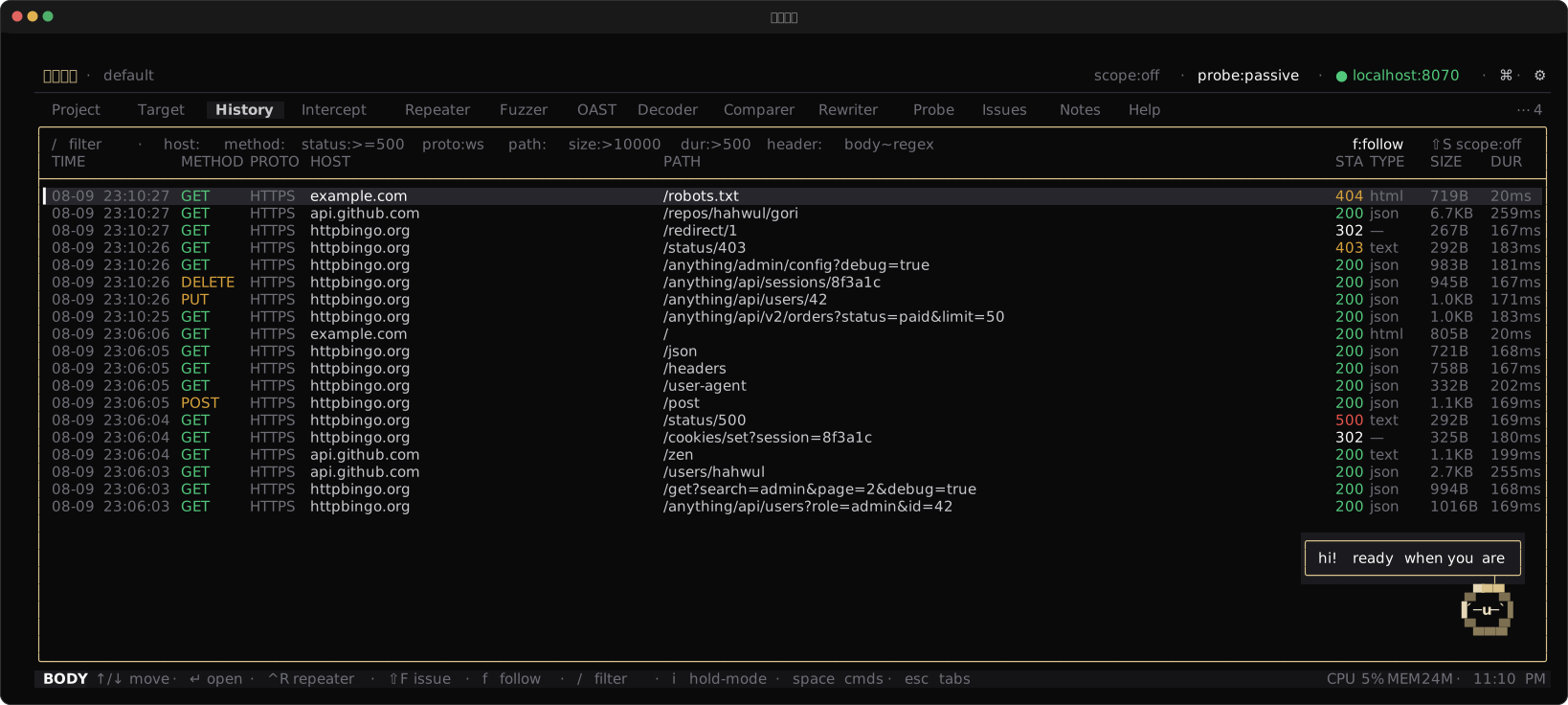
proto:wsfetch, Go, httpie, or a CSRF PoCCtrl-P) and context space menu (Space) reach every actiongori run exposes the core project and testing workflows for non-interactive usegori mcp) exposes those workflows to AI agents (it does not start a capture proxy)curl -fsSL https://gori.hahwul.com/install.sh | bash
Then update later with gori update (self-update for binary installs; package-manager guidance for Homebrew / Snap / AUR).
brew tap hahwul/gori
brew install gori
The repo is a flake, so it runs without being installed:
nix run github:hahwul/gori
nix profile install github:hahwul/gori   # or keep it
Requires Crystal >= 1.21.0 and pkg-config.
git clone https://github.com/hahwul/gori.git
cd gori
shards build --release
The binary is written to bin/gori.
For system libraries (Brotli / Zstd), offline builds, and other options, see the Installation guide.
gori runs one engine and one project behind three entry points. Drive it yourself, hand it to an AI agent, or script it, and pick the one that fits who is at the controls.
gori (TUI)Start the proxy and open the interactive terminal UI. No subcommand needed:
gori
The proxy listens on 127.0.0.1:8070 by default, and a short first-run wizard picks the
global default bind and theme (projects can pin their own later). To intercept HTTPS, trust
gori's root CA. The quickest path is the palette's Open browser (Ctrl-P), which launches a
browser already trusted and proxied. Captured traffic lands in History; press Ctrl-P for the
command palette or Space for context actions.
gori --listen 0.0.0.0 --port 8080 # global bind for this run only (not persisted)
gori mcp (MCP server)gori mcp is a Model Context Protocol server. An AI client
spawns it over stdio, reads your traffic, and drives the same tools you do. Let gori write the
config for your agent, then restart the client:
gori mcp --install-claude-code   # Claude Code   (~/.claude.json)
gori mcp --install-claude        # Claude Desktop
gori mcp --install-codex         # OpenAI Codex
gori mcp --install-agy           # Antigravity CLI
gori mcp --install-grok          # Grok
gori mcp --install-hermes        # Hermes        (~/.hermes/config.yaml)
gori mcp --install-pi            # Pi            (~/.pi/agent/mcp.json)
Pi needs an MCP adapter, such as pi-mcp-adapter
(pi install npm:pi-mcp-adapter). The installer honors PI_CODING_AGENT_DIR when set.
Add --read-only to hand a project to an untrusted agent (read tools only, no live requests). The
AI Setup guide walks through connecting an agent and
running your first request.
gori run (headless CLI)gori run exposes the same core project and testing engines without the interactive UI. It is
built for scripting and CI, but works just as well by hand or from an agent's shell:
gori run history --format json      # dump captured flows as JSON
gori run sitemap                    # endpoints seen so far
gori run --help                     # every subcommand
All three entry points share the same project database. See the documentation for the full guide, or open the Help tab in the app.
shards build          # release binary at bin/gori
shards run gori       # run without installing
If linking fails with undefined BrotliDecoder* symbols, libbrotlidec is missing or
pkg-config cannot find it — see the
Installation guide for the system libraries and the
-Dwithout_native_codecs offline build.