
Skip to content
KitploitKITPLOIT
ToolsBlog
Submit
ToolsBlog
Submit

Hacking, PenTest, and Cybersecurity Tools for Your Security Arsenal!

Kitploit is a directory of hacking, cybersecurity, and pentesting tools. Discover the latest project updates to find vulnerabilities, analyze systems, automate testing, and strengthen your security.

··Feeds·Contact·Privacy·© 2026 Kitploit

Tool Directory

Categories

View all categories
Loading categories
CVE-2018-20580 — A proof of concept for ReadyAPI 2.5.0/2.6.0 Remote Code Execution Vulnerability. | Kitploit
Tools/GitHubGitHub/gscamelo/cve-2018-20580
Vulnerability AnalysisExploitationWeb Application ExploitationPenetration TestingRemote Access Tool
GitHubgscamelo/cve-2018-20580

CVE-2018-20580

A proof of concept for ReadyAPI 2.5.0/2.6.0 Remote Code Execution Vulnerability.

View Repository
234 years agoNot yet reviewed

Most Popular

View all →

Discover the most used tools by our community.

Explore all tools

Browse our collection of tools

View all tools →
Share

CVE-2018-20580

A proof of concept for ReadyAPI 2.5.0/2.6.0 Remote Code Execution with interactions.

Intro

In December 2018 I found a new vulnerability in the (ReadyAPI). It allows an attacker to execute a remote code on the local machine putting in danger the ReadyAPI users including developers, pentesters, etc...

The ReadyAPI allows users to open a SOAP project and import WSDL files that help the users to communicate with the remote server easily.

The WSDL file owner can determine default values of some parameters. An attacker can impersonate a legitimate web service and inject a malicious code into a default value of one of the parameters and spread it to ReadyAPI clients.

When a ReadyAPI client load a malicious WSDL file to his project and send a request containing the malicious code the ReadyAPI will execute the malicious code on the victim's computer.

PoC

The attack scenario:

  • An attacker impersonates a regular web service with a WSDL containing the malicious code.
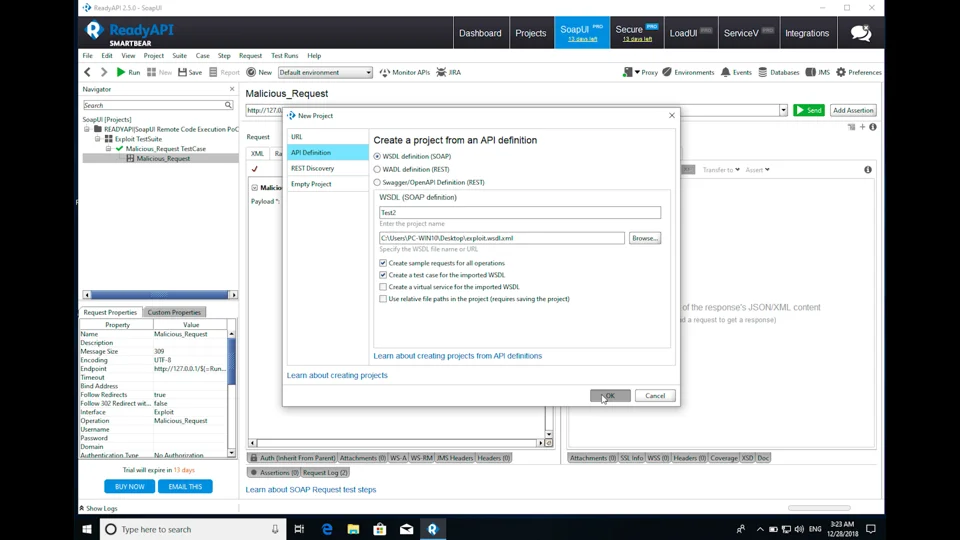
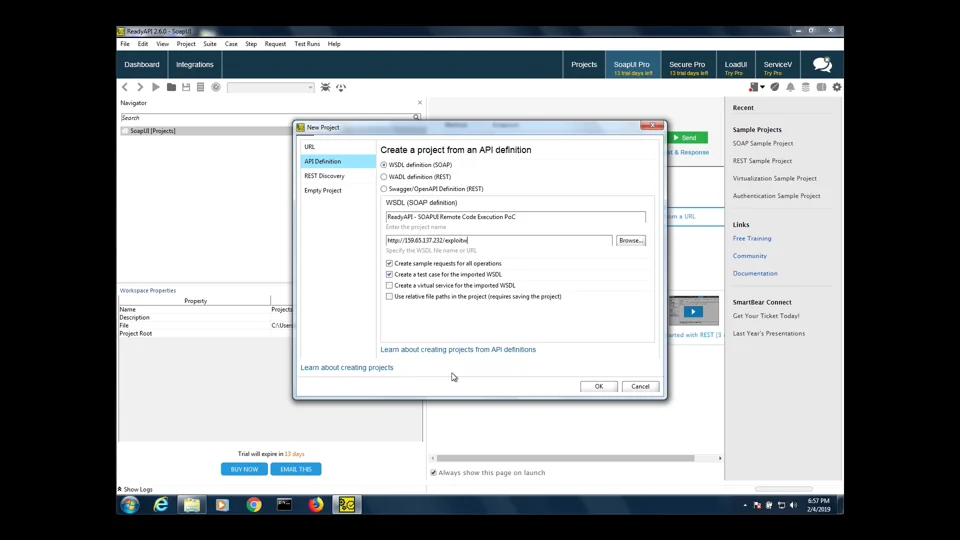
  • The victim creates a new project in the ReadyAPI and loads the malicious WSDL File.
  • The victim decides to send a request to the remote server and the ReadyAPI execute the malicious code.
  • The attacker succeeds in executing malicious code in the victim's machine and take it over.

Video

ReadyAPI 2.5.0 ReadyAPI 2.6.0

Timeline

  • December 26, 2018 - Vulnerability identified
  • December 28, 2018 - Vulnerability reported
  • February 04, 2019 - Vulnerability reported
  • March 21, 2019 - Bug not fixed
  • May 03, 2019 - Public disclosure

LINKS

https://www.exploit-db.com/exploits/46796 https://nvd.nist.gov/vuln/detail/CVE-2018-20580

Download Tool