Reverse Engineering Binaries with RCE Vulnerability
In the context of the seminar, the goal is to analyze simple binaries with RCE vulnerabilities using Ghidra and to develop exploits for them using a combination of reverse engineering, debugging, and exploit development.
Reverse engineering (RE), specifically with regard to software, is the process of analyzing systems without access to the source code in order to understand their design, structure, function, and potential vulnerabilities. In software development, the IEEE already defined reverse engineering in 1990 as "the process of analyzing a subject system to identify the system's components and their interrelationships and to create representations of the system in another form or at a higher level of abstraction" [1]. Important: RE is passive, i.e., the code under investigation is not modified (not to be confused with re-engineering or refactoring)
In doing so, one works directly with the executable machine code, i.e., the lowest form of program instructions that a processor understands. These machine instructions, however, are architecture-dependent, meaning they differ depending on the CPU platform used.
Each processor architecture – such as Intel x86 (32-bit), x86_64 (64-bit), ARM, or Apple M1 (ARM64) – has its own Instruction Set Architecture (ISA). The ISA defines exactly which binary codes stand for which operations (e.g., "add two registers") and how memory accesses, register usage, and system calls work.
For example: A simple machine instruction for x86 such as mov eax, 1 (register eax receives the value 1) is mov r0, #1 in ARM. The register names, byte order (endianness), and calling conventions are also different. Reverse engineering must take these differences into account – e.g., when tracing function calls or stack layouts.
Since a binary is always present in the machine code of the target platform, a reverse engineer must:
Example: When reverse engineering an iOS program on an Apple M1, knowledge of x86 will not get you far, since the machine code is ARM64-specific.
Exploit development is also directly affected: For example, Return-Oriented Programming (ROP) or buffer overflows work very differently on x86 vs. ARM, since the return mechanisms and security features differ.
Reverse engineering is carried out for various reasons:
Software analysis / security research: In IT security, RE is used to uncover vulnerabilities in third-party software (security auditing) or to analyze malicious software (malware), such as the ransomware WannaCry. [3]. This often involves understanding the behavior of a program without source code – for exploit prevention or detection of command-and-control mechanisms. However, the same techniques are also used by attackers to discover vulnerabilities and exploit them for exploits and remote code execution (RCEs).
Game development and modding: In the gaming community, RE has been and continues to be used to understand a game's mechanics, data structures and network protocols. On the one hand, this enables fans and developers to create mods or their own tools and thus extend games, fix bugs or make them run on other platforms; on the other hand, RE has also been actively used to develop cheats or to circumvent anti-cheat systems [2].
Digital Rights Management (DMR): RE plays a central role in the analysis and circumvention of DRM technologies. Digital Rights Management refers to technical protection measures used to protect digital content such as software, films, music or e-books from unauthorized access, copying or redistribution. This also includes the illegal acquisition of software licenses and keys. RE techniques are used to identify how a program implements its protection mechanism. Once an attacker has traced the processes, they can specifically look for minimal changes (e.g. to the binary file) in order to deactivate the protection mechanisms. This process is known as "cracking" and often aims to remove copy protection or license checks [4, p. 7].
This is highly controversial from a legal perspective: In many countries, including the USA and EU member states, such analyses operate in the legal tension between "fair use" and copyright infringement. Although RE of DRM technologies can be legal in certain cases (e.g. for interoperability or research), it is often considered a violation of laws such as the DMCA (Digital Millennium Copyright Act) or the EU Copyright Directive
Maintenance and re-documentation: For legacy systems without up-to-date documentation, RE can help to reconstruct how they work after the fact and document them anew. If original parts for older hardware are no longer available / no longer produced, the parts (e.g. chips) can be analyzed in order to continue operating and maintaining legacy systems. [1, P.15].
Competitive analysis and technical espionage: Companies and state actors can also use RE to analyze the function, design and possibly also the materials of competitors' products and technologies, and use the knowledge gained to replicate them, advance their own developments or improve them. [1, P.13].
Curiosity and learning purposes: Last but not least, curiosity is a major driver: Many researchers, hackers or simply technology enthusiasts engage in RE in order to develop an understanding of systems, learn new things and improve their own skills. Particularly in the field of security research and capture-the-flag (CTF), this is a recognized and valuable approach to technology.
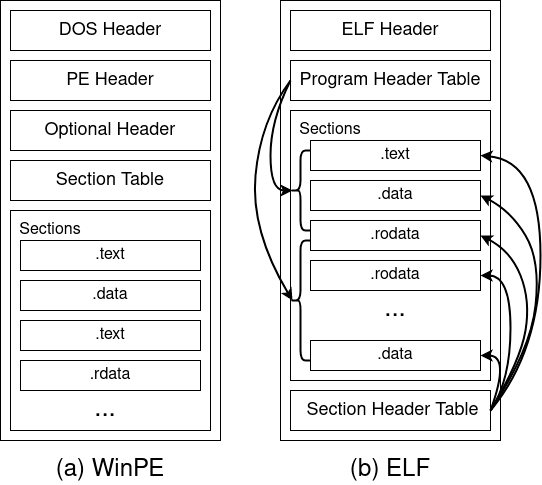
A binary is an executable program that exists entirely in machine code that can be interpreted by a specific processor architecture. Binaries are created by translating source code using a compiler and linker and, in addition to executable code, also contain structured metadata that the operating system needs in order to correctly load the program into memory and execute it.
This packaging is called the binary format – it is platform-dependent and determines the internal organization of the program: