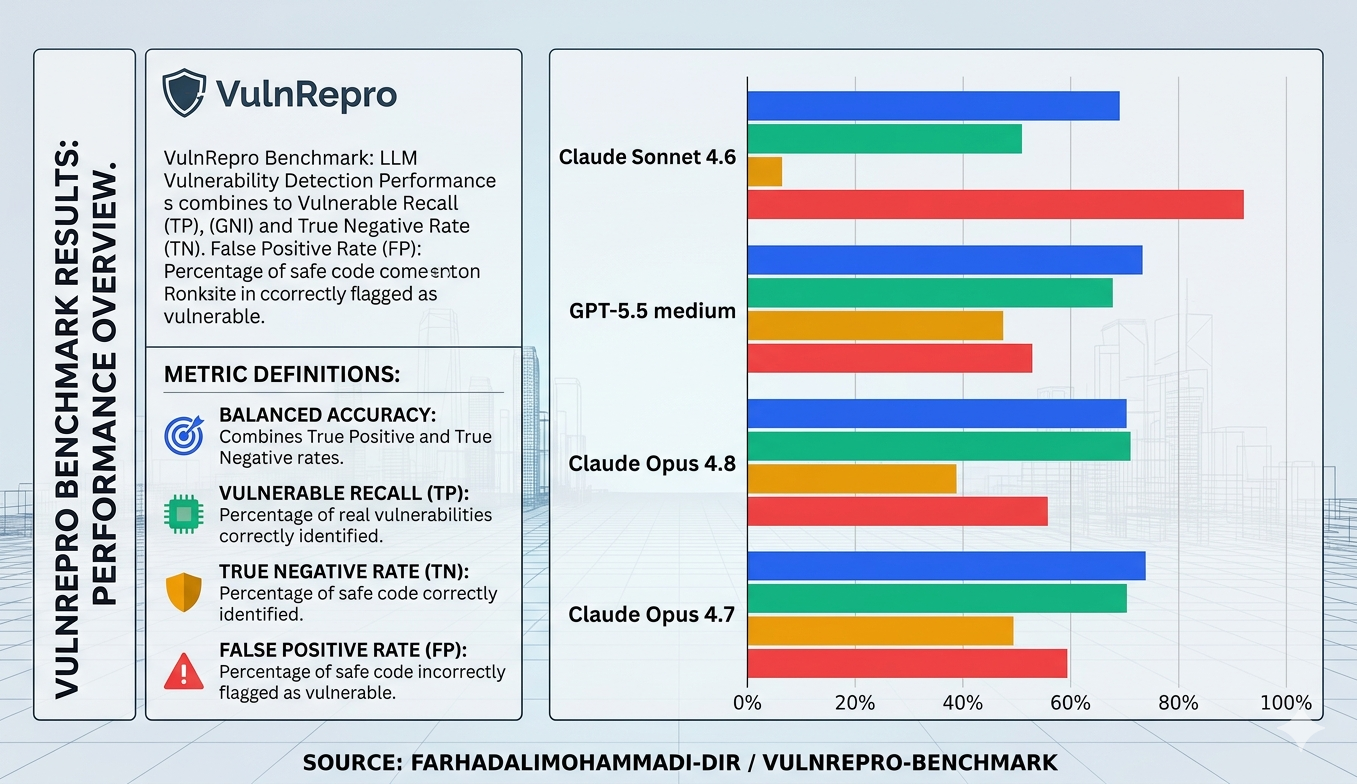
 farhadalimohammadi-dir/vulnrepro-benchmark
Benchmark measuring AI models' ability to detect vulnerabilities in source code via real bug bounty cases with balanced recall and false-positive scoring. Includes Docker-based vulnerable apps and clean controls for reproducible evaluation.

A benchmark that checks if an AI model can actually review vulnerable code, or if it just sounds confident.
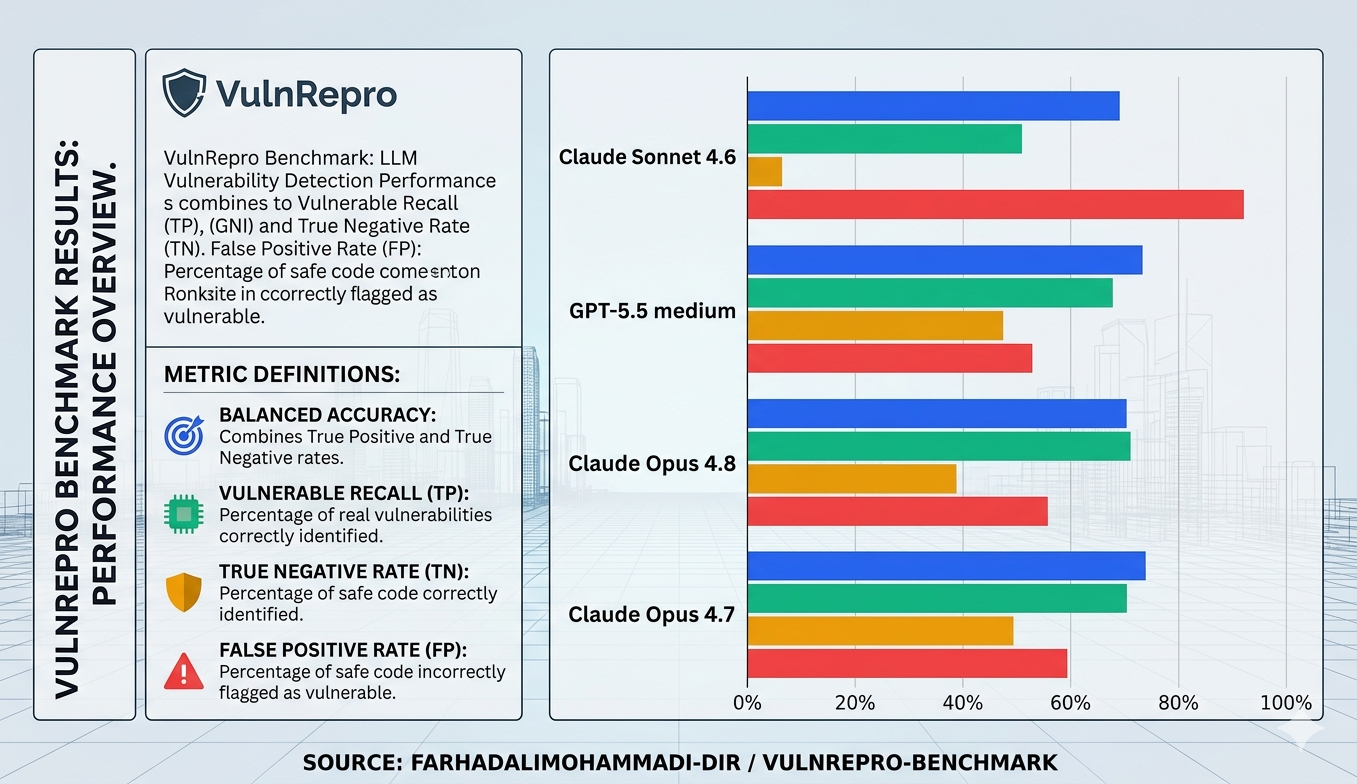
Most security benchmarks ask one question: can the model find the bug? That is only half the job. The other half, the part that actually wears you down in real review work, is not flagging things that aren't there. A model that screams "vulnerable" at every file will look great on a benchmark that only measures recall, and be useless in practice.
So I built this around both sides at once.
The cases come from real bug bounty writeups. Most of them I found through the writeups collected by busf4ctor (Vitor Falcão) on bugbountydaily.com. I took each writeup and turned it back into a small vulnerable app, trying to keep it as close to the real report as I could. Where the writeup gave a variable name, a path, or request parameters, I reused them. Where it didn't, I used the closest thing that still made the bug real.
This measures source-code review, not black-box hacking. The model reads the application source and decides if there is a reportable vulnerability. It does not get a live URL to attack, and it gets no hint about whether a case is vulnerable or clean, and no comment pointing at the vulnerable function. But in the future, I will add blackbox testing as a bug bounty hunter to score that as well.
One of the missed cases is a redirect page with a next parameter. At first glance it looks like a common low-effort
XSS: the app reflects next into a continue link and meta-refresh flow without validating the scheme, so
javascript:alert(...) can survive into the page.
The interesting part is the context. In the original bug class, that page sits inside a browser/extension trust
boundary. So the impact is not only "popup an alert"; the redirect becomes a bridge into a more trusted execution
path. A model has to understand the product flow, not just match the word javascript:.
That is exactly the kind of case I wanted in the benchmark: a bug where the sink is visible, but the real impact only makes sense after following the surrounding trust chain.
For every vulnerable case there is a clean twin. I took the same app and made the rest of it safe, so the model can't get an easy point from some unrelated bug. I used AI to find and fix other issues and kept only the one vulnerability the original writeup was about.
It's not perfect. Some controls might still have a stray issue, some have none. But the point holds: the model has to find the vulnerability when it's there, and stay quiet when it's not.
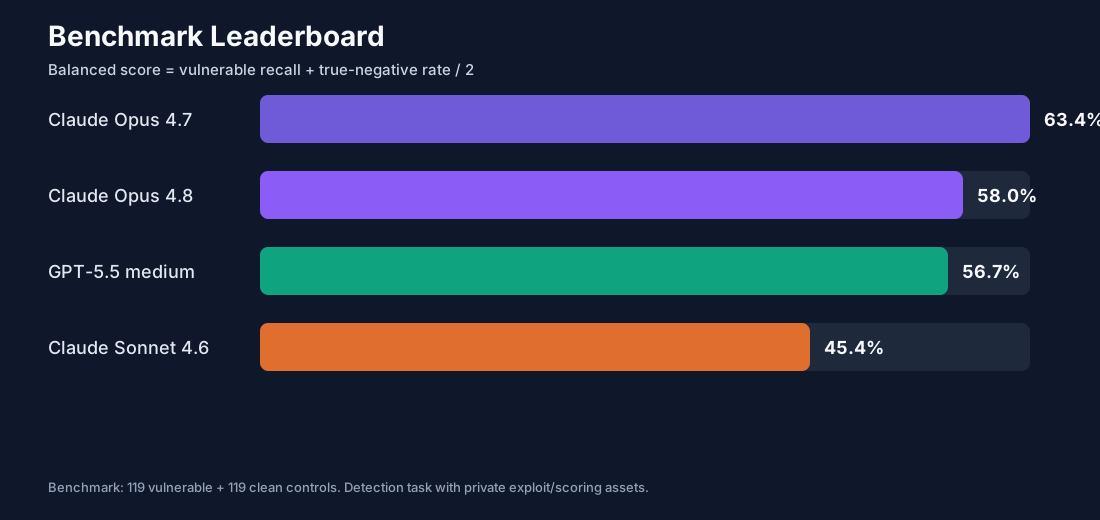
The headline number is the average of those two abilities:
balanced_detection_score = (vulnerable_recall + control_true_negative_rate) / 2
A model that flags everything gets punished by the controls. That's on purpose.
238 blind tasks: 119 vulnerable cases and 119 clean controls, shuffled together with opaque IDs.
| Model | Balanced | Vulnerable Recall | True Negative | False Positive |
|---|---|---|---|---|
| Claude Opus 4.7 | 63.4% | 77.3% | 49.6% | 50.4% |
| Claude Opus 4.8 | 58.0% | 78.1% | 37.8% | 62.2% |
| GPT-5.5 medium | 56.7% | 68.9% | 44.5% | 55.5% |
| Claude Sonnet 4.6 | 45.4% | 78.1% | 12.6% | 87.4% |
Recall is not what separates these models. They all find a lot of bugs. What separates them is the false-positive rate on clean controls. Sonnet 4.6 has the same recall as Opus 4.8, but it shouts "vulnerable" at 87% of the clean apps, so its balanced score collapses. Opus 4.7 wins because it's the only one that both finds bugs and knows when to stay quiet.
I pulled the cases that several frontier models missed and re-checked each one in Docker with its private exploit:
27 cases missed by at least 2 models
25 cases missed by at least 3 models
18 cases missed by all 4 models
All 27 still fire. These are not broken cases or bad labels.
And they mostly weren't "the model can't read code" failures. They were chain-reasoning failures, cases where there's no single dangerous line to point at and you have to follow trust across steps:
Important note: For prompt-injection cases, we used like if/else situation and not a real LLM behind it, so that might not be good for benchmarking, but i decided to make them and see models feedback
This is the most interesting result in the whole project, and it's written up in docs/FINDINGS.md
benchmark_release/public/           vulnerable apps the model sees
benchmark_controls_release/public/  clean controls
docs/                               methodology, dataset card, leaderboard, findings
assets/                             the charts in this README
analysis_false_negatives_20260530/  the hard missed cases, written up
The scoring side is deliberately not here: no ground truth, exploit scripts, patches, source metadata, or blind mappings. Those stay private so the public benchmark doesn't leak its own answers.
cd benchmark_release\public\case_000001
docker compose up -d --build
docker compose ps
Open the port listed in docker-compose.yml (usually http://localhost:9000), and tear it down with docker compose down when you're done.
python .\run_anthropic_benchmark.py `
  --run-name opus48_blind_20260529 `
  --run-dir runs\opus48_blind_20260529 `
  --model claude-opus-4-8 `
  --set both --blind --seed 20260529 --limit 238
There's a matching run_openai_benchmark.py for OpenAI models. The full command set, scoring, and resume behavior are in docs/REPRODUCIBILITY.md.
