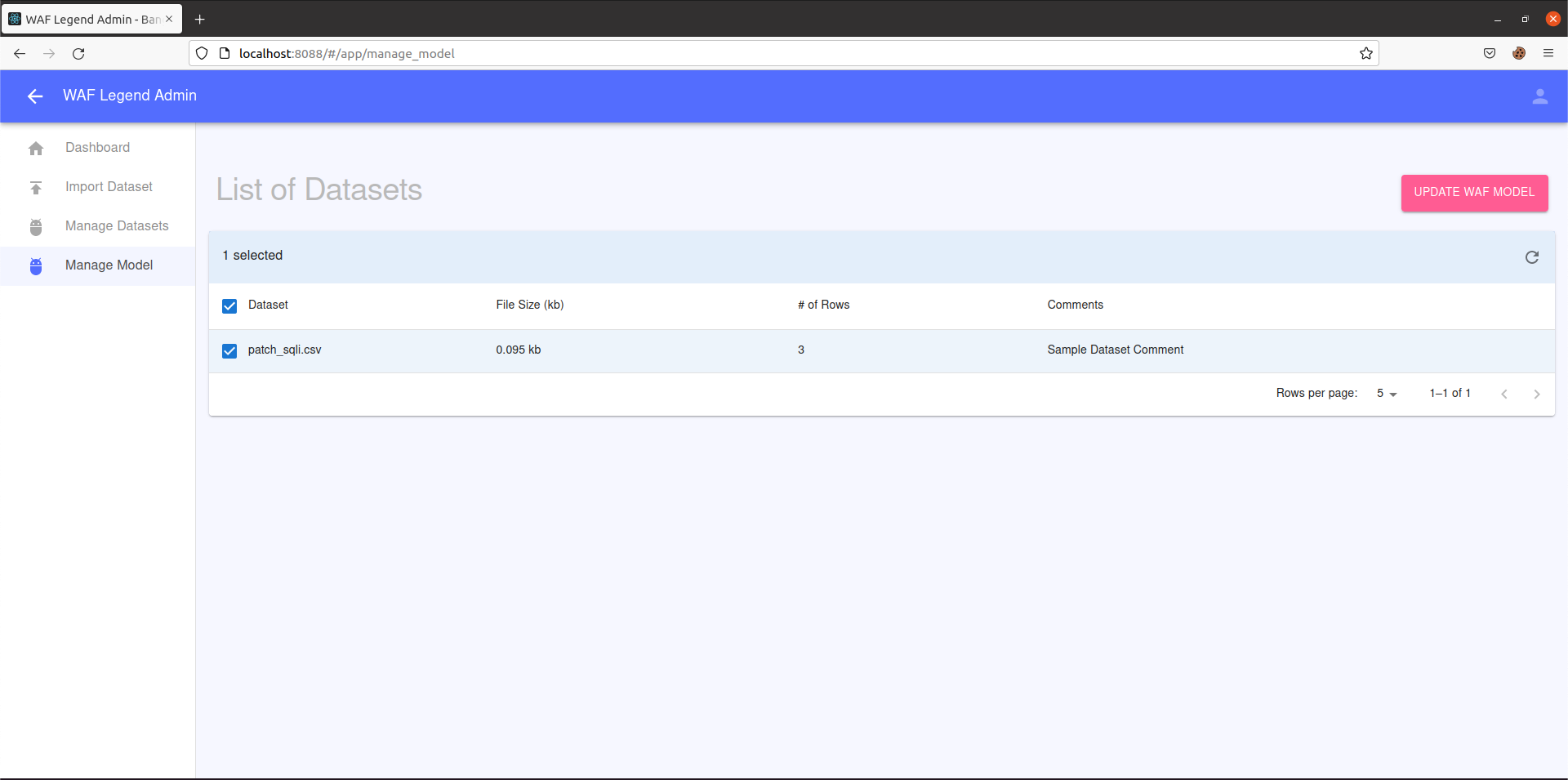

First iteration of ML based Feedback WAF
NGWAF is created by @yupengfei, @zhangbosen, @matthewng and @elizabethlim.
Special shoutout to @ruinahkoh for her contributions to the initial stages of NGWAF.
NGWAF is an experimental proof of concept and not ready for production use in its current form.
Contents
The Components | The Gears of NGWAF
The Brains: Machine-Learning based WAF
The Looking Glass: Scalable Interactive Quarantine Environment
With the explosive growth of web applications since the early 2000s, web-based attacks have progressively become more rampant. One common solution is the Web Application Firewall (WAF). However, tweaking rules of current WAFs to improve the detection mechanisms can be complex and difficult. NGWAF seeks to address these drawbacks with a novel machine learning and quarantine-to-honeypot based architecture.
Inspired by actual pain points from operating WAFs, NGWAF intends to simplify and reimagine WAF operations through the following processes:
| Pain point | NGWAF Feature |
|---|---|
| Maintenance of detection mechanisms and rules can be complex | Leverage machine learning to automate the process of creating and updating detection mechanisms |
| Immediate blocking of malicious traffic reduces chances of learning from threat actor behavior for future WAF improvements | Threat elimination through redirected quarantine as opposed to conventional dropping and blocking of malicious traffic |
To make deployment simple and portable, we have containerised the different components in the architecture using docker and configured them in a docker-compose file. This allows running it on a fresh install to be quick and easy as the dependencies are handled by docker automatically. The deployment can be expanded to be deployed into a local or cloud provider based kubernetes cluster, making scalabe as users can increase the number of nodes/pods to handle large amounts of traffic.
The deployment have been tested on macOS (Docker desktop), linux (ubuntu).
NGWAF runs out-of-the-box with three key components, these components as mentioned above are all containerised and are scalable according to desired usage. The protected resource can be customised by making a deployment change within the setup.
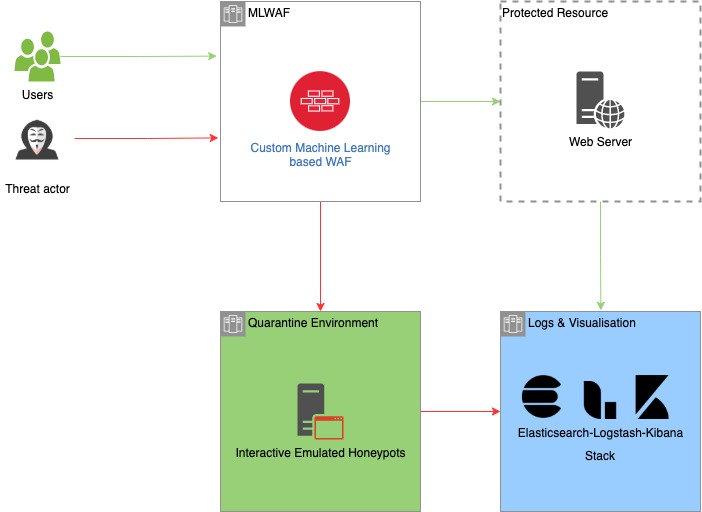
High level architecture of NGWAF with expected traffic flows from different parties
NGWAF was engineered with the following key user benefits in mind:
NGWAF replaces traditional rulesets with deep learning models to reduce the complexity of managing and updating rules. Instead of manually editting rules, NGWAF's machine learning automates the pattern learning process from malicious data. Data collected from the quarantine environment are automatically scrubbed and batched, allowing it to be retrained into our detection model if desired.
NGWAF adopts a novel architecture consisting an interactive and quarantine environment built to isolate potential hostile attackers. Unlike conventional WAFs which blocks upon detection, NGWAF diverts threat actors to emulated systems, trapping them to soften the impact of their malicious actions. The environment also act as a sinkhole to gather current attack methods, enabling the observation and collection of malicious data. These data can be used to further improve NGWAF's detection capability.
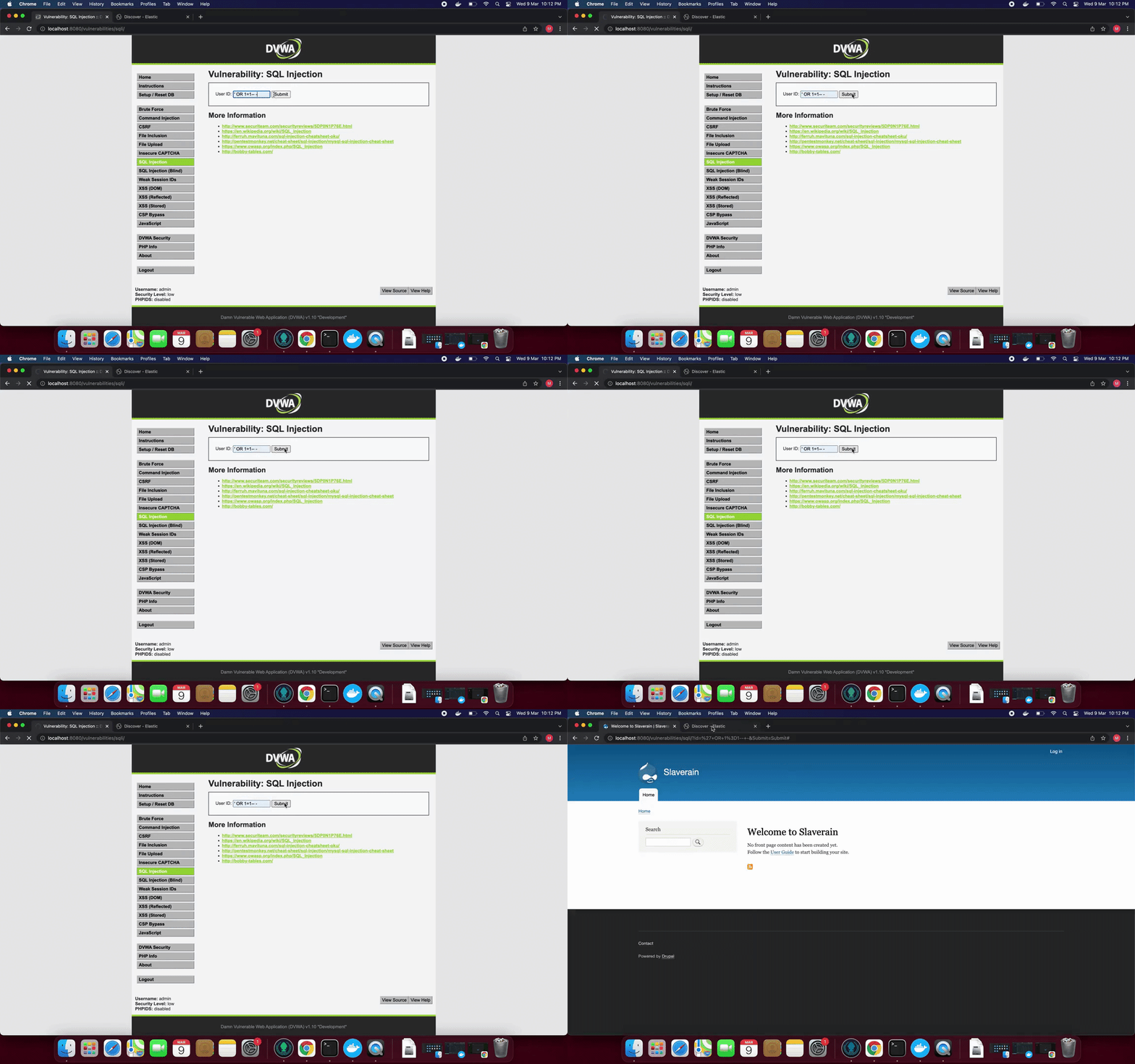
NGWAF in action: Upon detection of SQL injection, NGWAF redirects to our quarantine environment, instead of dropping or blocking the attempt.
The guiding principal behind the creation of NGWAF is to guard against the risks highlighted from the Open Web Application Security Project's standard awareness document - The OWASP Top 10 2021.
Training data and compliance checks for NGWAF are collected and conducted based on this requirement.
Who needs manual when we can go NEURAL
Instead of traditional rulesets which require analysts to manually identify and add rules as time goes by, NGWAF leverages end-to-end machine learning pipelines for the detection mechanism, greatly reducing the complexity in WAF rule management, especially for detecting complex payloads.
To do so, we needed to first create a base model and architecture that users can start off with, before they later use data collected from their own applications for retraining and fine-tuning:
The general architecture of the base model is a simple RNN with a bi-directional LSTM module such as below:
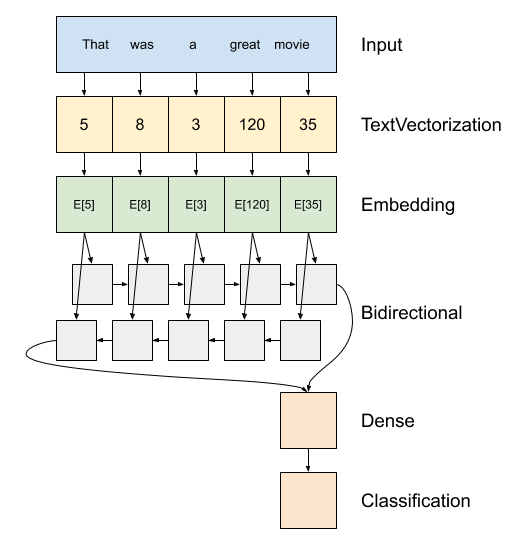
Image taken from Tensorflow (link)
By using this RNN architecture, we were able to achieve performance improvements over simpler models:
| Model architecture | Accuracy | F1 score |
|---|---|---|
| Our final model | 0.995 | 0.993 |
| Neural network without LSTM module | 0.956 | 0.891 |
| Decision Tree | 0.878 | 0.840 |
| Logistic Regression | 0.946 | 0.914 |
Although we have included logs from various applications in order to improve the generalizability of the base model, further maintenance and retraining of the model will be important to:
To address this, users of NGWAF benefit from our packaged end-to-end model retaining pipeline, and can easily trigger model maintenance with a few simple steps without having to dig under the hood. (See Section 3 below).

