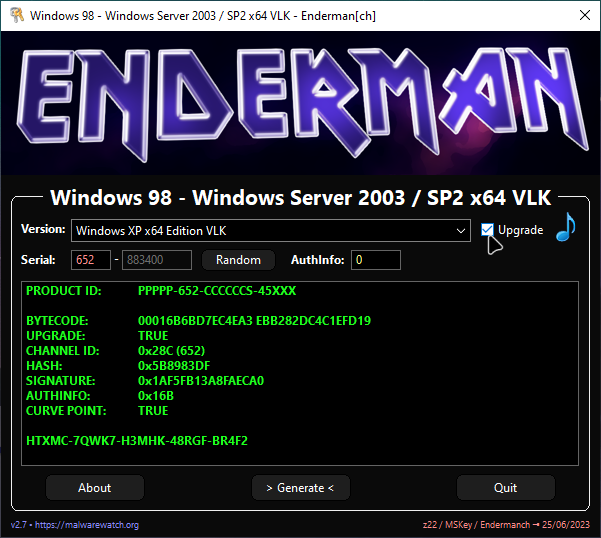
 endermanch/xpkeygen
Windows XP Keygen

A Windows XP / Windows Server 2003 VLK key generator. This tool allows you to generate valid Windows XP keys based on the Raw Product Key, which can be random.
The Raw Product Key (RPK) is supplied in form of 9 digits XXX-YYYYYY and is only necessary to generate a Windows XP Key.
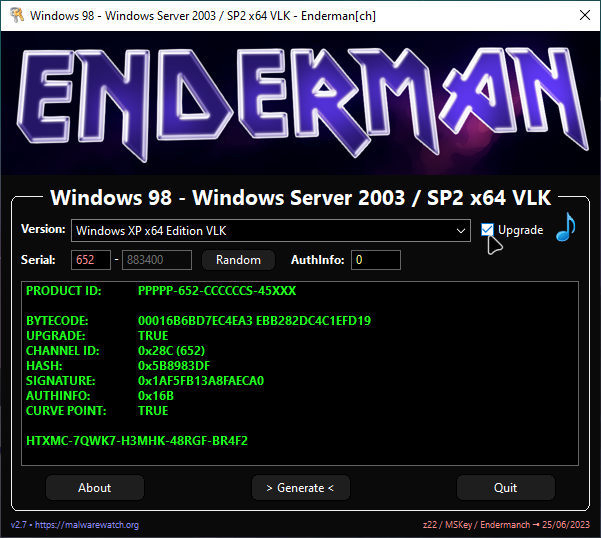
Head over to the Releases tab and download the latest version from there.
This project is not dead — I'll try my best to bring it to fruition.
In general, the only thing that separates us from generating valid Windows XP keys for EVERY EDITION and EVERY BUILD is the lack of respective private keys generated from their public counterparts inside pidgen.dll. There's no code for the elliptic curve discrete logarithm function widely available online, there's only vague information on how to do it.
As time went on, the problem has been partially solved.
The BINK resource was not encoded in any way and the data was just sequentially written to the resource. sk00ter also fully explained the BINK format on the MDL forums. Utilizing prior community knowledge on the subject, I wrote a BINK Reader in Python 3. The file is public in this repository, click here to view the source code.
The discrete logarithm solution is the most unexplored area of research as of May 28th, 2023. However, my friend nephacks did find that elusive tool to solve that difficult problem in the darkest corners of the internet. It's called ECDLP (Elliptic Curve Discrete Logarithm Problem) Solver by Mr. HAANDI. Since it was extremely frustrating to find online, I did reupload it on my website. You can download the tool here.
The ReadMe file that comes with the version 0.2a of the solver is good enough by itself, so anyone with a brain will be able to set that tool up. However, it's not open-source, so integrating it into my keygen is proven impossible.
In the ideal scenario, the keygen would ask you for a BINK-resource extracted from pidgen.dll, which it would then unpack into the following segments:
pubX; pubY)genX; genY)a; b)pKnowing these segments, the keygen would bruteforce the geneator order genOrder using Schoof's algorithm followed by the private key privateKey, leveraging the calculated genOrder to use the most optimal Pollard's Rho algorithm. There's no doubt we can crack any private key in a matter of 20 minutes using modern computational power, provided we have the working algorithm.
Once the keygen finishes bruteforcing the correct private key, the task boils down to actually generating a key, which this keygen does. To give you a better perspective, I can provide you with the flow of the ideal keygen. Crossed out is what my keygen implements:
genOrder, privateKey)We need to use a random Raw Product Key as a base to generate a Product ID in a form of AAAAA-BBB-CCCCCCS-DDEEE.
| Digits | Meaning |
|---|---|
| AAAAA | OS Family constant |
| BBB | Channel ID |
| CCCCCC | Sequence Number |
| S | Check digit |
| DD | Public key index |
| EEE | Random 3-digit number |
The OS Family constant AAAAA is different for each series of Windows XP. For example, it is 76487 for SP3.
The BBB and CCCCCC sections essentially encode the Raw Product Key. For example, if the first section is equal to XXX and the second section is equal to YYYYYY, the Raw Product Key will be encoded as XXX-YYYYYY.
The check digit S is picked so that the sum of all C digits with it added makes a number divisible by 7.
The public key index DD lets us know which public key was used to successfully verify the authenticity of our Product Key.
For example, it's 22 for Professional keys and 23 for VLK keys.
A random number EEE is used to generate a different Installation ID each time.
The Product Key itself (not to confuse with the RPK) is in form FFFFF-GGGGG-HHHHH-JJJJJ-KKKKK, encoded in Base-24 with
the alphabet BCDFGHJKMPQRTVWXY2346789 to exclude any characters that can be easily confused, like I and 1 or O and 0.
As per the alphabet capacity formula, the key can at most contain 114 bits of information. $$N = \log_2(24^{25}) \approx 114$$
Based on that calculation, we unpack the 114-bit Product Key into 4 ordered segments:
| Segment | Capacity | Data |
|---|---|---|
| Upgrade | 1 bit | Upgrade version flag |
| Serial | 30 bits | Raw Product Key (RPK) |
| Hash | 28 bits | RPK hash |
| Signature | 55 bits | Elliptic Curve signature for the RPK hash |
For simplicity' sake, we'll combine Upgrade and Serial segments into a single segment called Data. By that logic we'll be able to extract the RPK by
shifting Data right and pack it back by shifting bits left, because most a priori valid product keys I've checked had the Upgrade bit set to 1.
Microsoft redid their Product Key format with Windows Server 2003 to include a backend server authentication key, which was an actually secure approach to license validation, as no one could ever make a guess on which validation algorithm they had employed on their private server. Besides adding the online validation mechanism, they also cranked up the overall arithmetic from 384 to 512 bits, and the signature scalar to 62 bits of information.
| Segment | Capacity | Data |
|---|---|---|
| Upgrade | 1 bit | Upgrade version flag |
| Channel ID | 10 bits | The BBB part of the RPK |
| Hash | 31 bits | RPK hash |
| Signature | 62 bits | Elliptic Curve signature for the RPK hash |
| Auth Key | 10 bits | Backend authentication value |
However, if we generated a key without the online activation in mind, we still could generate valid keys that would let us through the setup of the operating system. And that's exactly what the code does - it generates a random 10-bit authentication key. Nowadays it doesn't matter at all, as activation servers are down and Server 2003 is considered abandonware, the same way this entire project shouldn't be considered piracy.
Elliptic Curve Cryptography (ECC) is a type of public-key cryptographic system. This class of systems relies on challenging "one-way" math problems - easy to compute one way and intractable to solve the "other" way. Sometimes these are called "trapdoor" functions - easy to fall into, complicated to escape.[5]
ECC relies on solving equations of the form $$y^2 = x^3 + ax + b$$
In general, there are 2 special cases for the Elliptic Curve leveraged in cryptography - F2m and Fp. They differ only slightly. Both curves are defined over the finite field, Fp uses a prime parameter that's larger than 3, F2m assumes $p = 2m$. Microsoft used the latter in their algorithm.
